
1. Context Compaction
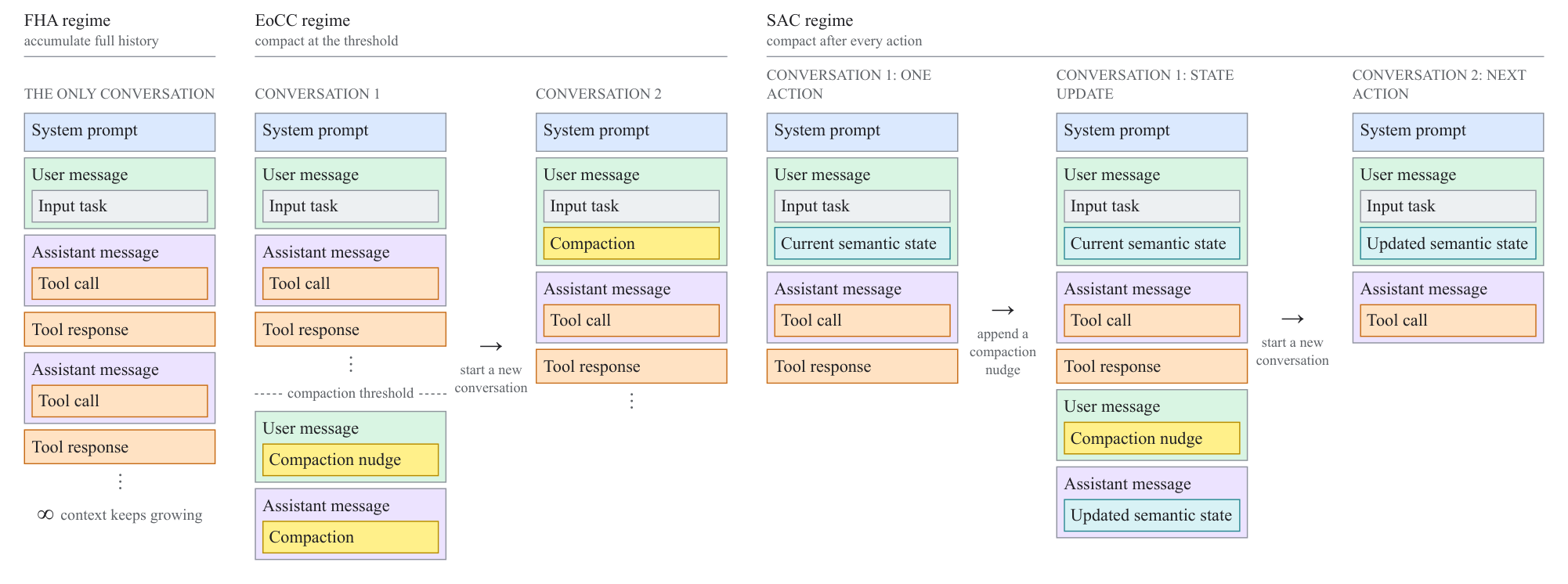
Agent runs keep growing their context as tasks get longer, yet later tokens cost more to generate than earlier ones, by as much as 7x on frontier open-weight models. Researchers from NVIDIA test whether frontier models actually need that long context by compacting it frequently across long-horizon and long-input tasks.
Three regimes: The paper compares full-history accumulation, compaction once the context reaches a threshold, and single-action compaction, where the agent takes one action per context and carries forward only a short natural language summary of its state.
Long-horizon results: With one action per context, Claude Opus 4.5 scores 70.2 on SWE-bench Verified against 70.0 with the full history, and median peak context drops from 32K to 8K tokens. The best end-of-conversation compaction setting raises Opus to 74.8.
Long inputs: Reading the input selectively, with compaction as a fallback, matches or beats full-input baselines in almost every case. The pattern holds on Terminal-Bench, FRAMES, BFCLv3, and multilingual SWE-bench, with modest losses in some settings.
Why it matters: The authors outline semantic state space models, which would be post-trained to keep a readable language state between turns. Their evidence does not rule out tasks that need long context, but teams can test aggressive compaction on their own workloads before paying for million-token agent runs.
2. Skill++
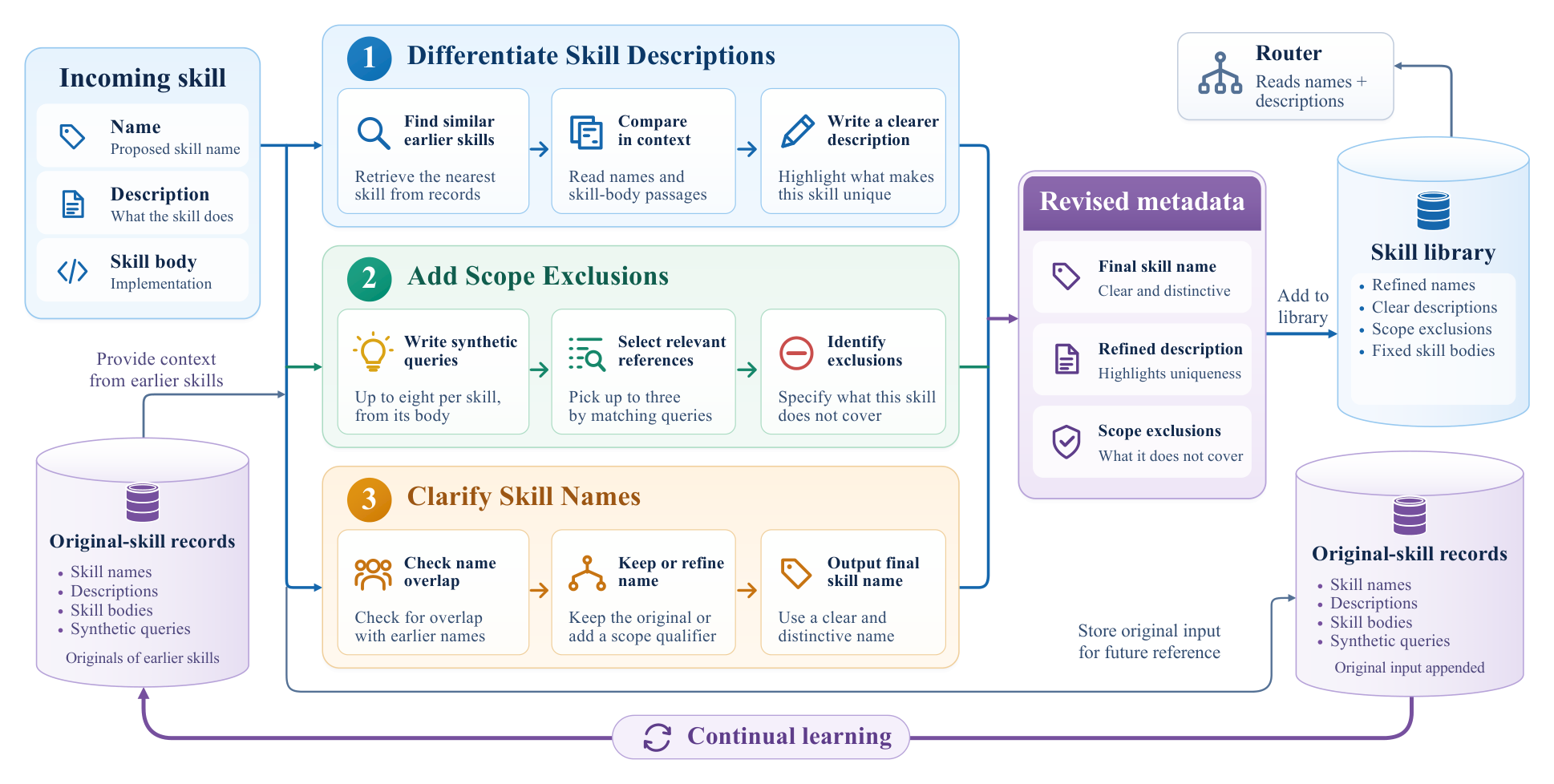
Agent routers pick skills by reading only their names and descriptions, so a new skill with similar metadata can displace an older one even when neither the older skill nor the router changed. Researchers from the University of Illinois Chicago, McGill University, and other institutions frame this as lifelong skill routing and propose Skill++, which rewrites a new skill’s metadata before it enters the library.
Metadata rewriting: Skill++ retrieves the most similar earlier skills and writes a description stating what the new skill supports, how it differs from its closest predecessor, and what related work it excludes. It needs no router training and no labeled data.
Growing library: As a library grows to 731 skills over ten sessions, the router selects every required skill for 76.3% of queries, against 36.4% with the original metadata. Substitution errors nearly disappear, and crowding errors halve.
Broad gains: Across SRA-Bench, SkillRet, and SkillRouter with five LLM routers, Skill++ improves final-session routing accuracy by 23.1 points on average over the original metadata and beats all compared approaches. It also improves on the original metadata in the Codex CLI harness.
Why it matters: Public skills often have descriptions that don't match their bodies, which makes interference worse as libraries grow. Anyone maintaining a skill library can apply the main lesson today by describing how each new skill differs from the closest installed one.
3. Recursa
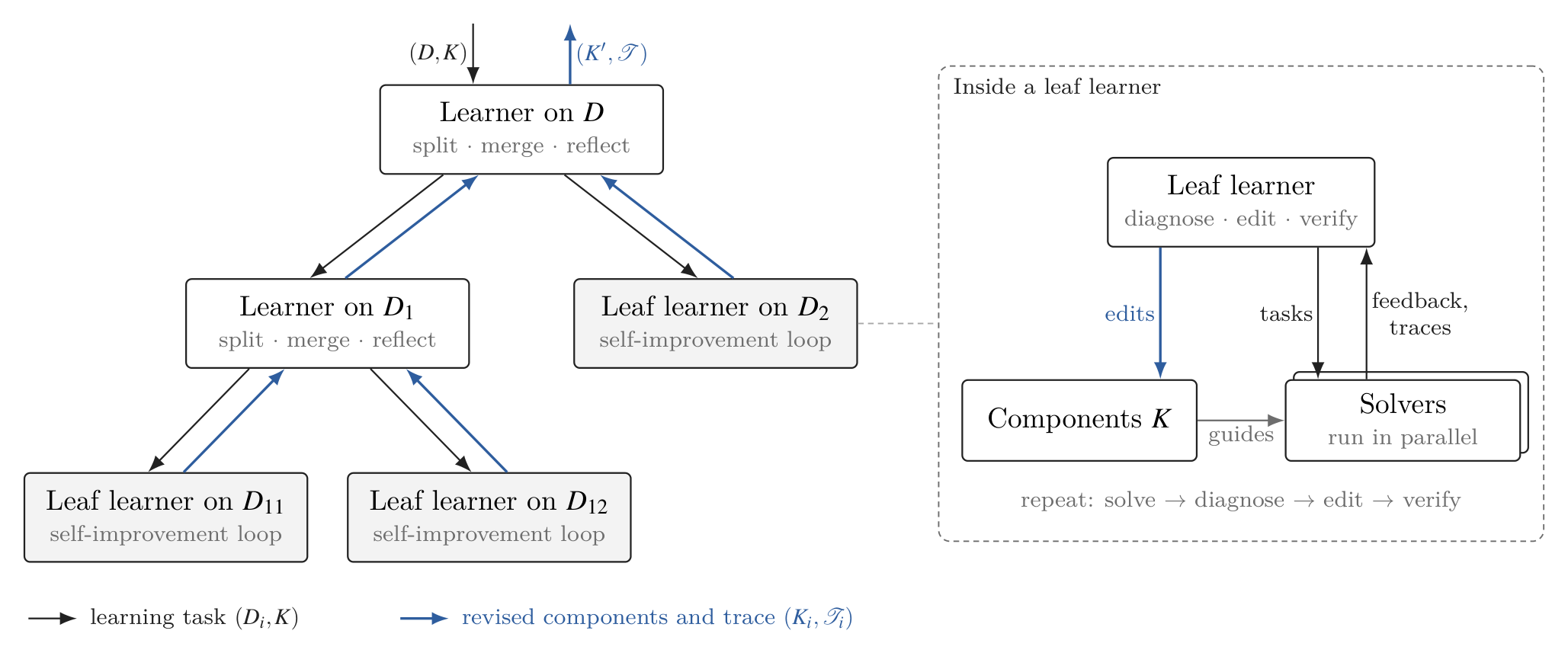
Foundation models often meet domains their training never covered, and those domains rarely come with expert training data or a stronger teacher model. Alibaba Research introduces Recursa, a system that adapts to a new domain by learning from its own task experience while the model weights stay fixed.
Knowledge repository: Recursa stores domain skills, instructions on when to apply them, memories of past tasks, and reflections on what to improve. It bootstraps this repository from domain materials before refining it.
Recursive learning: A learner splits its training tasks into subsets and hands them to child learners. Leaf learners run solvers in parallel, diagnose failures, and propose edits, and only validated edits get merged back into the repository.
Results: On Harvey LAB’s Firm Knowledge legal benchmark, the all-pass rate on held-out test tasks rises from 30.0% to 55.0% with DeepSeek-V4.1-Flash and from 35.0% to 46.0% with Qwen3.8-Flash. No human expert or stronger model revises the repository along the way.
Why it matters: Teams adapting an agent to a new domain can try a validated skill repository before reaching for fine-tuning. The authors note that results depend on the quality of domain corpora, that experiments cover a limited set of domains, and that extending self-improvement to the model and harness is ongoing work.
4. Routed Continual Learning
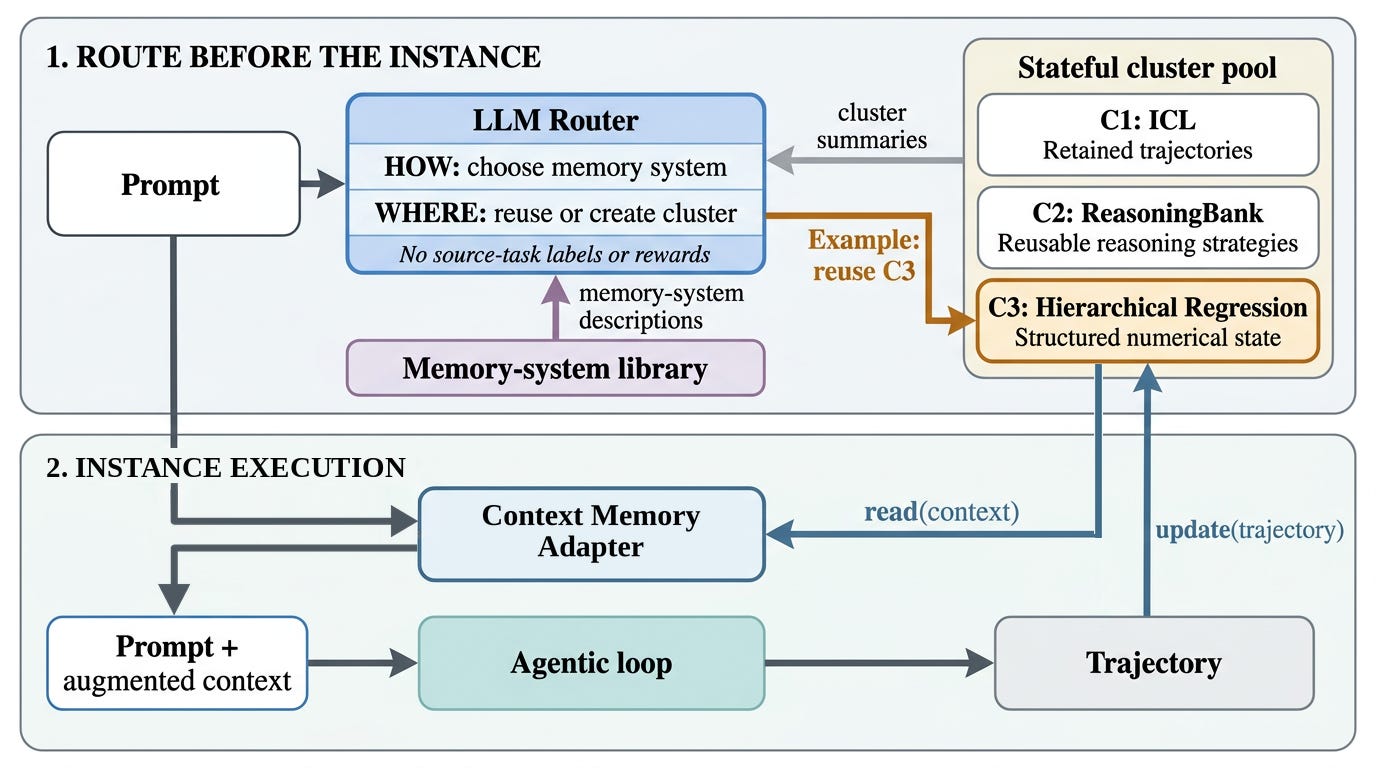
Agents deployed at scale keep running into related problems, yet the usual way to share past experience, one global history, mixes unrelated runs and grows expensive. Researchers from FAIR at Meta propose Routed Continual Learning, which decides how to partition experience and which memory system to use for each partition.
Clustered memory: Past trajectories are grouped into clusters, and each cluster keeps its state in one memory system from a fixed library, such as retained trajectories or reusable reasoning strategies. Before each run, an LLM router reuses a cluster or creates a new one based on the problem statement, memory system descriptions, and cluster summaries.
Context Memory Adapter: A separate component adds the memory system’s output to the agent’s initial context and updates the chosen cluster with the new trajectory, using hooks that agent frameworks already provide.
Results: On a stream mixing 301 CL-Bench instances with 97 banking instances from τ³-Bench, a single global history gains only +0.015 normalized reward over no memory. Across four language models, Routed CL raises reward over the global history by 15% to 30% of the maximum attainable and cuts estimated API cost by 65% to 72%.
Why it matters: The paper treats continual learning as a routing choice over both the learning mechanism and the state cluster. The runs were sequential, so parallel agents updating one cluster remain untested.
Message from the Editor

We’re excited to invite extended abstracts for Humanoids at the Edge, a full-day Space Robotics workshop at IEEE-RAS Humanoids 2026 on December 7 in Santa Clara, CA. If you work on humanoids for hazardous operations or space exploration, we’d love to see your research, work in progress, negative results, or field reports. Abstracts of up to 3 pages are due November 6, 2026, at 11:59 PM AoE.
Submit an abstract | Workshop website
5. JevAct
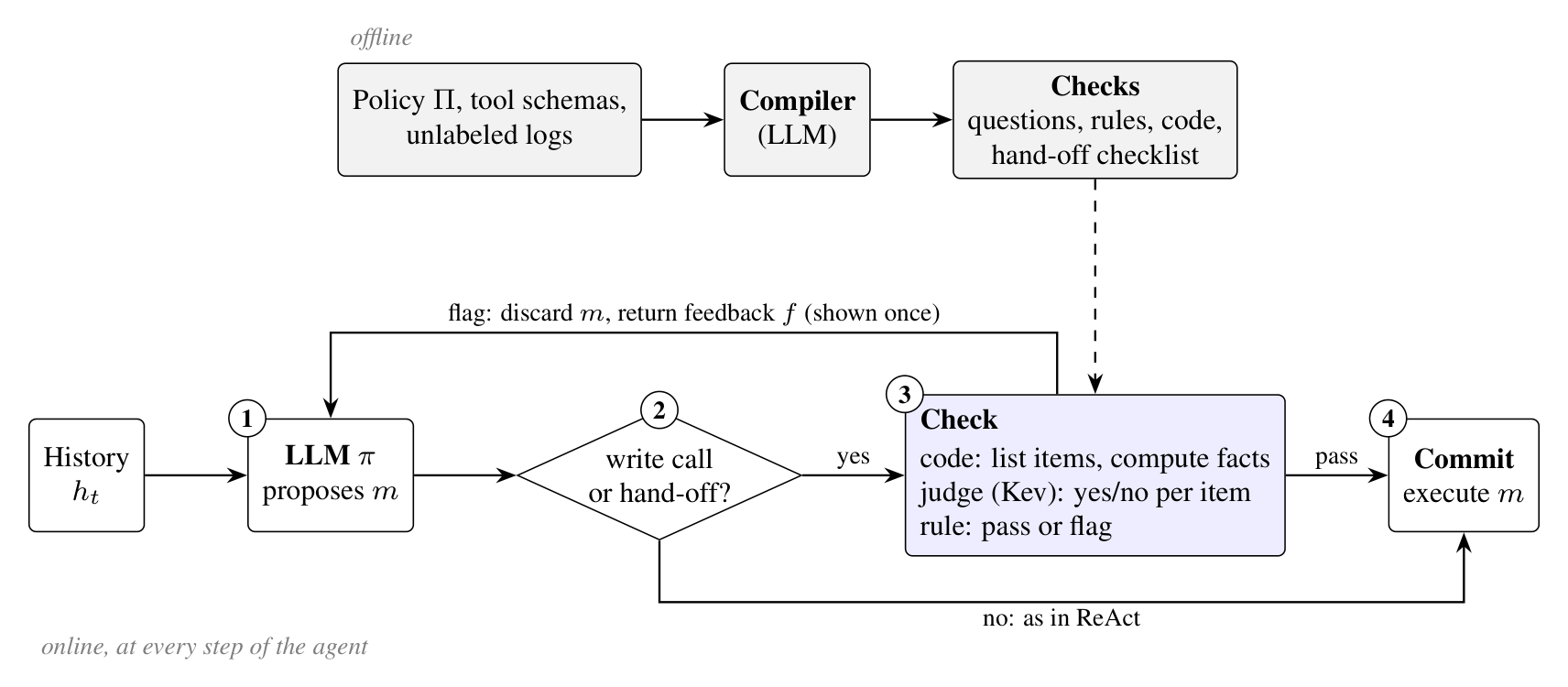
Tool-using agents often execute consequential actions without any independent check on policy compliance or on whether the task is actually finished. IBM researchers introduce JevAct, a runtime gate between the agent and its tools that leaves the agent’s model and tools unchanged.
Offline compilation: An LLM turns the domain policy, tool schemas, and unlabeled logs into code checks, yes/no questions, rules, and a hand-off checklist.
Runtime checks: Before a selected write call or hand-off runs, code verifies facts in the tool records, and a prefill-only decision model answers conversation questions with probabilities instead of generated text. A failed call returns to the agent with feedback so it can revise.
Results: On τ²-bench Telecom, Opus 4.6’s success across all three runs rises from 39.5% to 80.7%, and all eight agents improve by 16.9 points on average in three-run success. All nine agents evaluated on BFCL improve, while Airline results are smaller and mixed.
Why it matters: The evaluation spans eleven LLM agents, and the gains come from the harness alone. Pairing deterministic state checks with a decision model gives teams a way to catch invalid actions and premature task endings without retraining anything.
6. SPAR
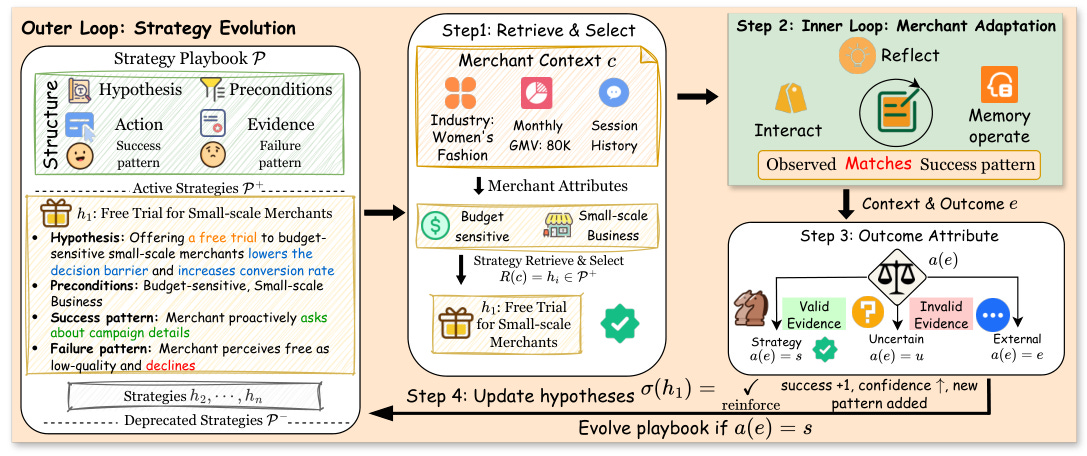
Closing a B2B sales deal usually takes several rounds of outreach, but most LLM sales agents work within a single session and store lessons as unstructured text. Researchers from Alibaba Group and South China University of Technology propose SPAR, a self-evolving sales agent that treats selling strategies as testable hypotheses and refines them without updating weights.
Double loop: An inner loop keeps episodic memory for each merchant across sessions, so follow-ups build on earlier conversations. An outer loop maintains a shared playbook of strategies, each with a hypothesis, preconditions, and success and failure patterns.
Causal attribution: Before changing the playbook, SPAR decides whether an outcome came from the strategy, from an external factor, or remains uncertain. A deal lost to outside factors does not weaken a strategy that works.
Live results: In an A/B test on Alibaba’s 1688 platform with over 200,000 merchants, SPAR lifts conversion by 15.8% and grows high-intent merchants by 35.8%. Domain experts rate it 4.62 out of 5 on overall sales quality, the highest among all methods.
Why it matters: Agents that learn from production outcomes can write the wrong lesson when they misread why something failed. An attribution step before writing to memory is a design choice that applies well beyond sales.
7. RSI-Dojo
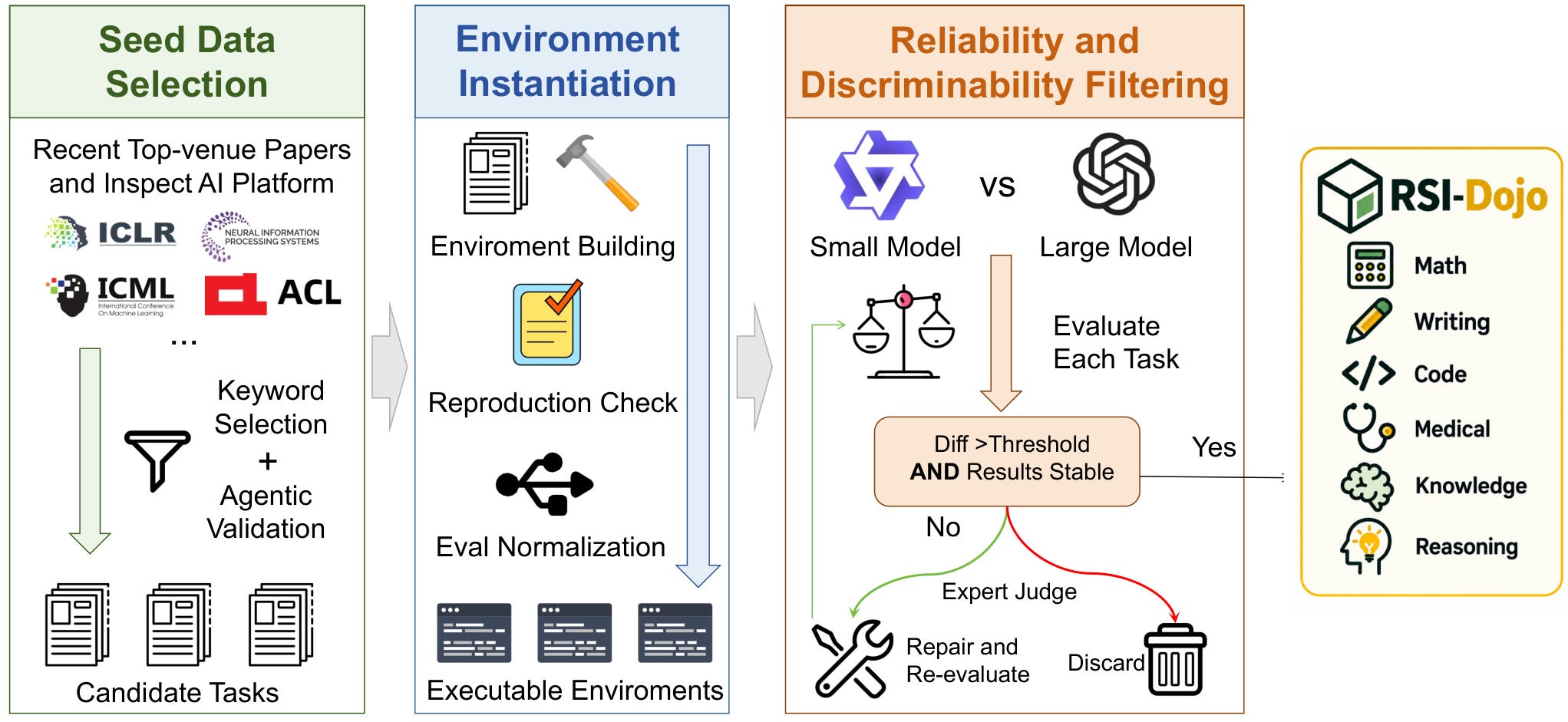
Most work on automated model training optimizes workflows or harnesses, rather than teaching the model itself how to run post-training. Researchers from CUHK, ByteDance, Tsinghua University, and Shanghai Jiao Tong University introduce RSI-Dojo, a collection of executable environments for training LLM agents to conduct post-training.
RSI-Craft pipeline: The pipeline collects papers from top venues, instantiates their datasets and metrics behind a unified interface, and reproduces evaluation dependencies. Filtering by data size, execution reliability, and discriminability leaves 281 seed training tasks across math, writing, code, medical, knowledge, and reasoning.
Trajectory collection: Frontier models solve the tasks under an improved harness, and rubric- and outcome-based filters keep only high-quality trajectories that show how to select data, train, diagnose failures, and iterate.
Results: Fine-tuning Qwen3.5-9B and Qwen3.6-35B-A3B on these trajectories yields gains of 8.74 and 16.87 PostTrainBench points over the base models. RSI-Dojo-35B-A3B reaches 29.95 on PostTrainBench and 53.29 on PostTrainBench-Lite, matching frontier models such as GLM-5.2 and GPT 5.5.
Why it matters: Recursive self-improvement needs agents that can train models, and this work moves that skill into the weights of a mid-sized open model. Converting published research into executable environments also gives a repeatable source of new training tasks.
8. Drex
Nace AI presents Drex, a family of four open decision models (8B, 9B, 35B with 3B active, and 27B) that take a state such as a document, record, or agent context, plus questions with fixed options, and return a probability for each option without generating text. The 27B Max model scores 67.52 on the public Decision Index 0.4.1 suite against 60.70 for Jev 1.14.0, is statistically tied with GPT-6 Sol and d3-turbo on Decision Bench v4 while trailing Claude Opus 5.5 by 1.6 points, and answers a typical request in 183 ms against about 3.5 s for Opus. Training adds reinforcement learning from adjusted feedback, where a teacher’s option probabilities adjusted by the verified answer serve as targets, and a consistency loss cuts flipped answers under option reordering from 6.3% to 4.2%.
9. Collaborative Intelligence
Researchers from Stanford introduce the Collaborative Intelligence Benchmark, 240 tasks across 8 teamwork skills built from real records such as aviation accident reports, clinical cases, coding tasks, and negotiations, with each model scored only on tasks it can solve alone given full information. The best of 18 models scores 82.2 out of 100, and frontier models almost always refuse unsafe shortcuts yet reach the best team deal in only 14% of pressured negotiations, while their pass rate drops from 97% to 81% when they take over a task where a weaker model cheated. Models with nearly the same capability score differ by up to 11 points as teammates, and 160 of the tasks are public with code and data.
10. LifeVal
OpenAI introduces LifeVal, a benchmark built from a survey of 3,837 US consumers who ranked 148 life tasks, such as managing finances and finding childcare, by what they would pay an assistant to handle, together worth over $1.7 trillion a year. Its 169 agent tasks are written by people who have done them many times in real life, using their own ChatGPT conversations, memories, and files. The most common failure for every model is a wrong answer or recommendation, often due to a missed fact in past chats, with a 33% win rate on criteria tied only to past conversations versus 48% for saved memories.