
1. Self-Improvement Memory
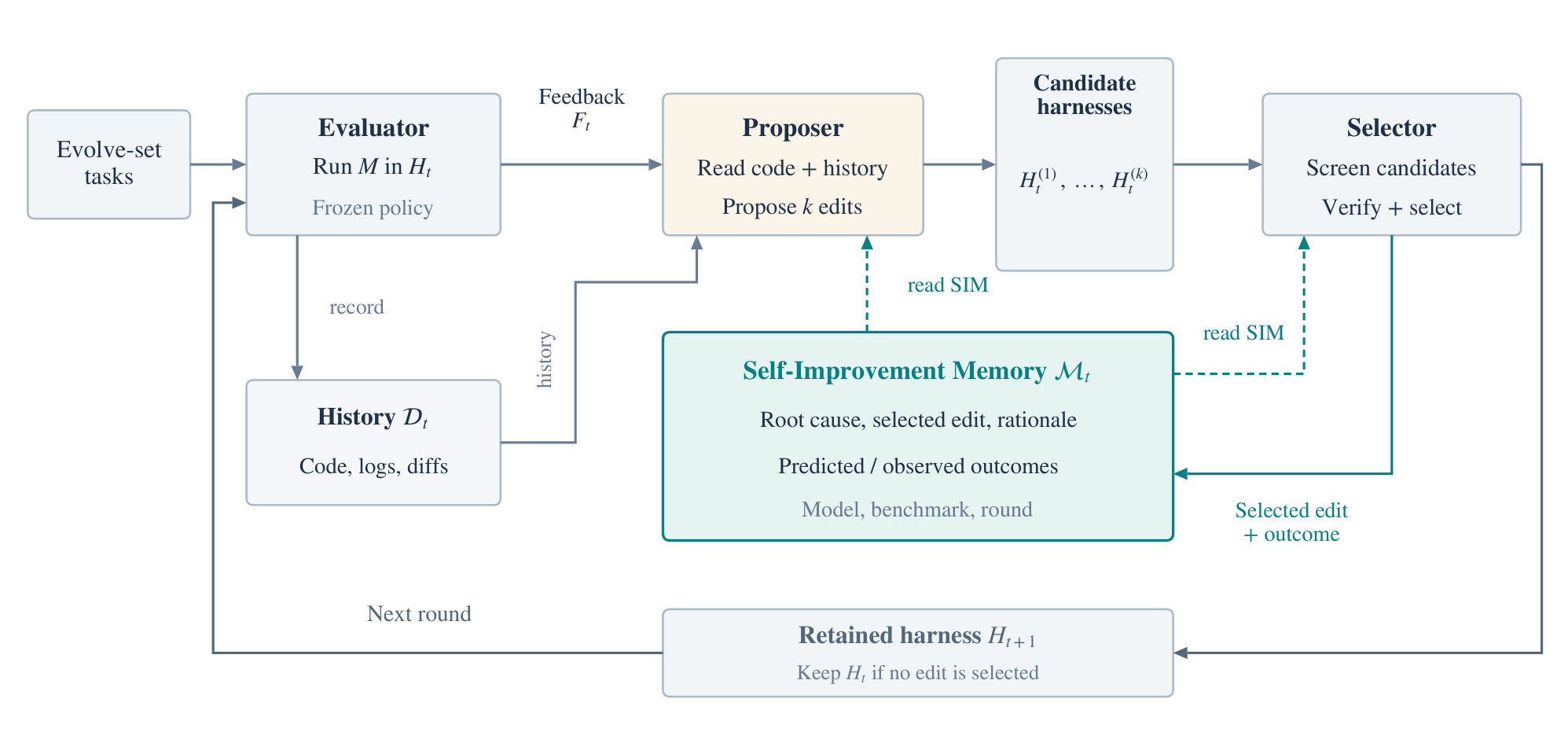
Harness optimization is usually studied with one fixed model and one fixed benchmark. When either changes, the optimizer has to decide which parts of an evolved harness to keep, but the harness code alone does not record why earlier edits were made or how they performed. Researchers from Google Cloud AI, Google DeepMind, and Penn State study this setting, which they call continual recursive self-improvement, and give the harness optimizer its own memory.
The transfer problem: An evolved harness can do worse than the plain seed when the model changes. In one workspace experiment, a harness evolved with Opus starts at 68.41 on Gemini, below the 73.89 of the seed harness.
What SIM stores: Self-Improvement Memory groups past edits by the recurring harness problem they addressed. Each entry keeps the rationale, predicted outcome, observed outcome, and evaluation context, and new attempts extend the record as optimization continues. Both the proposer and the selector read it before making changes.
Results: Across four domains, including a coding move from Terminal-Bench 2.1 to Terminal-Bench 4, SIM beats harness-only and root-cause-only continuation in six cross-dataset and four Opus-to-Gemini settings. Across ten coding runs, it improves 9 of 10 and adds 2.36 points on average (p = 0.003).
Why it matters: The record of past edits carries information that the harness code cannot. If you evolve harnesses automatically, keep the reasons and results of each edit next to the code so the next run can reuse them.
Message from our Sponsor

Validate your AI expertise with an official Nebius certification: choose from AI Leader, AI CloudOps Engineer, Agentic AI Builder, Agentic Web Search, Physical AI, AI Solutions Architect, or AI Infrastructure Engineer. Pass a remotely proctored online exam in up to 60 minutes to earn an official certificate and a verifiable Credly digital badge that you can showcase on your LinkedIn profile and add to your CV. Prove your skills, stand out to employers, and unlock new career opportunities in the fast-growing AI Cloud ecosystem.
Use code ELVIS2026 to take the exam for free.
2. AutoRL
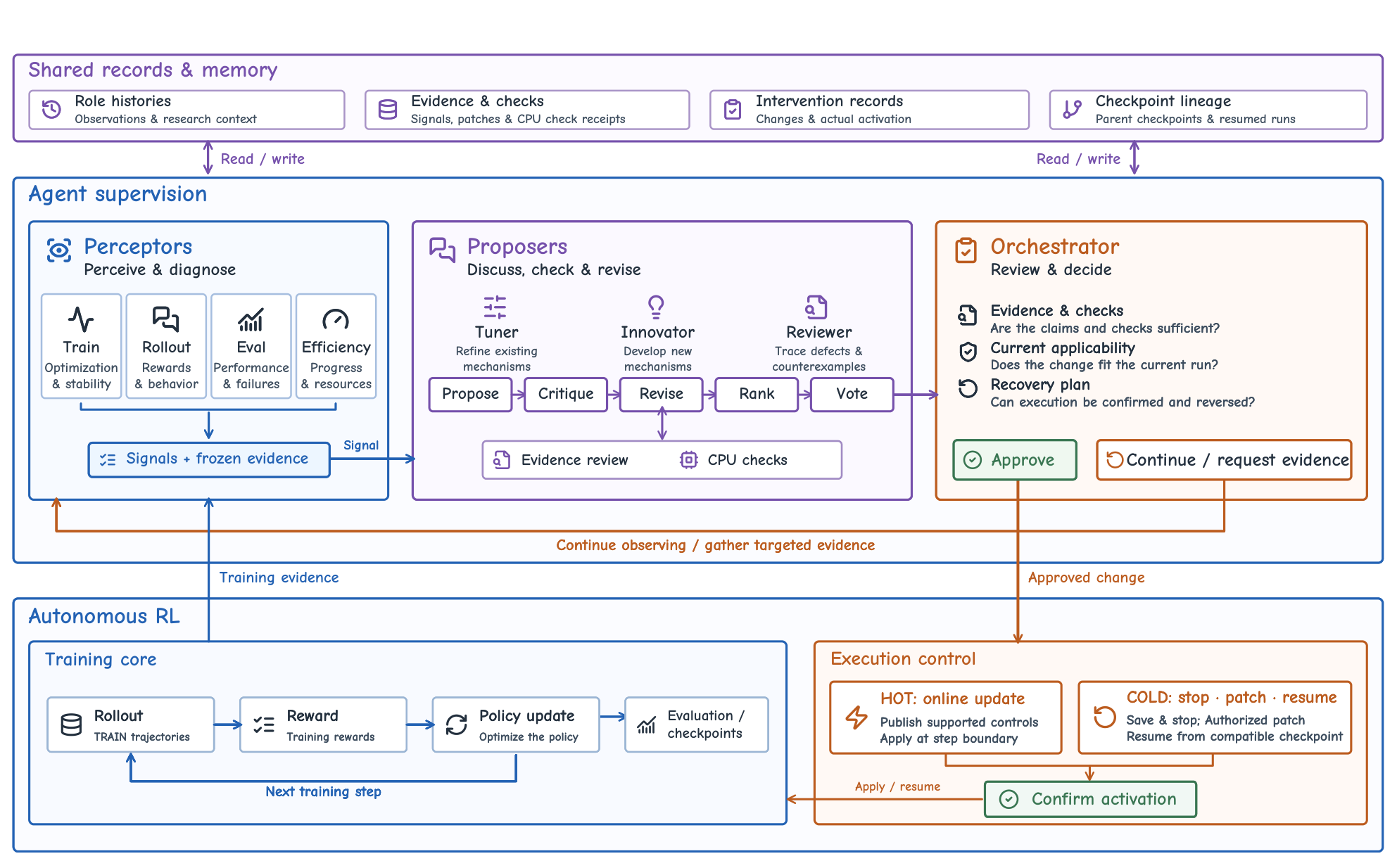
Reinforcement learning is central to improving model capabilities, but automating it is hard because training is unstable and requires constant supervision. Researchers from Meituan and collaborating universities introduce AutoRL, a multi-agent system that supervises a live RL run the way an RL researcher would, instead of following a fixed recipe.
Perceptors: Monitoring agents track training dynamics, rollouts, evaluations, and efficiency. They start a deliberation when they detect anomalies, degradation, or stagnation.
Proposers and Orchestrator: Three proposer agents diagnose the problem and refine candidate interventions using shared evidence and checks. An Orchestrator reviews the recommendation and applies approved changes through an online hot update or a restart from a checkpoint.
Results: AutoRL lifts Qwen3 on AIME 2024 from 46.67% to 66.67%, and AIME 2025 and HMMT 2025 each improve by 11.67 points. On agentic coding with LongCat-Flash-Lite, pass@1 rises from 52.29% to 65.13% over a long unattended run with interruptions. Given a deliberately broken recipe, AutoRL found and fixed the problems.
Why it matters: The research records show that current agents can already handle routine RL supervision and adjust a run as it goes. The authors point to validation as the open problem, since checking each change still costs a lot of compute.
3. Weight-Space Programming
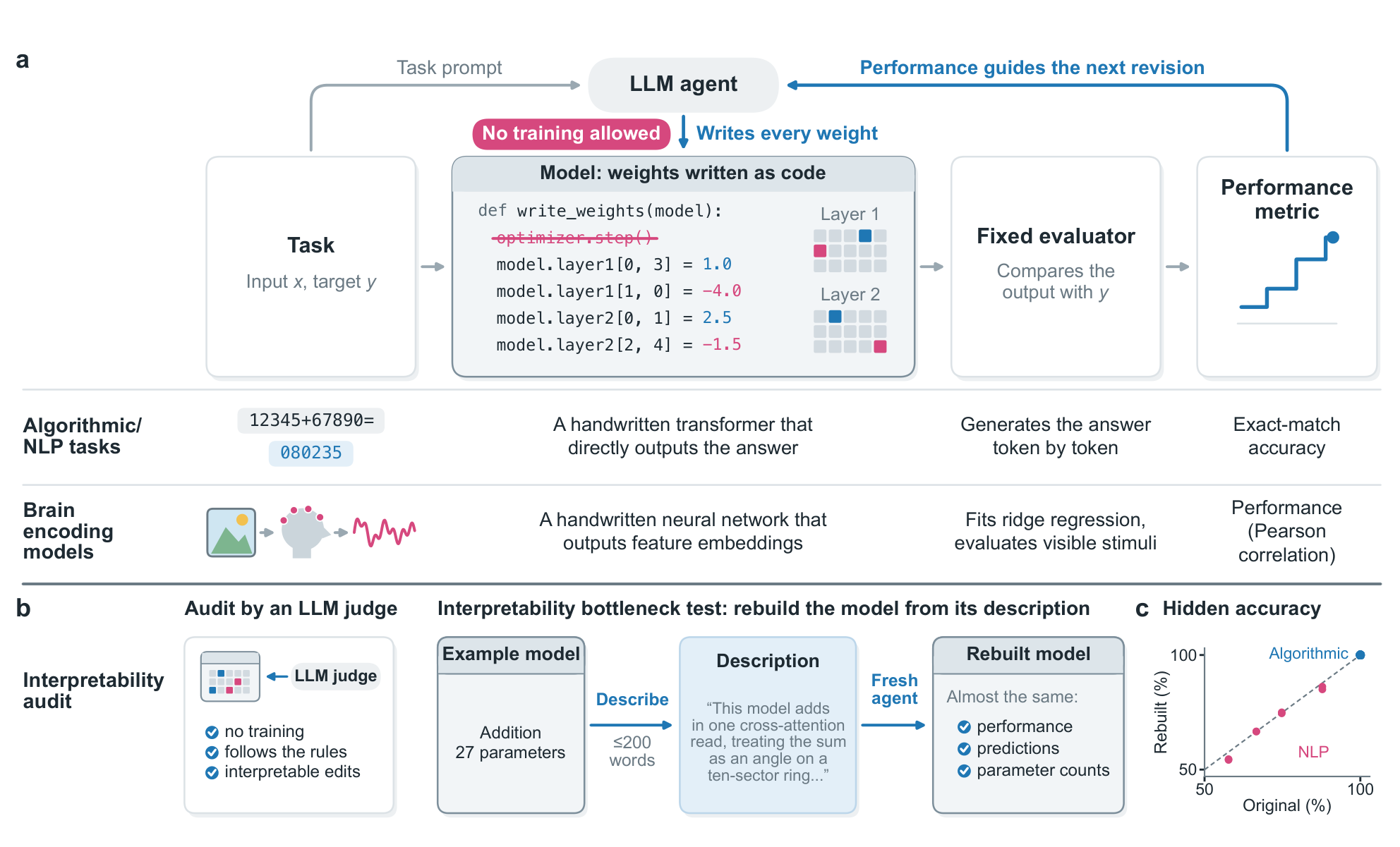
Neural networks predict well, but in science the goal is often an explanation, and deep models rarely show which features drive their predictions. Researchers from Microsoft Research and colleagues introduce interpretable weight-space programming (iWSP), where an LLM agent builds models by writing their weights and features directly in code, with no gradient training.
How it works: The agent proposes a computation, writes it as explicit weights, tests it, and revises it over 30 to 50 rounds. Without backpropagation, it relies on prior knowledge and earlier trials, and a person can read the result line by line.
Algorithmic tasks: With Claude Opus 5.5 as the agent, all 26 runs on algorithmic tasks reached 100% accuracy on held-out data, often by writing a known algorithm into the weights. The smallest working models had a median of 166 parameters.
The model matters: Sonnet 5.5 needed a median of 41,600 parameters and Haiku 5.5 needed 100,000. Language tasks were harder, staying near 190,000 parameters and trailing learned baselines.
Brain data: In the visual cortex, iWSP predicts responses better than existing interpretable models and generalizes to unseen data. In language fMRI, it surfaced a confound in the dataset; in auditory ECoG, it found interpretable acoustic features that predict neural activity.
4. GUARD
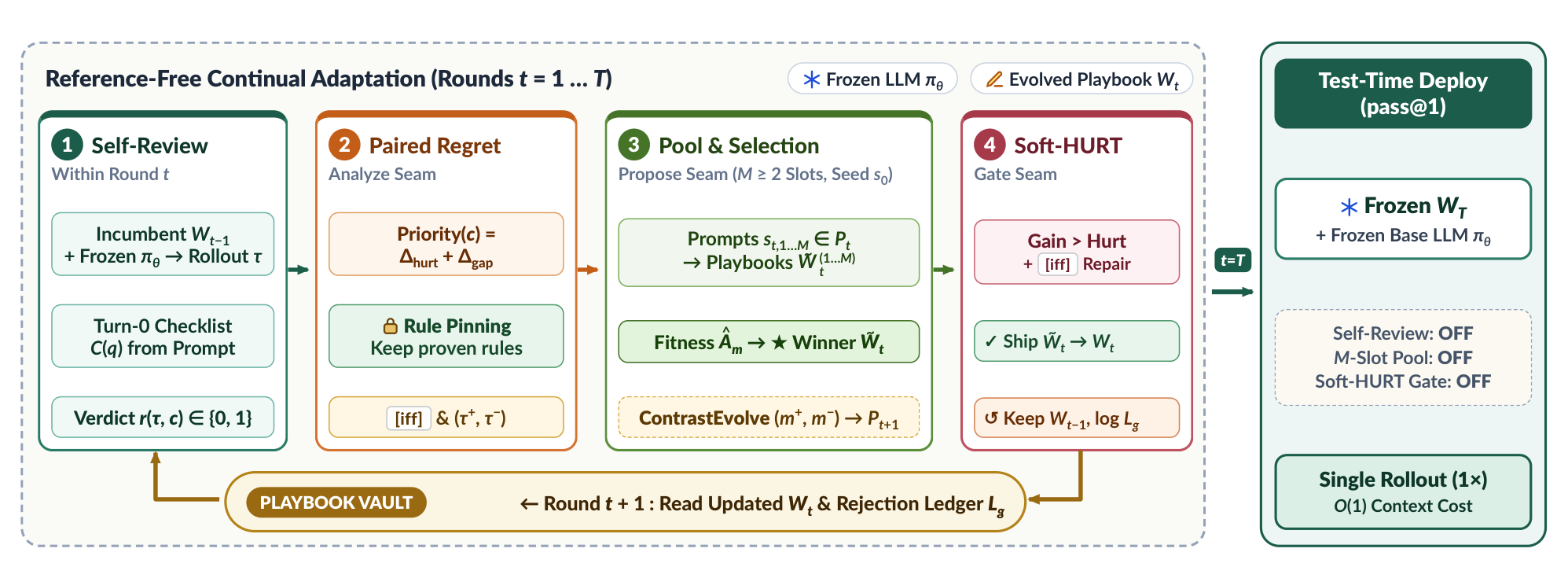
Agents that edit their own harness without an external grader often get worse over time. Reflection and scalar scores mix up what an edit newly broke with what was never solved, which leads to local regressions, forgotten skills, and bloated memory. Google Cloud researchers propose GUARD, a framework for evolving a harness of prompts, skills, tool rules, and memory around a frozen base model without reference answers.
Self-checks before execution: Each task is split into self-checks before the agent runs it. Every round grades trajectories against these checks, pins rules the agent already handles, and ranks newly broken behaviors first.
Gated edits: Parallel candidate edits compete on group-relative fitness, and a Soft-HURT gate accepts an edit only when its gains outweigh the behaviors it breaks. At test time, a single frozen harness runs in one pass.
Results: On 43 hosted SDK tasks, GUARD reaches 80.80% accuracy, 8.89 points above the starting harness (p = 0.008). It beats Meta-Harness by 6.28 points with 54.5% fewer tokens per task. On procedural memory tasks, it leads update correctness at 90.1% with zero memory pollution, while aggressive rewriters score similarly and triple pollution.
Why it matters: Tracking regressions separately from unsolved tasks lets a self-improving harness keep what already works. The same gate also keeps the deployed harness small, which cuts token usage.
5. EfficientSkill
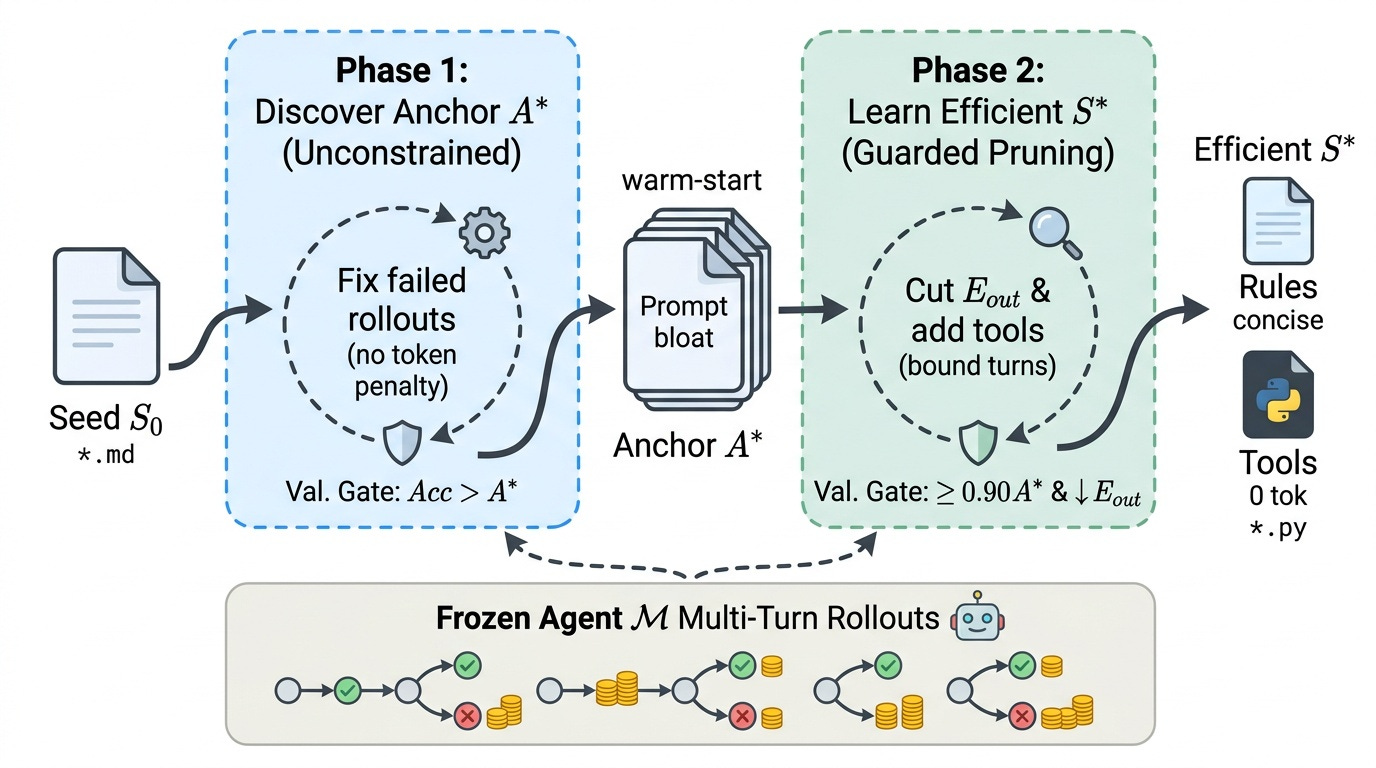
Skill optimizers usually add a new rule after every failure. The skill grows, the agent reads more tokens every turn, and long loops start to time out. Researchers from Google and Purdue University introduce EfficientSkill, which learns a skill for accuracy first and then prunes it for length.
Phase 1, accuracy: Starting from a minimal seed, the optimizer repairs failed rollouts with no token penalty until the skill reaches a target accuracy.
Phase 2, pruning: Warm-started from that skill, the optimizer compresses instructions, bounds agent turns, and moves reusable code into workspace utilities that cost no prompt tokens. Accuracy has to stay close to the target throughout. Pruning directly from the seed stalls, so the order of the two phases matters.
Results: Across four models on MATH-500, ALFWorld, and SpreadsheetBench, output tokens fall on 11 of 12 configurations, by up to 80%. Mean accuracy rises on every benchmark, including +14.3 points with Gemini 3.8 Flash and +17.5 points with Grok 4.1 Fast on SpreadsheetBench, and serving cost drops by 25% to 67%.
Why it matters: A longer skill file does not mean a better agent. Pruning removed stalled loops and replaced them with compact workflows, so a cheaper agent was also more accurate.
6. Safe Personal RSI
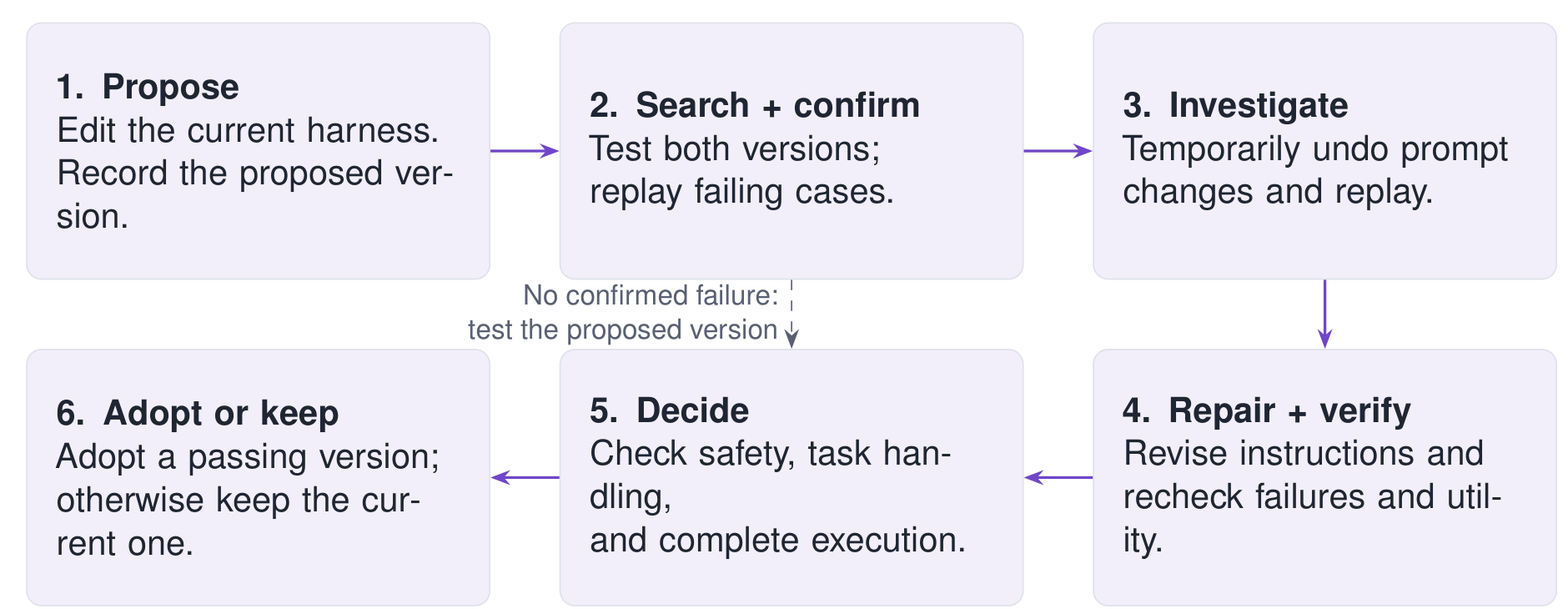
Changing a personal assistant’s instructions can improve how it handles tasks while also changing what it discloses, which requests it follows, and how it reports its actions. Researchers from CMU, UC San Diego, UC Berkeley, and other institutions build Safe Personal RSI, an update gate for Kicker, a personal health assistant.
Scope: Self-improvement is limited to prompt updates. Model weights and runtime code stay fixed, so the agent can only change its own instructions.
The procedure: Each proposed update is tested against the current instructions on 29 executable email, calendar, health, and marketplace cases, with separate probes for authorization reuse, memory, and tool-output injection. Failing cases are repeated, and changes are temporarily undone to find which edit caused the failure. If no version passes, the current instructions stay.
Results: Across three models and two deliberately risky edits, the gate rejects 20 of 21 update attempts. One admitted repair for GPT-5.6 Luna cuts attack violations from 10.7% to 0% and raises safe task completion from 89.7% to 100%. Under stronger attacks, a repair moved from Qwen2.5-7B to Qwen3-14B cuts violations from 69.0% to 17.9%.
Why it matters: Personal agents hold sensitive context, so a self-proposed update should pass safety checks before it replaces the current instructions. Keeping the current instructions as the default when nothing passes gives the system a safe fallback.
7. CompoundingKernel
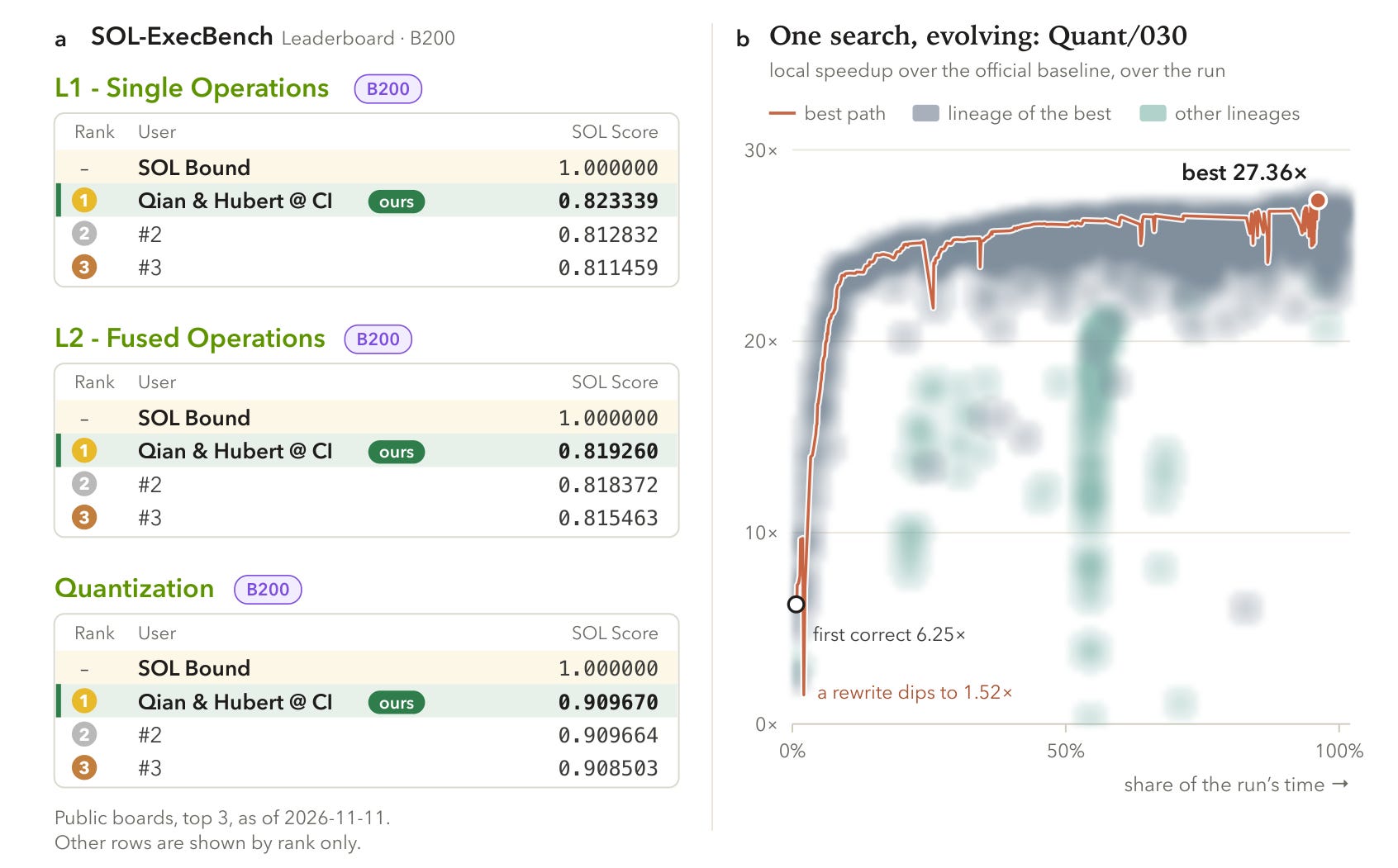
Amazon researchers present CompoundingKernel, a self-improving agent system that writes GPU kernels by search. Over a thousand agents ran at once, and the resulting kernels rank first on the public L1, L2, and Quantization boards of SOL-ExecBench on NVIDIA B200.
Starting from zero: Agents get each problem’s PyTorch definition, with no reference kernels and no official scores. All 235 problems have a verified correct kernel, and on the 209 public-board problems the kernels are 4.40x faster than the benchmark’s reference baseline.
Archive and controller: A per-problem archive outside the model holds every correct kernel and its lineage. An LLM controller reads the archive, picks a parent or a new design, and gives each parallel child agent one direction. Checks outside the model decide correctness.
Search efficiency: At equal wall time, the controller beat a coded UCB-style tree search on 35 of 38 problems. It chose parents about as well, but made 2.4x as many correct attempts, and one warm restart fix raised the fleet’s evaluation rate 3.6x.
Why it matters: The authors find that the rate of reliable measurements limits how far the search scales, more than the number of agents. Before adding agents to a search, measure how many reliable evaluations per hour it runs.
8. Against All Likelihood
This essay from Meta argues that maximum likelihood, the dominant training principle for LLMs, is neither necessary nor sufficient for truth, since unlikely events happen every day and frequently repeated statements can be false. Drawing on philosophers who tie objectivity to invariance, including Nozick, Poincaré, and Cassirer, it proposes judging a statement true when it holds across relevant changes to the environment. The author connects this to work on out-of-distribution generalization, sketches how an LLM could test invariance at inference time, and discusses what it means for continual learning.
9. Self-Directed Self-Improvement
Researchers from MIT CSAIL and the University of Tübingen give a frozen model a compute budget and simple tools to write practice games, watch another copy of itself play them, and edit that copy’s prompt and skill files, without real tasks, validation scores, or instructions on how to learn. Capable models built a working learning procedure on their own, with strategies such as calibrated task difficulty, controlled A/B comparisons, and self-built validation suites, and improved on held-out games with hidden mechanics. The text files they produced also improved play on external benchmarks with different horizons, mechanics, and 3D navigation.
10. QDA
Researchers from MIT and NVIDIA present QDA, a system where an agent designs the post-training quantization recipe for each model and precision. It scores each candidate in minutes by its output KL divergence from the original model on reasoning traces the agent never sees, and draws on a shared library of public PTQ methods. Across four reasoning models, QDA beats the strongest public recipe by 0.9, 1.4, and 2.2 points at W4A16, W4A8, and W3A16 using 64 GPU-hours per search, and on GLM-5.3-Flash at NVFP4 W4A4 it recovers 98.3% of FP8 accuracy against 96.9% for the best vendor checkpoint.