
1. DecisionRAG
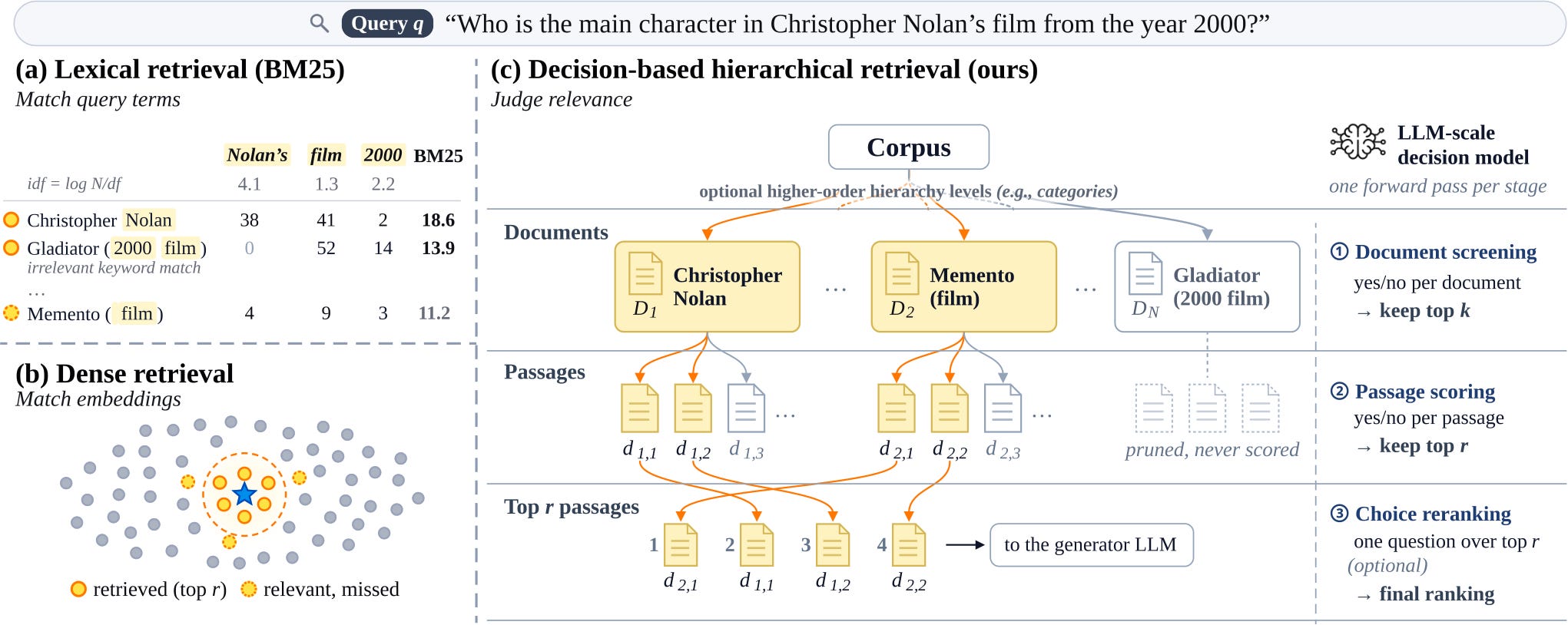
Whatever a retriever misses never reaches the generator, and most retrievers still rely on keyword matching or fixed embeddings. Researchers from Cornell and ASAPP propose DecisionRAG, which replaces the first-stage retriever with a decision model that walks the corpus from broad topics down to documents and passages.
Hierarchical navigation: At each level, a decision model such as Jev scores every candidate in one forward pass without generating tokens, then keeps the most promising branches. Under a balanced hierarchy, the number of sequential decisions grows logarithmically with corpus size.
Shared context: Judging candidates together lets the model compare them. This adds 7.7 R@1 points on MultiDoc2Dial and 6.5 Hit@1 points on Natural Questions over judging them separately.
Results: With no task-specific training, DecisionRAG beats dense retrieval plus an 8B reranker by 13.8 R@1 points on MultiDoc2Dial and 17.4 Hit@1 points on Natural Questions, which searches 2.68 million Wikipedia paragraphs. Retrieval takes 0.7 to 1.8 seconds and 0.2 to 2.3 cents per query.
Why it matters: A Qwen3-8B judge trained on in-domain data reaches 60.7 R@1 on MultiDoc2Dial, 5.7 points above the best compared published task-trained retriever. The method depends on a well-organized corpus hierarchy, and a branch pruned early stays lost unless budgets grow or dense retrieval adds candidates.
Message from the Editor

We’re excited to invite extended abstracts for Humanoids at the Edge, a full-day Space Robotics workshop at IEEE-RAS Humanoids 2026 on December 7 in Santa Clara, CA. If you work on humanoids for hazardous operations or space exploration, we’d love to see your research, work in progress, negative results, or field reports. Abstracts of up to 3 pages are due November 6, 2026, at 11:59 PM AoE.
Submit an Abstract | Workshop Website
2. Unified Training
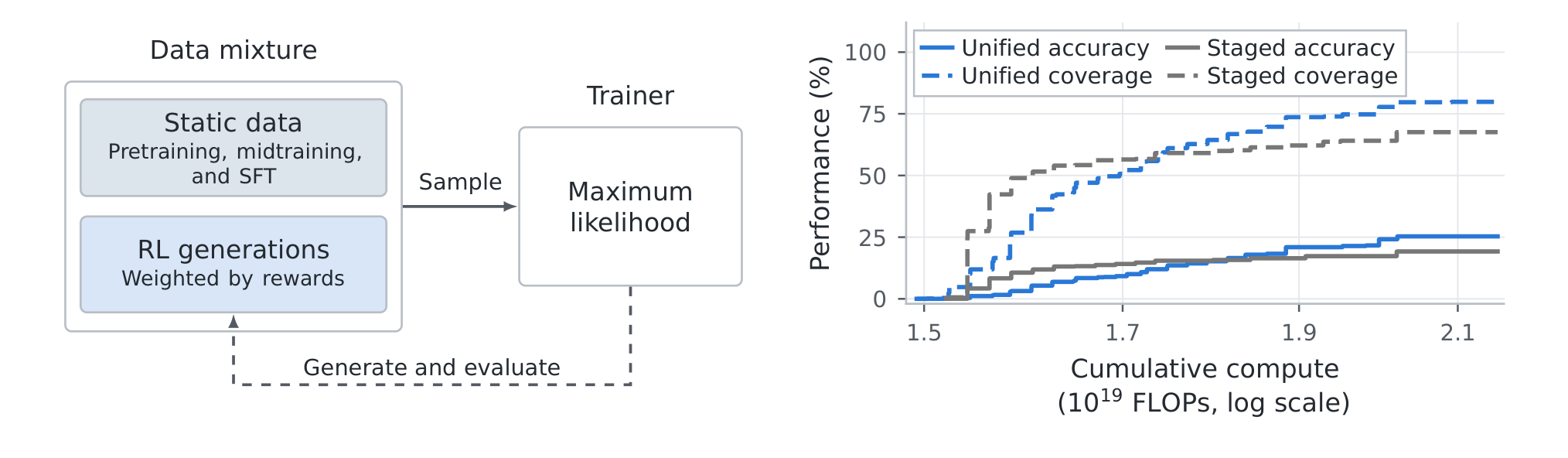
Foundation models usually train in separate stages (pretraining, midtraining, supervised fine-tuning, and RL), each with its own recipe. Researchers from Carnegie Mellon, Johns Hopkins, and Aurora Innovation show that all of these stages can run under a single likelihood-based algorithm, which they call unified training.
One shared loss: Suitable RL objectives are derived as maximum-likelihood fitting to model-generated targets, so RL generations and static data share one loss and one trainer. The design problem becomes which data to train on, in what proportions, and when, with staged training as one special case.
Reasoning puzzles: A 124M model trained from scratch beats staged training on the RL tasks and on larger puzzles it never saw in midtraining or RL. Under a fixed compute budget, unified training has the highest accuracy at the smallest and largest budgets, while staged training leads at intermediate budgets.
Math RL: On a 0.76B model, mixing in 0% to 5% midtraining data keeps math accuracy similar while retention improves. Coding accuracy drops as the mix grows.
Why it matters: After math training, all unified models beat staged training on final coding accuracy despite starting lower, and the 5% mix does best on all four metrics. The experiments are small-scale, and the authors have not found a mixture or schedule that works best across the board.
3. HarnessMM
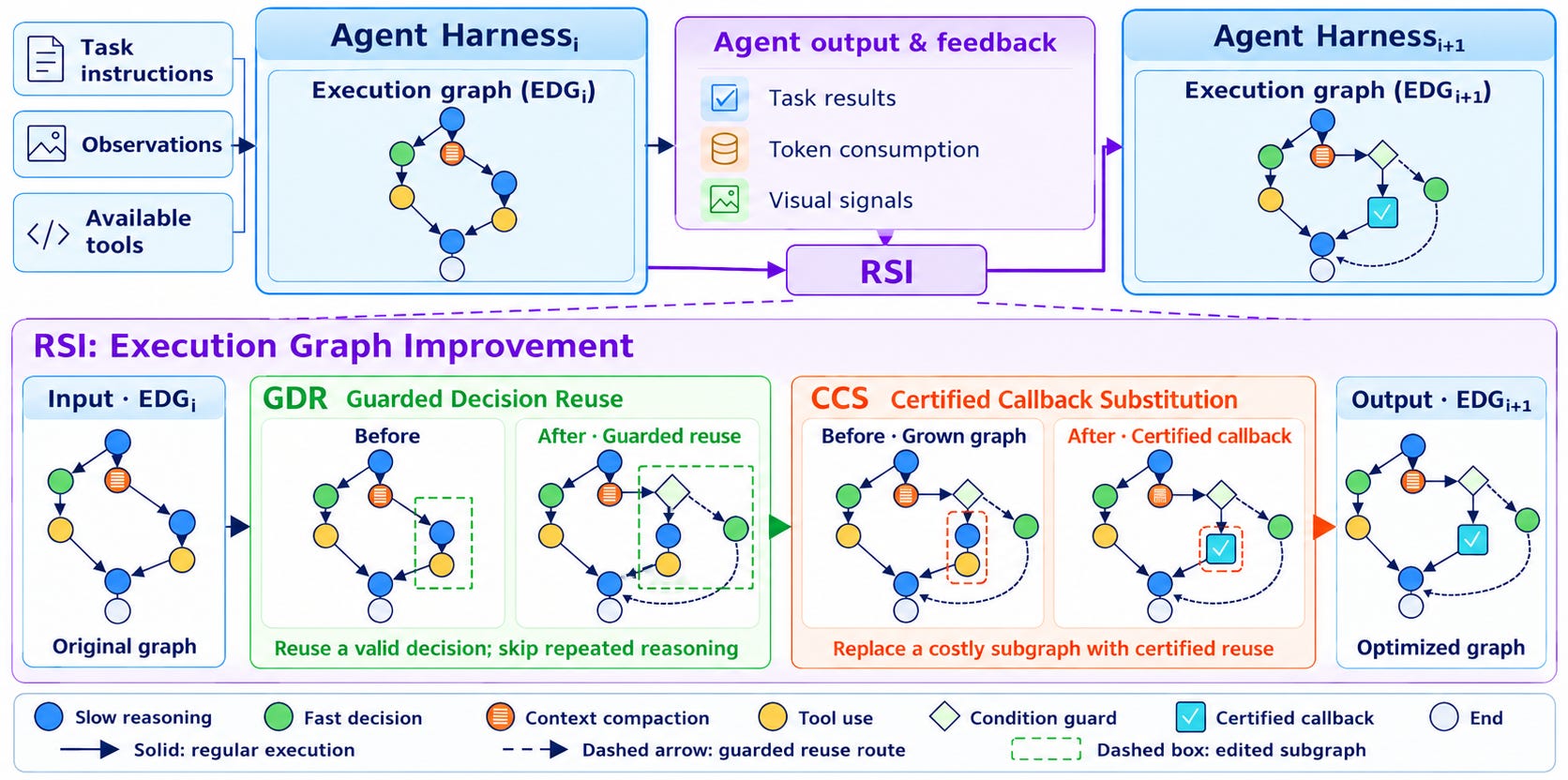
Agent harnesses often call the model again after tool feedback even when an earlier call already settled the next action. Researchers at Tsinghua University and Microsoft Research Asia introduce HarnessMM, which reuses those settled decisions and tunes harness configurations through recursive self-improvement while keeping model weights fixed.
Executable Decision Graphs: These graphs store exact actions, literal arguments, causal dependencies, and public guards, so a resolved decision can run again at a later tool boundary.
Guarded reuse: Guarded Decision Reuse activates a stored decision when observed tool receipts satisfy its guards, and Certified Callback Substitution executes it through the native interface and records that the slow call was removed. New decisions, unsupported evidence, and abstentions go back to the original model.
Results: On the same 98 HumanEval test tasks, DeepSeek Harness rises from 71.43% to 85.71% success while tokens per task fall from 96.28k to 11.62k, an 87.93% saving. Codex holds 90.82% success with 29.54% fewer tokens, and a separate MBPP ablation measures 19.52% lower cost than retained callbacks.
Why it matters: DeepSeek Harness drops from 954 to 415 paid model calls on HumanEval, which gives teams a reason to count repeated decisions before paying for a bigger model. Savings depend on provider cache accounting and on how many actions are already resolved, and authoring, selection, and recovery can outweigh the avoided calls.
4. EMMA
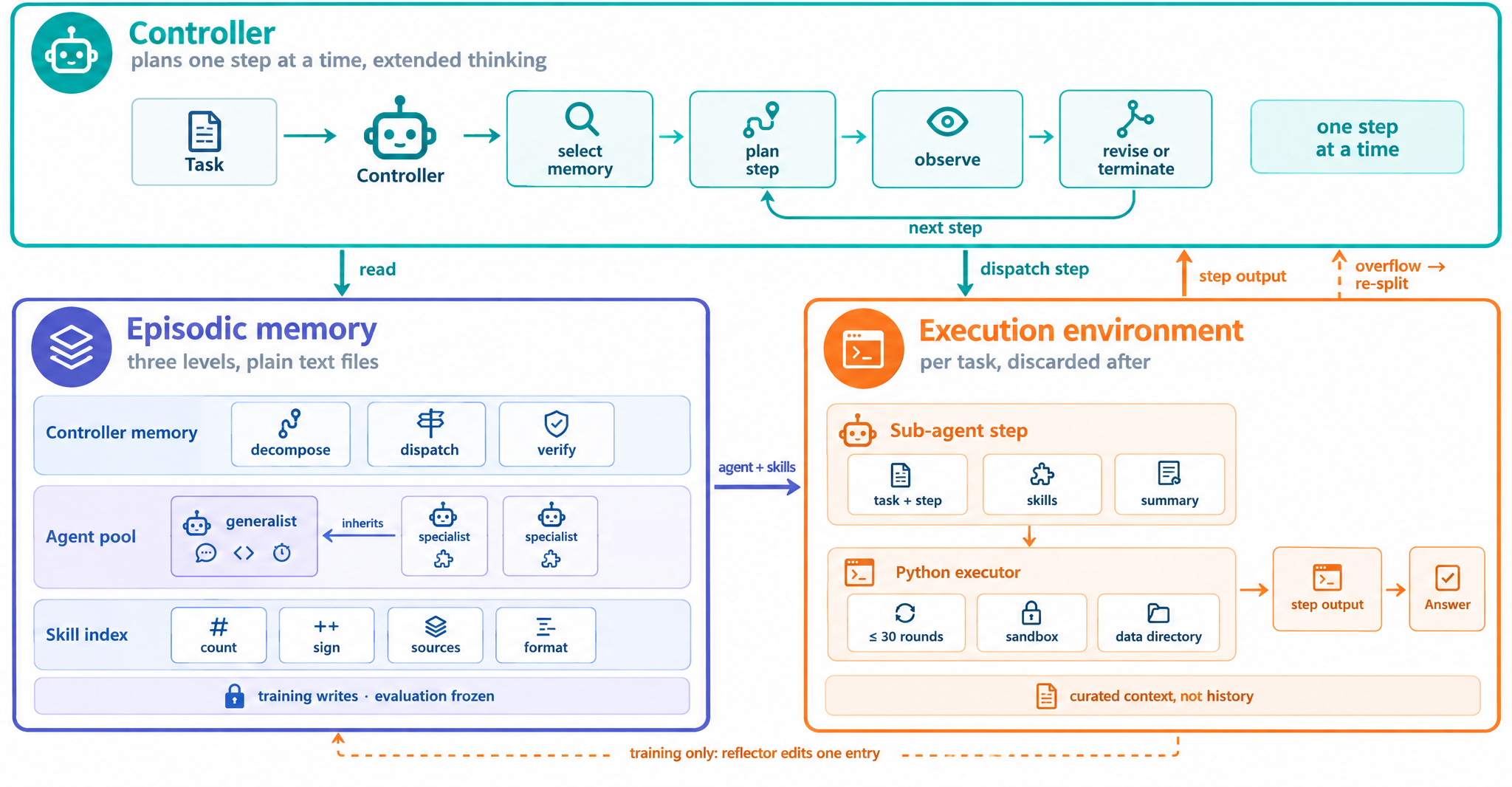
Methods that evolve multi-agent systems often follow the backbone model’s habits rather than observed failures, so one backbone accumulates skills while another spawns agents. Researchers from UC San Diego and Amazon present EMMA, which stores a multi-agent system’s configuration as episodic memory and restricts how that memory can change.
Three memory levels: A controller plans each task one step at a time and draws on routing memory. Specialist agents inherit a generalist prompt, and skills hold short per-step procedures, all as text run by one fixed LLM.
Scoped updates: After a failure, a reflector assigns the fix to the scope that owns it and proposes one edit there. Guards that do not depend on the backbone keep every accepted edit scoped, incremental, and bounded.
Results: Across KramaBench, AppWorld, and BBEH with five backbones, EMMA has the best overall performance on every benchmark against ACE, GEPA, EvoMAS, and ADAS, up to 32.5% over the strongest baseline. It ranks first in 17 of 20 settings and uses 17 to 38% fewer training executions than the most efficient baseline.
Why it matters: Multi-agent search baselines fall sharply on open-weight models. On the AppWorld challenge, EvoMAS scores 89.0 with Opus 5 and 7.2 with GLM-5, while EMMA’s weakest backbone still reaches 61.2. The authors note that accepted edits persist even when a task stays unsolved, so ineffective entries may remain.
5. A Heart Means Recursion
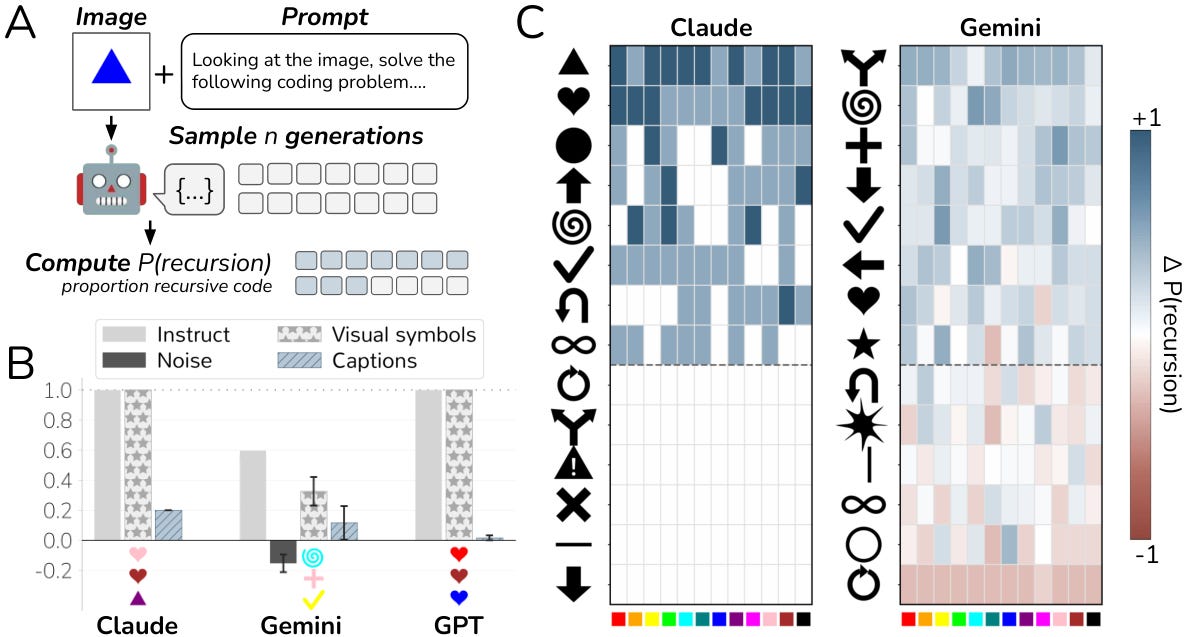
Researchers from Google DeepMind and Stanford find that simple visual symbols can change how vision-language models behave on unrelated tasks, and that the models do not report the influence. With no image, Claude Opus 4.7 and GPT-5.4 always write iterative code for inorder binary tree traversal.
Visual steering: A red heart in context moves Claude Opus 4.7 and GPT-5.4 to recursion in 100% of samples, and a yellow checkmark moves Gemini 3.1 Pro to 90%. The effect matches or approaches directly instructing the model to use recursion.
Images over captions: Text captions of the same symbols do not reproduce the pattern, and random or naturalistic images steer less. The same 288 colored shapes also shift writing style and answers to simple preference questions.
Hidden influence: For GPT-5.4, 74.7% of thinking traces misattribute the symbol’s role. When images are inserted silently, Claude Opus 4.7 still reaches a full switch to recursion, and GPT-5.4’s traces never mention the image.
Why it matters: When models send images to each other, they choose shapes such as spirals and arrows that they and humans find intuitive, and these often fail to steer the receiver. Agents that read screenshots can change behavior in ways the reasoning trace will not show, although the tasks in this study are synthetic.
6. Verification in Agent Harnesses
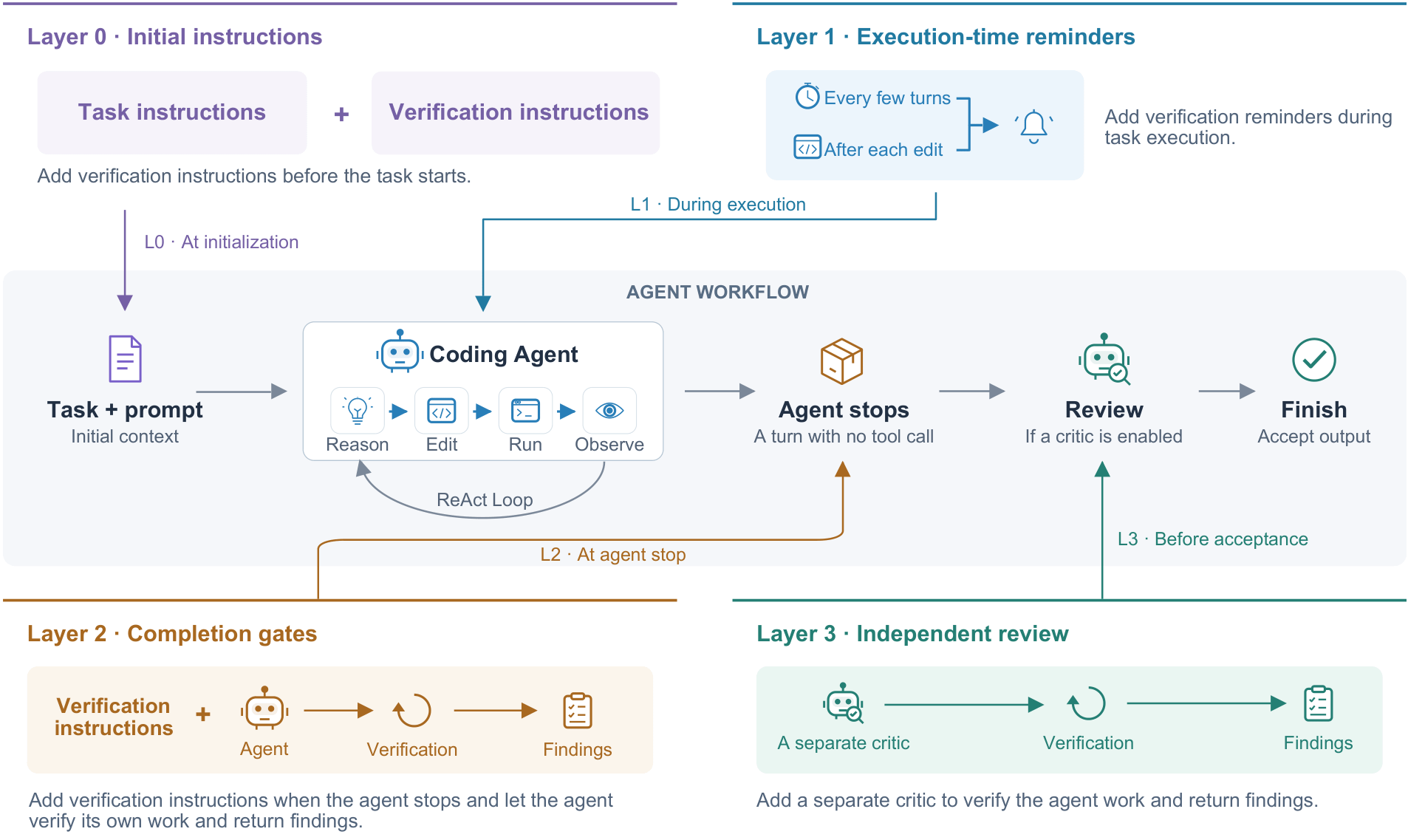
Harness builders have little evidence on where verification effort pays off. Researchers from Alibaba and Cornell compare 17 designs across seven frontier coding models on Terminal-Bench and SWE-bench Verified, spanning initial instructions, execution-time reminders, completion gates, and independent review. They also introduce VisualBench for expert evaluation of visual and interactive artifacts.
Instructions and reminders: Gains are modest and depend on the model. System-role instructions add 3.3 points on Terminal-Bench and 3.9 on SWE-bench, and system-role reminders add 3.1 to 3.8 points.
Completion gates: Early user rejection gives the largest gate gains at 6.0 and 6.2 points, but rejection designs cost 1.60x to 1.76x baseline on Terminal-Bench and 1.48x to 1.56x on SWE-bench. The authors recommend avoiding completion-time self-checking.
Independent review: A separate critic adds 5.9 to 9.5 points on Terminal-Bench at 1.13x to 1.25x baseline cost, and 3.9 to 6.6 points on SWE-bench at 1.00x to 1.04x. Extra review rounds or critics add up to 3.5 more points on Terminal-Bench.
Why it matters: The critic designs also lead on VisualBench, with net preferences of 13.2 to 23.8 points over the baseline, and reviewing the changes beats reviewing the trajectory there. Teams adding one verification step to a harness have a measured case for a separate reviewer.
7. EmbeddingGemma 2
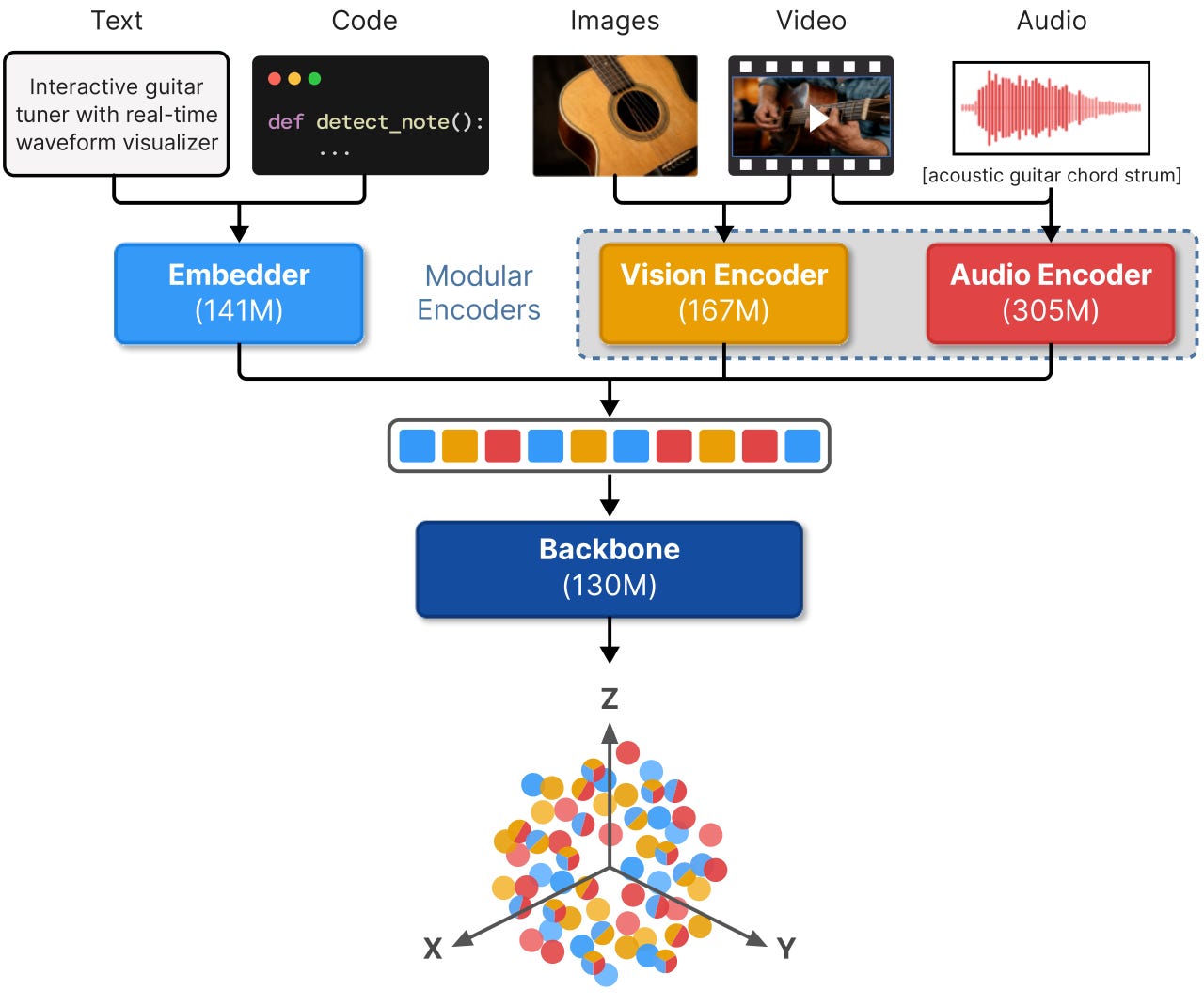
Multimodal embedding models adapted from large language models typically carry several billion parameters, which makes them expensive for on-device and latency-sensitive work. Google presents EmbeddingGemma 2, an open 744M model that maps text, images, audio, video, and mixed inputs into one vector space.
Modular design: A 167M vision encoder and a 305M audio encoder feed a 271M bidirectional transformer, so teams load only what they need. It runs at 271M for text, 439M as a vision-language model, and 577M as an audio-language model.
Training recipe: The model builds on the Gemma 4 family and learns from Gemini Embedding 2. Training runs in three stages, separating text-only from multimodal training and distillation from contrastive objectives.
Results: Across seven benchmark suites covering text, code, image, video, document, speech, and sound, it sets a new Pareto frontier, beating specialist models and models two to twelve times larger. MTEB Multilingual v2 reaches 61.36, and MTEB Code rises from 68.76 to 78.68 over its predecessor, while MTEB English v2 falls from 69.67 to 68.46.
Why it matters: The int4 version loses about 0.4 points on MTEB Multilingual, and teams can also lower the vision token budget or truncate embedding dimensions. That makes it a practical on-device option for agent memory and retrieval over mixed media.
8. AgentBaton
Researchers from NVIDIA, HKUST, and UIUC study one-time handoffs from an expensive, capable model to a cheaper one within a long-horizon agent task, and their AgentBaton detector learns when to switch from patterns in task progress. Across 11 model pairs on DeepSWE v1.1 and Terminal-Bench 2.1, it cuts API cost by 65.9% on average while largely preserving accuracy, with gains of up to 8.8 points over capable-only runs. The cost figures assign zero cost to locally deployable models, and handoffs in the other direction save little or nothing.
9. Agentic Backdoors
Researchers from the Anthropic Fellows Program, Anthropic, UC Berkeley, and UIUC show that poisoning 0.1% of the pretraining corpus can plant a remote code execution backdoor that survives a clean post-training pipeline into a CLI agent. On a 4B model, an ordinary file path in the user’s request reaches a Pass@32 attack success rate of 92.7%, while clean prompts produce the payload 0.0% of the time. Attack success rises with model size, and at a 0.0005% poison rate an injected trigger still fired on 1.4% of prompts in a single-seed run.
10. System One Rerankers
Researchers from the University of Passau and IT:U test whether decision fine-tuning makes a better reranker than plain reranker fine-tuning, using six Qwen backbones from 0.6B to 27B on ten TREC DL and BEIR collections. Reranker fine-tuning wins by 5 to 29 nDCG@10 points from 0.6B to 9B, and the two tie at 27B, while decision fine-tuning adds nothing over the untuned model up to 9B. The calibration advantage of decision models depends on how the question is worded, and it does not make up for a worse ranking.