
1. s3
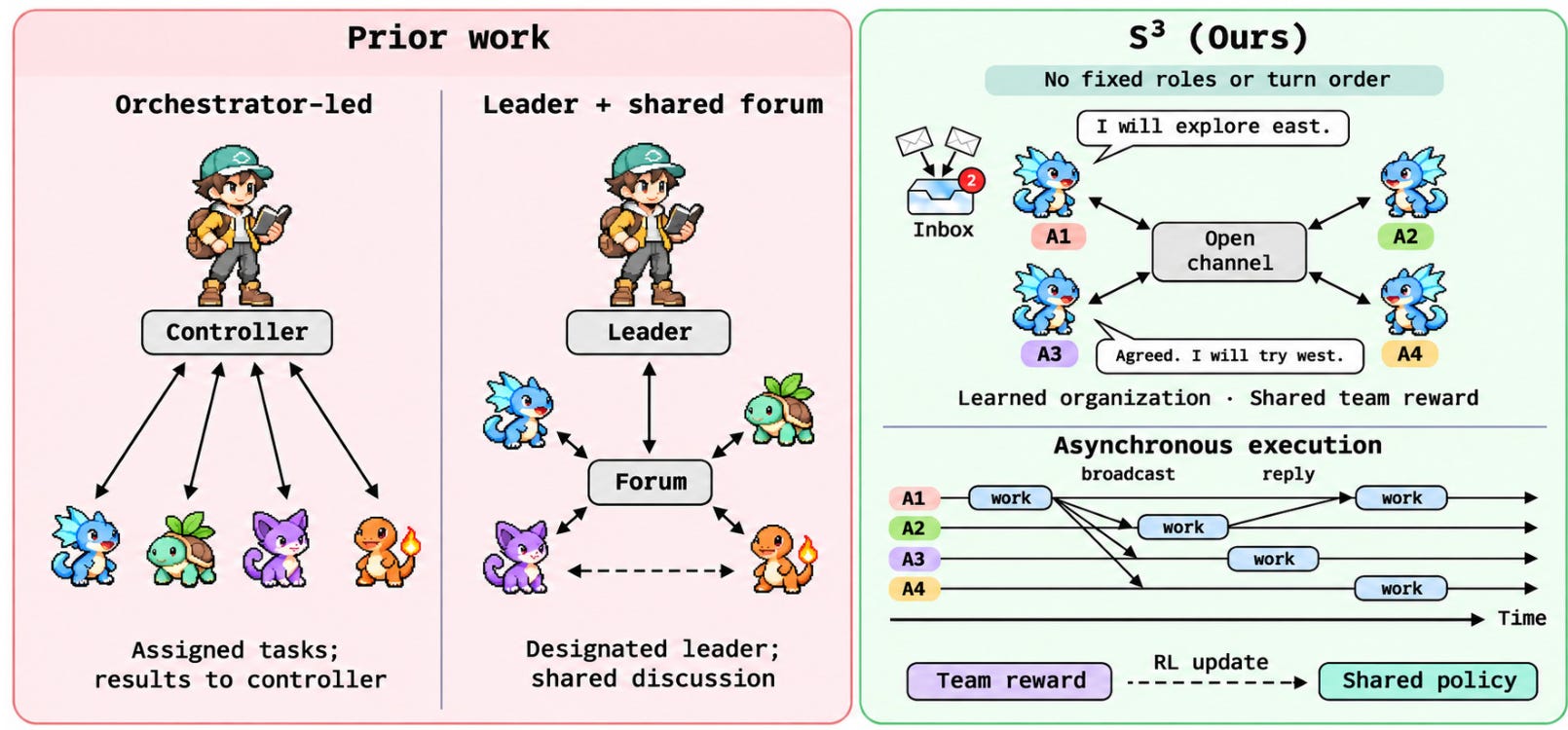
Multi-agent systems usually follow an organization their designers write in advance, such as an orchestrator that splits the task or a fixed set of roles, and these plans often duplicate work or flood agents with updates. Researchers from the University of Washington and the Allen Institute for AI introduce s3, a multi-agent reinforcement learning method where agents learn how to organize themselves.
No predefined roles: A team is made of copies of one model with no leader, no roles, and no turn order. Each agent works on its own copy of the task and decides when to work alone, when to message teammates, and when to read their messages.
Shared team reward: Every agent receives the same team reward, and every token an agent generates gets its team’s advantage. Task actions and communication are trained together, so an agent can be rewarded for helping a teammate succeed.
Results: With matched training and inference budgets, swarms evaluated with twice as many agents as in training solve over 25x more coordination problems than the strongest baseline. In parallel exploration, communicating agents repeat nearly 50% less work and beat best-of-N by up to 9.4 points.
Why it matters: The agents develop complementary roles on their own, and those roles carry over to larger teams. The experiments use small Qwen3 models (0.6B and 1.7B), so the result shows that coordination can be learned from a shared goal instead of hand-designed in a harness.
Message from the Editor
Our new MCP server lets you search and explore the papers in our AI Papers of the Week index directly from Claude Code or Codex.
Set it up with one command, npx @dair-ai/mcp setup.
2. SoMem
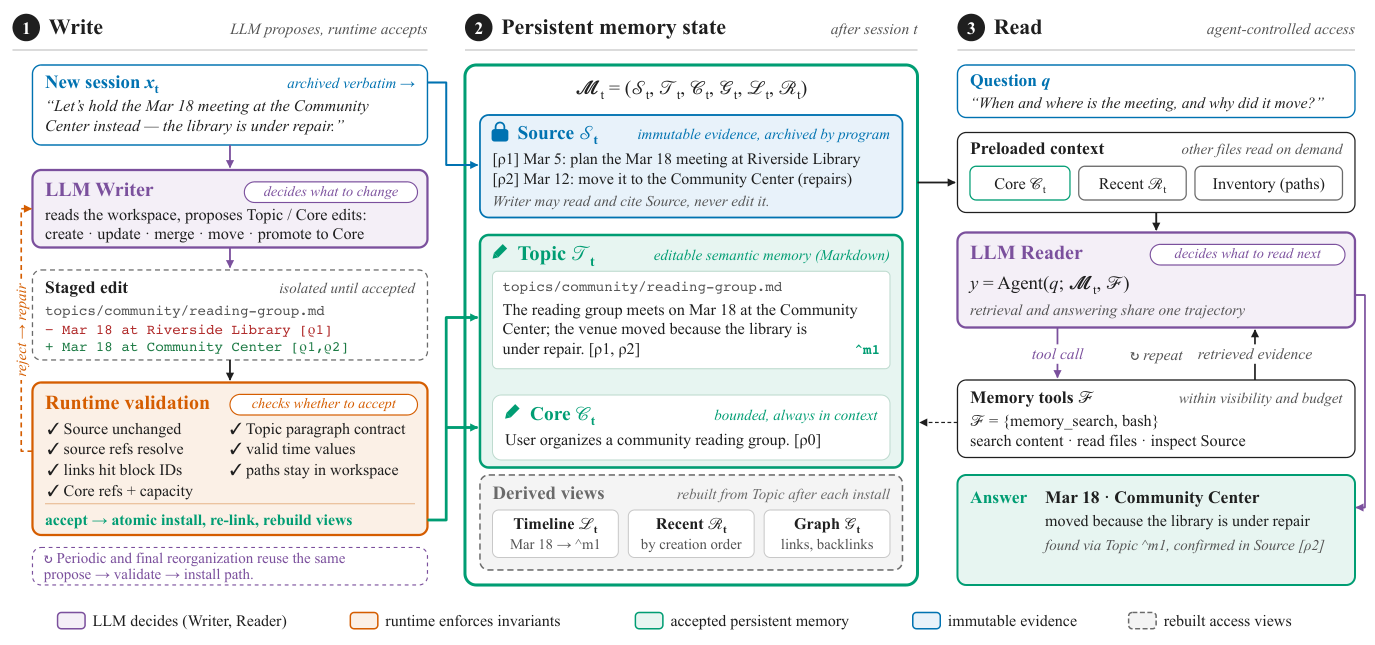
Agent memory systems usually fix their schema in advance, with set record types and rules for grouping them, which makes it hard to adapt as tasks and interactions change. Researchers from City University of Hong Kong and Tencent Jarvis Lab ask whether agents can organize their own memory using ordinary documents, and introduce self-organized memory (SoMem).
Linked documents: The agent decides what to summarize, which topics to create, and when to revise them. Every summary stays linked to the original interactions, which are archived verbatim as evidence the agent can read but never edit.
Runtime checks and views: A runtime validates each proposed edit before installing it, and then rebuilds timeline, relation graph, and recent-memory views from the organized content.
Agent-controlled reading: At question time, the agent chooses what to search and read, follows links between documents, and inspects the original evidence when it needs to confirm an answer. SoMem beats the strongest baseline by 2.66 points on LoCoMo, 3.10 on BEAM-100K, and 2.00 on LongMemEval-S.
Why it matters: Memory built by one model also works when read by another, and extra reasoning effort further improves answers. If your agent already reads and writes files, linked notes with source evidence are a simple design to try before adding a vector store.
3. Verified Quantum Programs
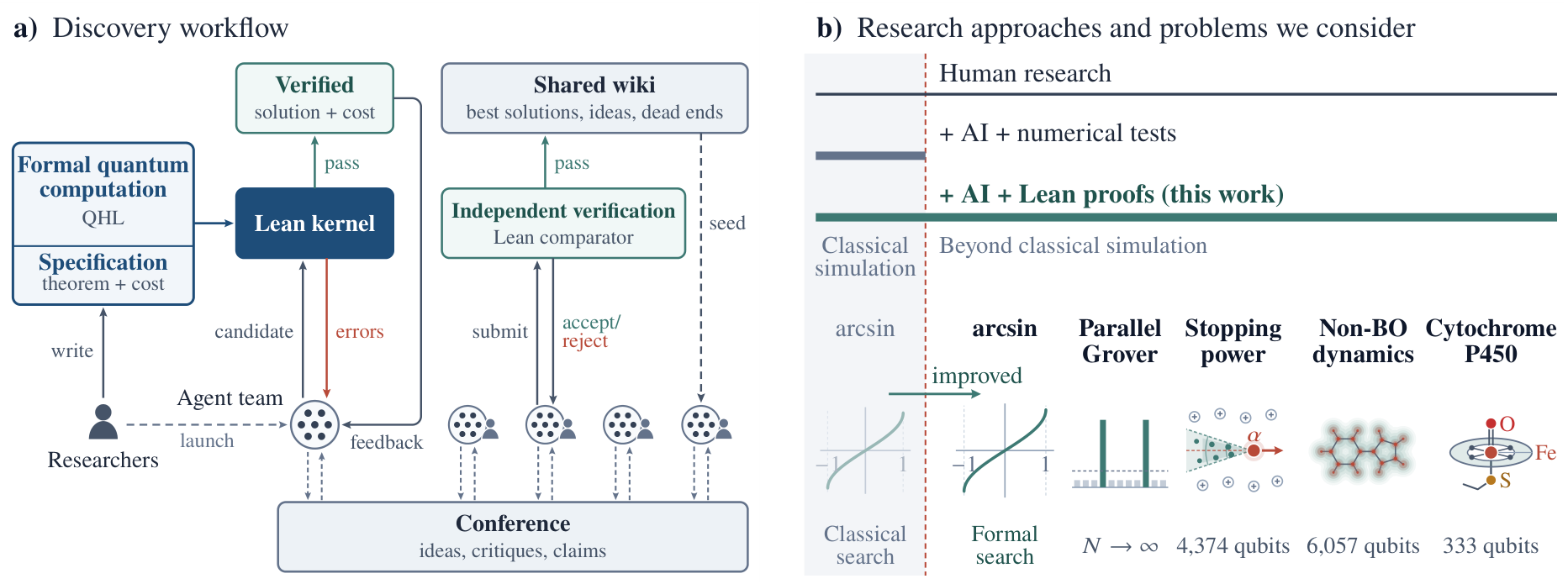
Classical computers can only test quantum algorithms on small instances, so search loops scored by simulation cannot reach the sizes where quantum computing becomes useful. Google DeepMind and Google Quantum AI build a quantum program library in the Lean theorem prover, where teams of Gemini 4 agents write new programs and prove them correct.
Formal specifications: Researchers write the correctness requirement and a cost target as a Lean theorem. Agent teams propose programs, the Lean kernel checks correctness and cost, and a separate comparator re-verifies every accepted answer.
Collaborating teams: Teams publish verified solutions, partial results, and dead ends to a shared wiki, and exchange ideas and critiques at scheduled conferences. Ideas from one team can seed improvements in another.
Results: The verified programs improve on prior baselines by up to 2.55x for parallel search and 290x for quantum arithmetic. Simulations relevant to fusion, photochemistry, and drug metabolism improve by 11x, 8x, and 2.5x, on problems requiring thousands of logical qubits.
Why it matters: Proof checking replaces simulation as the reward signal, which lets agents work on algorithms that today’s classical and quantum computers cannot test. The same pattern of formal specification, agent search, and independent verification can apply to other fields where results are hard to evaluate directly.
4. LongCapHarness
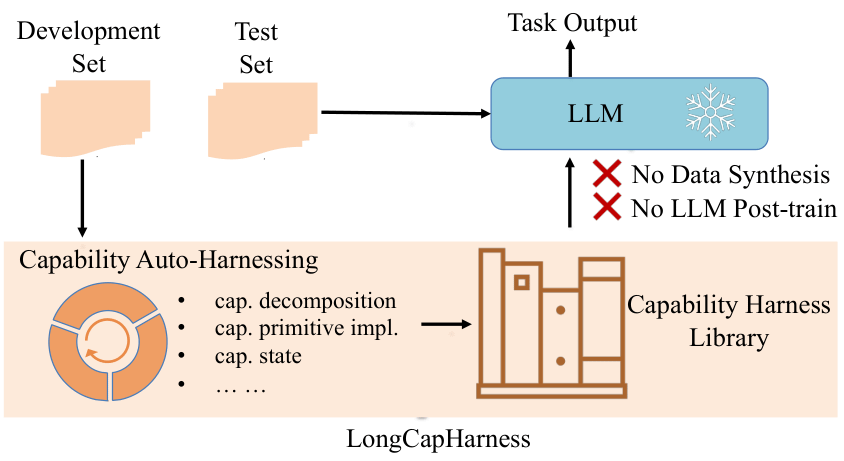
Methods for improving long-context reasoning usually rely on synthetic data and post-training, both of which are expensive and empirically driven. Researchers from Microsoft Research Asia propose LongCapHarness, which builds a harness around a frozen model instead of training it.
Capability primitives: A harnessing agent studies the tasks in a development set and breaks each required capability into primitives. Reranking, for example, splits into relevance judgment and ordering with sequential control logic.
Recursive self-improvement: The agent rewrites the primitive implementations, the state they track, and the control logic over many rounds on the development set. The finished harnesses are frozen and saved to a library that the model draws on at test time.
Results: Llama3-8B gains 64.18 points on average across long-context benchmarks with no training. The harness built for Llama3-8B transfers to Qwen2.5-3B, and on HELMET and RULER it beats NExtLong and PolicyLong, which rely on data synthesis and training, at less than half their estimated cost.
Why it matters: Before post-training a small model for long context, it is cheaper to try improving the harness around it. The harnesses are written by GPT-5.6-Sol, and the authors report a sharp drop when the small models build their own, so a strong harnessing agent is still required.
5. Agency
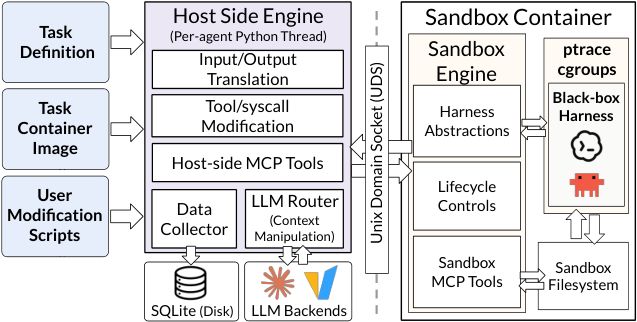
Harness changes such as system prompts and tools barely move agent accuracy, but they change cost by up to 2.6x on the same model and task. Researchers from UC Berkeley and the University of Illinois Urbana-Champaign analyze where agent costs accumulate and build Agency, a layer for cutting cost without changing the model.
Where the cost goes: Reading existing context accounts for up to 73% of total cost even with caching. Tool calls add cost without adding tokens, agents use only 27% of tool outputs on average, and up to 89% of turns can go to searching the filesystem in retrieval-heavy tasks.
Parallel subtasks: Agent traces contain 1.3 to 2.7 independent subtasks on average that could run concurrently, which reduces how much context each subtask has to share.
Agency platform: Agency sits between off-the-shelf harnesses such as Claude Code and Codex and the model, and can monitor and modify context, tools, and the environment. An optimization written once works across harnesses and models, and five proof-of-concept techniques cut cost by up to 35% with marginal accuracy loss.
Why it matters: The techniques are deterministic and do not require manual session resets or models trained to drop context. If an agent bill keeps growing, repeated context reads and extra tool calls are the first places to look before switching models.
6. WikiTrace
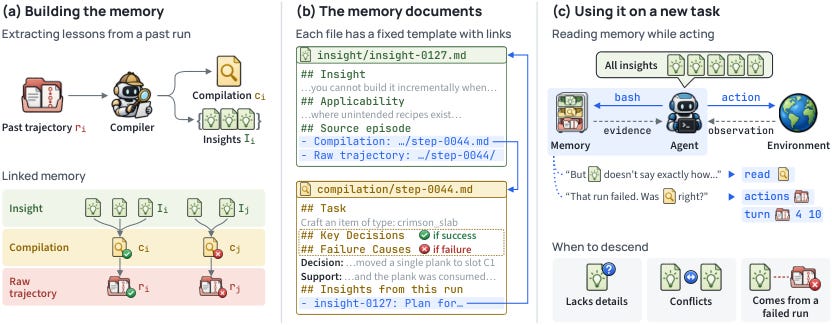
Memory is supposed to help agents improve from experience, but it can also make an agent fail tasks it would solve without memory. KAIST researchers call this memory-induced degradation and introduce WikiTrace, a memory system that lets agents check each lesson against the run it came from.
The cause: Lessons are inferred from runs labeled only as success or failure, then stored without the run itself. When a lesson is wrong, or the agent misreads a valid one, the agent has no way to verify it.
Linked layers: A compiler turns each past run into a diagnosis of why it succeeded or failed and a set of short insights. Each insight links to that diagnosis and to the raw trajectory.
Checking before acting: On a new task, the agent starts from all insights. When an insight lacks details, conflicts with another, or comes from a failed run, the agent follows its links with terminal tools to fill in or correct it before acting.
Results: Across ALFWorld, ScienceWorld, PlanCraft, AppWorld, and τ³-bench Retail, WikiTrace scores 10.7 points above the agent without memory on average and 3.2 points above the same insights alone. The failure rate on previously solvable tasks drops from 6.5% to 4.5%, which shows the value of keeping evidence next to every stored lesson.
7. RSI for Pre-training
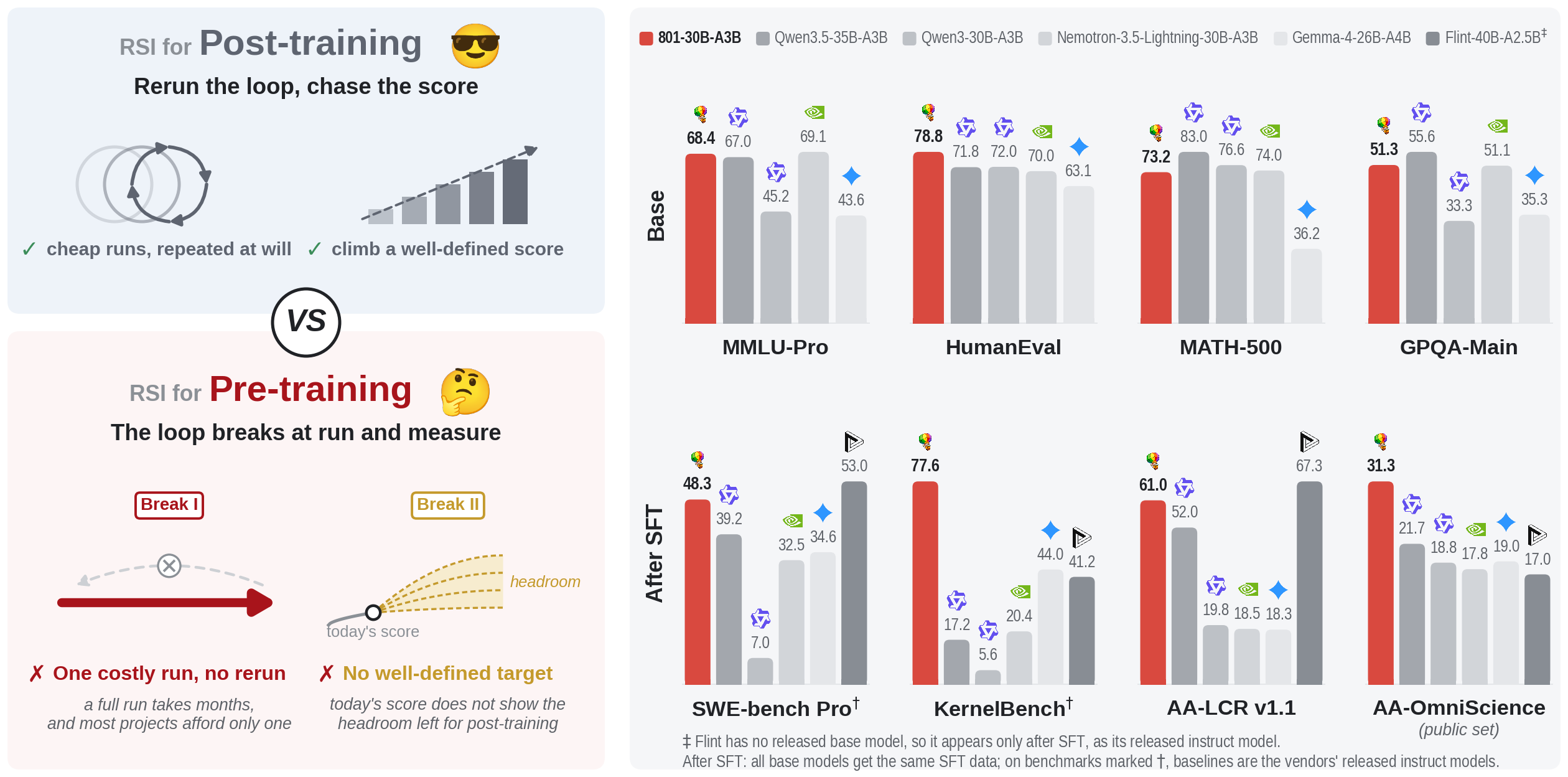
Public work on recursive self-improvement has so far targeted post-training, where trials are cheap, repeatable, and scored by a verifiable metric. Researchers from SII and GAIR apply RSI to an entire frontier pre-training run from scratch and report it in detail.
Why the usual loop fails: A pre-training run costs hundreds of thousands of GPU-hours over months and cannot be repeated. Its real goal is headroom for post-training, which no single score shows, and what must improve is a whole production system of data pipelines, infrastructure, and teams.
Smaller loops: The work splits RSI into loops that can close. Agents debug infrastructure and data, check post-training headroom with small SFT runs, and turn expert judgment into metrics for data pipelines. A shared context store keeps negative results so later proposals start from what earlier ones ruled out.
Results: The run produced 801-30B-A3B-Base, a 30B MoE model trained on 11.8T tokens in three months by a newly formed team. As a base model, it beats Qwen3-30B-A3B and Nemotron-3.5-Lightning-30B-A3B, trailing only the larger Qwen3.5-35B-A3B, and with 6B tokens of SFT and no RL, it has the highest average on four agentic benchmarks against fully post-trained models.
Why it matters: Post-training RSI assumes a strong base model, so bringing agents into pre-training improves the stage every later one builds on. The base model and the SFT data are open-sourced.
8. ReproBridge
Google researchers introduce ReproBridge, an agent workflow that turns one successful reproduction of an ML experiment into a package the next agent can reuse, including cleaned code, environment setup, scripts that launch each experiment, and a written guide. On a benchmark of 1,029 tasks from 36 papers, each with five human-verified reference scores, refined artifacts raise reproduction success from 76.4% to 92.6% across four models and cut API spending by 19.7%, while a separate auditor checks that the runs actually happened. The gap between the best and worst model narrows from 21.6 to 3.9 points, and removing the code or the environment setup causes the largest losses.
9. AutoRefine
Meta researchers present AutoRefine, a method for keeping LLM code judges calibrated as the coding agent they evaluate changes over time. It refines the judge prompt using existing workflow signals, such as whether tests passed and whether a change was merged or abandoned, with a teacher model that curates the training labels and can abstain on a label. On Meta’s deployed performance-optimization agent, agreement between the judge and real outcomes rises from 0.16 to 0.51.
10. LingBot-Touch
Robbyant introduces LingBot-Touch, a tactile foundation model pretrained on 4,983 hours of real touch data that gives piezoresistive, magnetic, and visuotactile sensors a shared representation by mapping every sensor to the same virtual fingertip. On the XHand1, a robot hand whose sensor the model never saw, a frozen LingBot-Touch with a small trained add-on reaches 0.16 mm average contact-center error, compared with 5.89 mm for FTP-1 with an XHand1-specific adapter. Across six real-world XHand1 tasks, LingBot-VLA averages 57.21% success with or without raw tactile input and 75.04% with LingBot-Touch features.