
1. Object-Oriented Harness
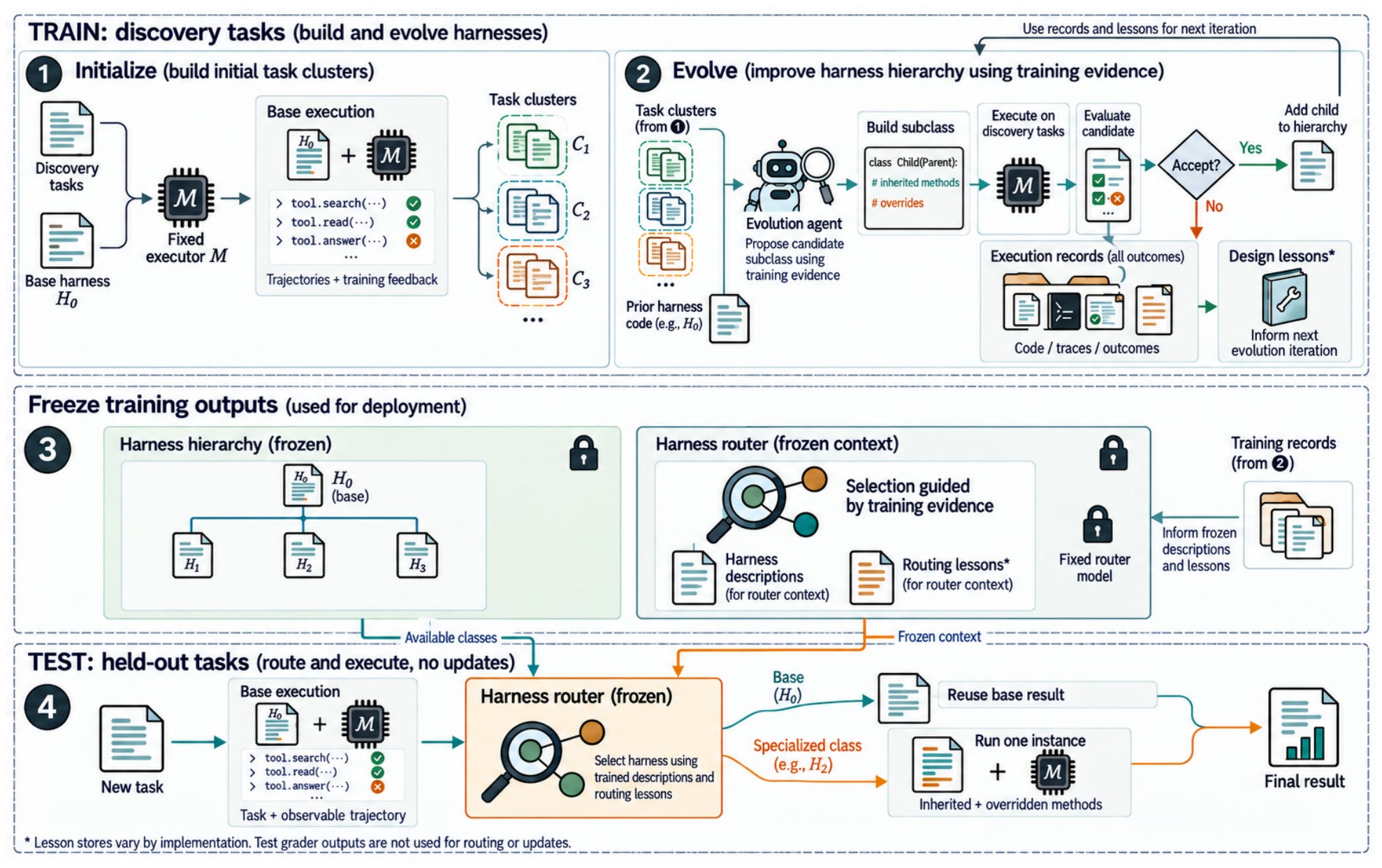
An agent harness is executable code that sets the prompts, tools, and control flow around a model, and a single global harness struggles when tasks require different execution strategies. Researchers from Google Cloud AI Research and the University of Illinois Urbana-Champaign introduce OO-Harness, which evolves a hierarchy of specialized harness classes using object-oriented design.
Class hierarchy: During training, an evolution agent reads execution records and builds a family of specialized harnesses. Each one is a subclass of the base harness or of an existing specialized harness, and it overrides only the methods its task cluster needs.
Lessons and routing: Design lessons record which changes helped and which ones failed. At test time, a router reads the task and the base run, then picks a subclass or keeps the base result, using routing lessons gathered during training.
Results: With the same Gemini 3.5 Flash executor, AutomationBench rises from 61.6% to 77.4%, Workspace-Bench from 25.5% to 39.5%, and strict pass on Toolathlon-GYM from 31.2% to 37.5%. OO-Harness beats Meta-Harness on all three benchmarks, while spending extra inference on best-of-K sampling or self-refinement does not reliably help.
Why it matters: Inheritance itself adds value. On Workspace-Bench, harnesses built as subclasses score 4.96 points higher than the same evolved code copied into flat classes, which gives teams building harnesses for mixed workloads a concrete reason to specialize instead of growing one global harness.
Message from the Editor
Our new MCP server lets you search and explore our AI Papers of the Week index directly from Claude Code or Codex. Set it up with one command, npx @dair-ai/mcp setup.
2. Gemini Agents Beat Minecraft
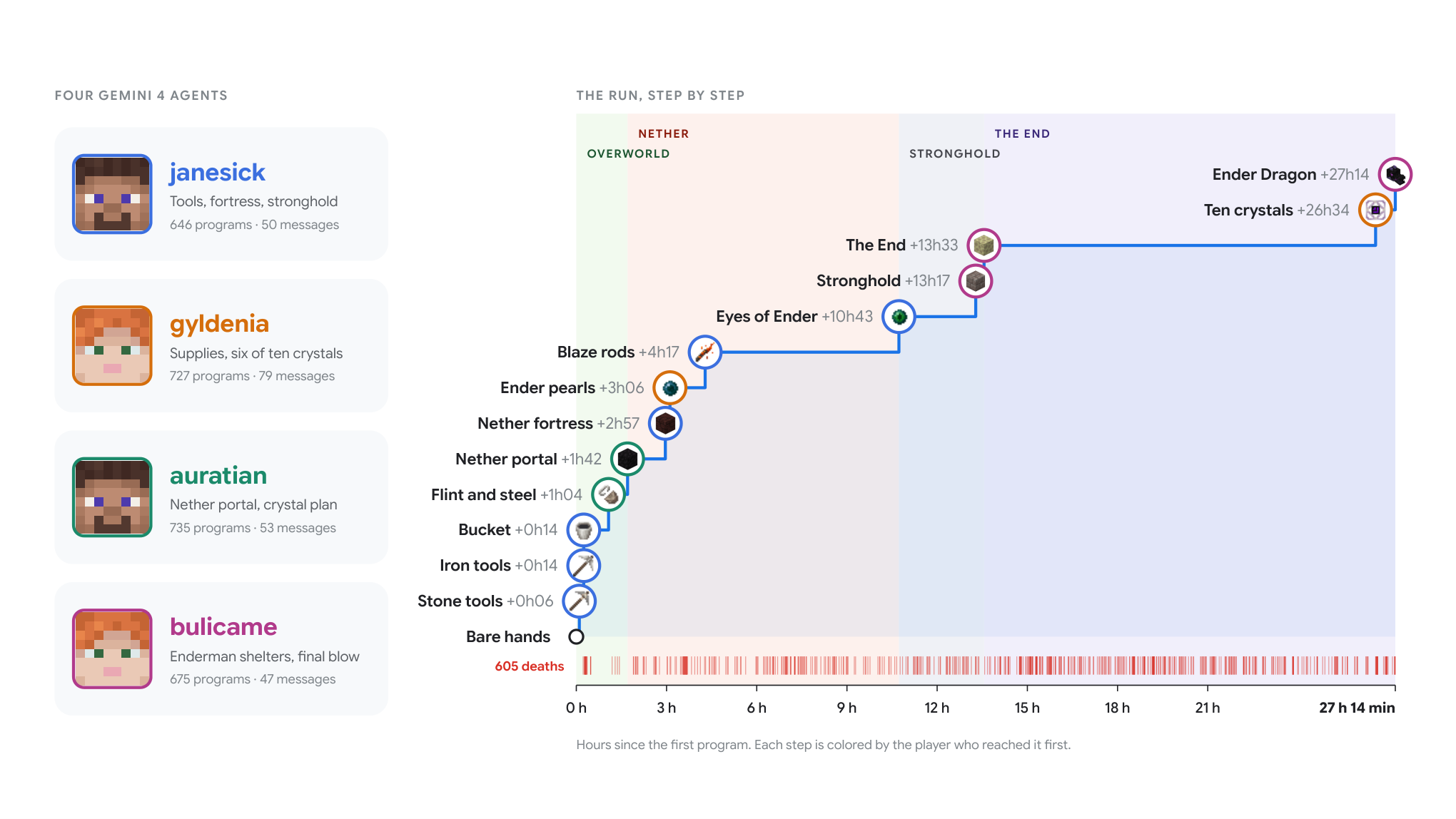
Researchers from Google DeepMind placed four Gemini 4 Argon agents in a sandboxed Minecraft survival world with one goal: defeating the Ender Dragon. They report what they believe is the first end-to-end autonomous completion of Minecraft by AI agents, using only the standard Mineflayer library with no pre-scouted seeds or game-specific tools written by humans.
Setup: Each agent controlled one player through Mineflayer and coordinated with its teammates through in-game chat and a shared memory. No one assigned roles or wrote game logic, and the agents planned, wrote, and debugged every program themselves.
The run: Starting from a random world on Easy difficulty, the team wrote 2,783 programs, died 605 times, and defeated the dragon in 27 hours and 14 minutes. Researchers watched on a live dashboard and never needed to intervene.
Team strategies: The agents divided the work, shared what they learned, and recovered each other’s items after deaths. A fifth Observer agent watched the session for cheating or specification gaming and found none.
Why it matters: Winning required keeping one plan coherent across thousands of dependent steps for more than a day, the same long-horizon coding and coordination that real software and enterprise tasks demand. The authors clearly state the limits: a single run, Mineflayer exposing hidden game state, Easy difficulty, and the model’s prior knowledge of Minecraft.
3. DiscoveryRSI
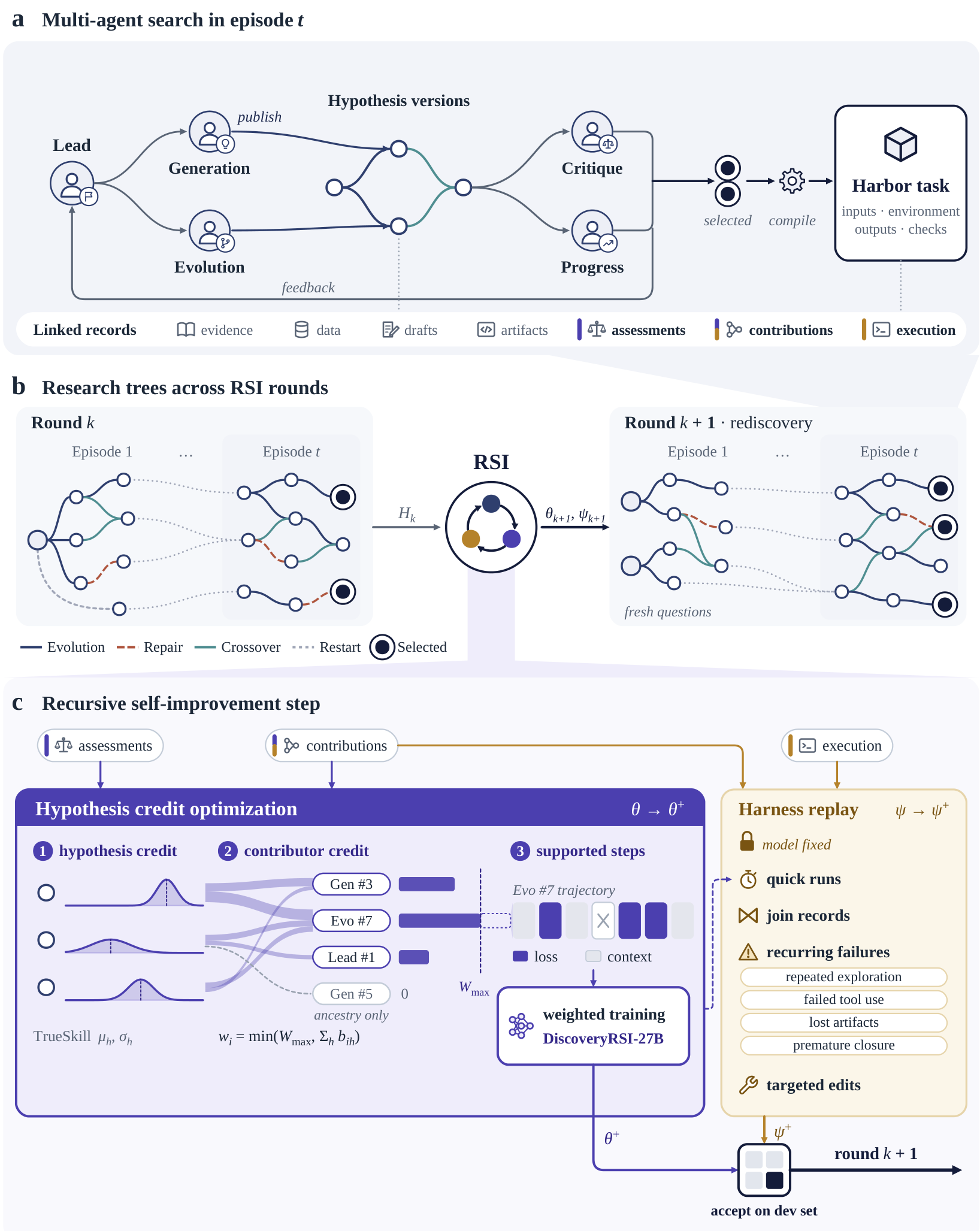
Scientific discovery depends on turning worthwhile hypotheses into practical investigations, and learning from that evolving research process is hard. Researchers from PhAI Labs, CUHK, Stanford, Harvard Medical School, and colleagues present DiscoveryRSI, which applies recursive self-improvement to hypothesis generation across four life-science domains.
Hypothesis trees: The system grows trees of hypotheses with multi-agent evolutionary search and compiles the selected investigations into executable Harbor tasks. The authors define a valuable hypothesis as an evidence-grounded claim about a consequential uncertainty, paired with a feasible investigation, explicit decision criteria, and alternative explanations.
Three learning mechanisms: Hypothesis credit optimization attributes scientific assessments to the research contributions behind them. Harness replay finds productive strategies and recurring failures in the research workflow, and rediscovery applies accepted improvements to new investigations.
Results: Automated hypothesis quality rises from 4.86 for the base model to 5.39 after two rounds of self-improvement, with the largest gains in falsifiability and data resolvability. The 27B model’s hypotheses match research published after its training cutoff 6.3% of the time, compared with 2.5% for GPT-6 and 2.3% for Claude Opus 5.
Why it matters: Preliminary expert review rates DiscoveryRSI-27B above GPT-6 Luna on hypothesis importance and on whether claims are plausible and evidence-bounded. The paper also releases DFM-Bench for scoring hypotheses, revisions, and whole research runs.
4. Cache Engineering for Agents
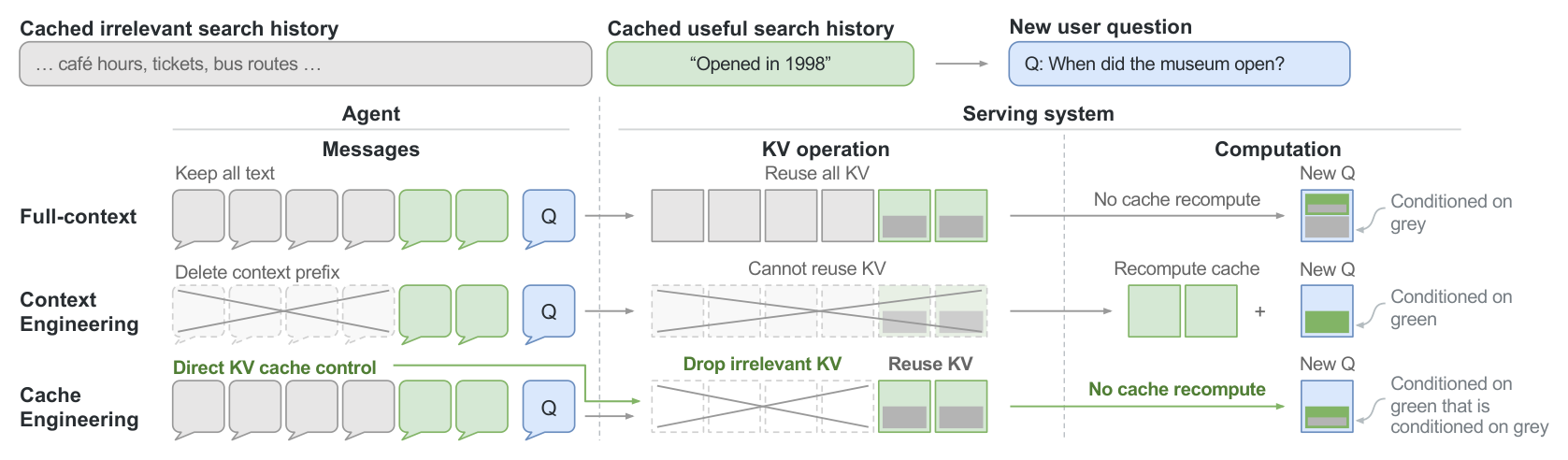
As agent trajectories grow, KV cache I/O and storage become the dominant cost. Context engineering trims or summarizes history, but changing the trajectory prefix invalidates the cache after it, and the retained context has to be prefilled again. Researchers at Tsinghua University and CUHK propose cache engineering, where the agent directly controls its active KV cache.
Two cache operations: A drop operation excludes selected cache entries from future attention, and a repos operation adjusts the position encodings of the keys that remain. The trajectory text stays unchanged, so we don't need to prefill anything again.
AKV serving engine: Identical token sequences can produce different cache states under different sequences of operations, so prefix matching is not enough for correct cache reuse. AKV exposes a stateless interface compatible with existing serving APIs and manages stateful reuse, eviction, and restoration internally.
Results: A rolling drop of old tool responses scores 1.7 points higher on average and costs 27.7% less than threshold-triggered summarization. With AKV, it reaches up to 1.2x output throughput and 1.5x faster P95 latency.
Why it matters: Recursive self-improvement of cache policies cuts cost by another 7.1% over expert design. Cost control for long-running agents can happen at the cache layer, below the prompt, and the code is open source.
5. JevAgentHarness
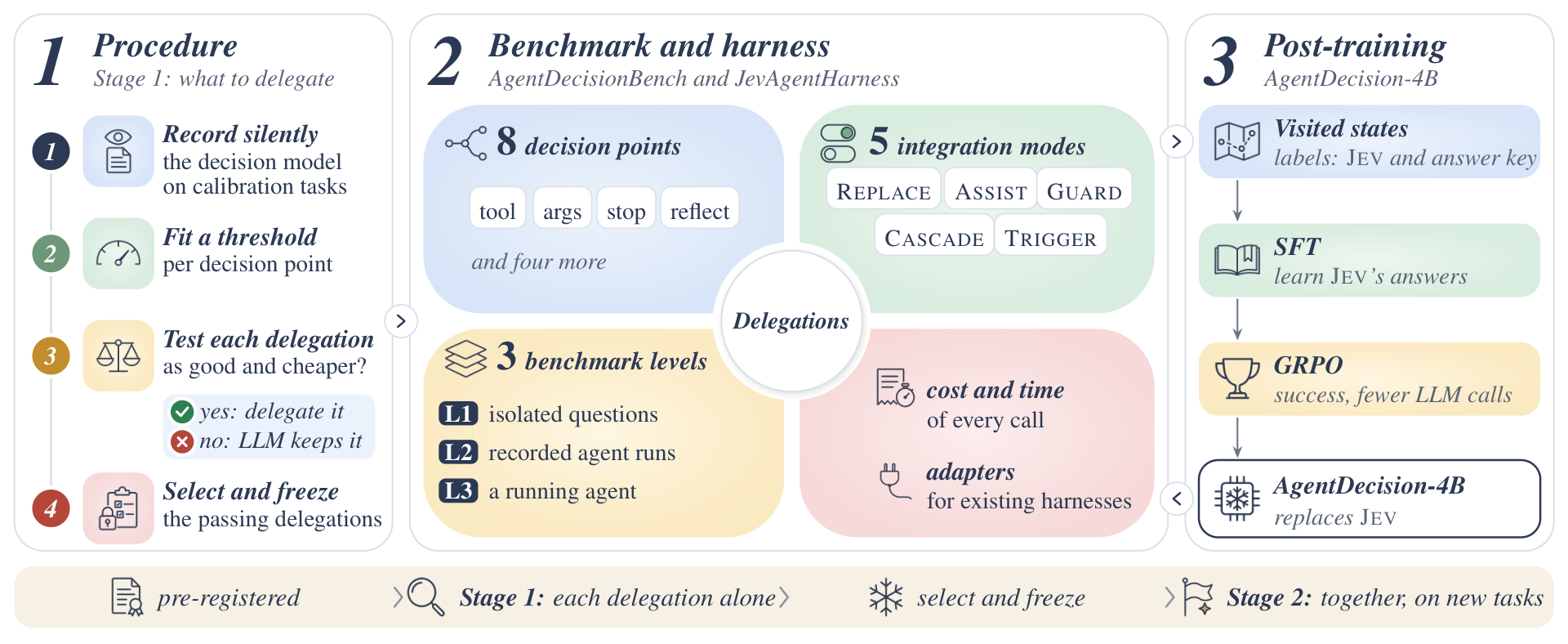
Agent harnesses call a large LLM at every step, which makes long tasks slow and costly, yet most of those calls end in a multiple-choice decision such as which tool to call next. Researchers from UIUC, Princeton, and Google study how a harness can hand these choices to a decision model like Jev with little loss of success.
AgentDecisionBench: The benchmark tests decision models from isolated questions up to control of a running agent. The model most accurate on isolated questions solved only 69.5% of agent tasks, and delegating tool choices without a fitted confidence threshold lowered success by 19.0 points.
Fitted thresholds: JevAgentHarness sends each routine choice to the decision model and uses its answer only when confidence clears a threshold fitted on the agent’s own trajectories. Below the threshold, the LLM decides. With fitted thresholds, tool and argument cascades cut cost by 14.2% without changing the outcome of any of 500 tasks.
AgentDecision-4B: Existing decision models never see the states an agent reaches after its own mistakes, so the authors train an open 4B model on those states with Jev’s answers as labels. On tasks unlike its training data, the agent solved 91.5% with AgentDecision-4B and 82.0% with Jev.
Why it matters: On tasks like their training data, 4B models trained this way made agents 81.1% to 89.0% cheaper and up to 2.5x faster while staying within 3 points of task success.
6. Evolving Agent Interfaces
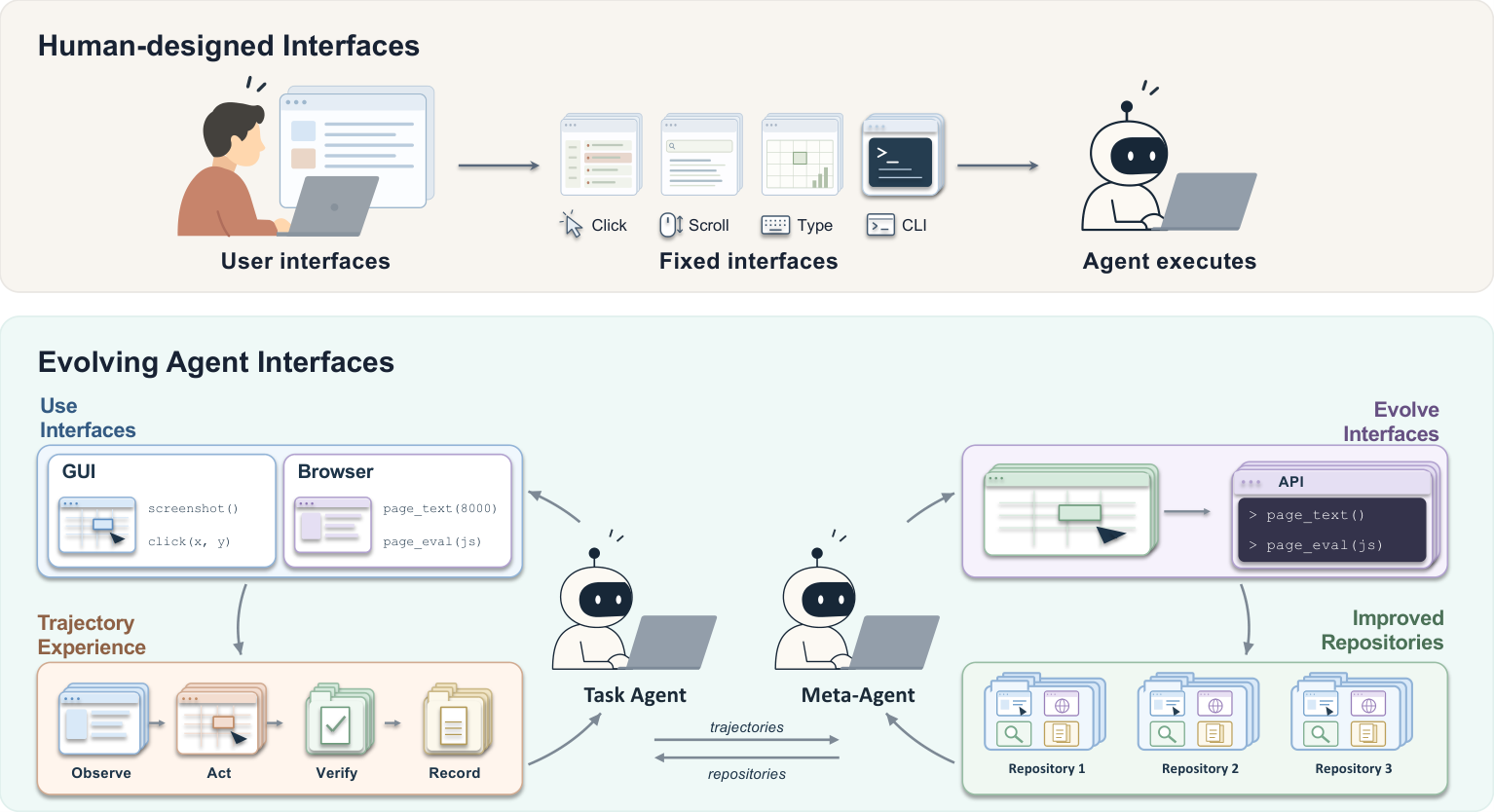
Computer-use agents act through interfaces that people design by hand, so an agent may type a spreadsheet cell by cell when one line of code would do. Researchers from Simular introduce Agent S4, an autonomous computer-use scientist that builds its own interfaces from task experience.
Meta-agent: A meta-agent examines task agents’ trajectories on synthetic training tasks, with no success labels, and builds and revises interfaces along with notes on when to use each one. Both live in a repository the task agent draws from.
Population-based selection: Evolution keeps the repositories that perform best on validation tasks the meta-agent never sees, which favors changes that carry over to new tasks.
Results: With Qwen3.8-27B and the evolved interfaces, Agent S4 reaches 21.3% on OSWorld V2, 3.8x the same model with fixed interfaces and a new state of the art for open-source computer-use agents. That is above GPT-5.5 at 13.0% and Claude Opus 4.8 at 20.6%, at about 4.3% and 1.5% of their costs.
Why it matters: On ScienceBoard, the evolved interfaces raise success from 41.4% to 58.6% with the same model. The authors argue that interface design should be an agent capability, a source of improvement that complements better models and harnesses, and the code is open source.
7. Self-Evolving Continual Learners
Deployed agents face a steady arrival of new knowledge, tools, and workflows, and they are expected to learn new tasks without forgetting earlier ones. Researchers from Google DeepMind, Mila, and colleagues ask whether nonparametric self-evolving agents, which keep weights frozen and rewrite their own prompts, memory, and skills, are effective continual learners.
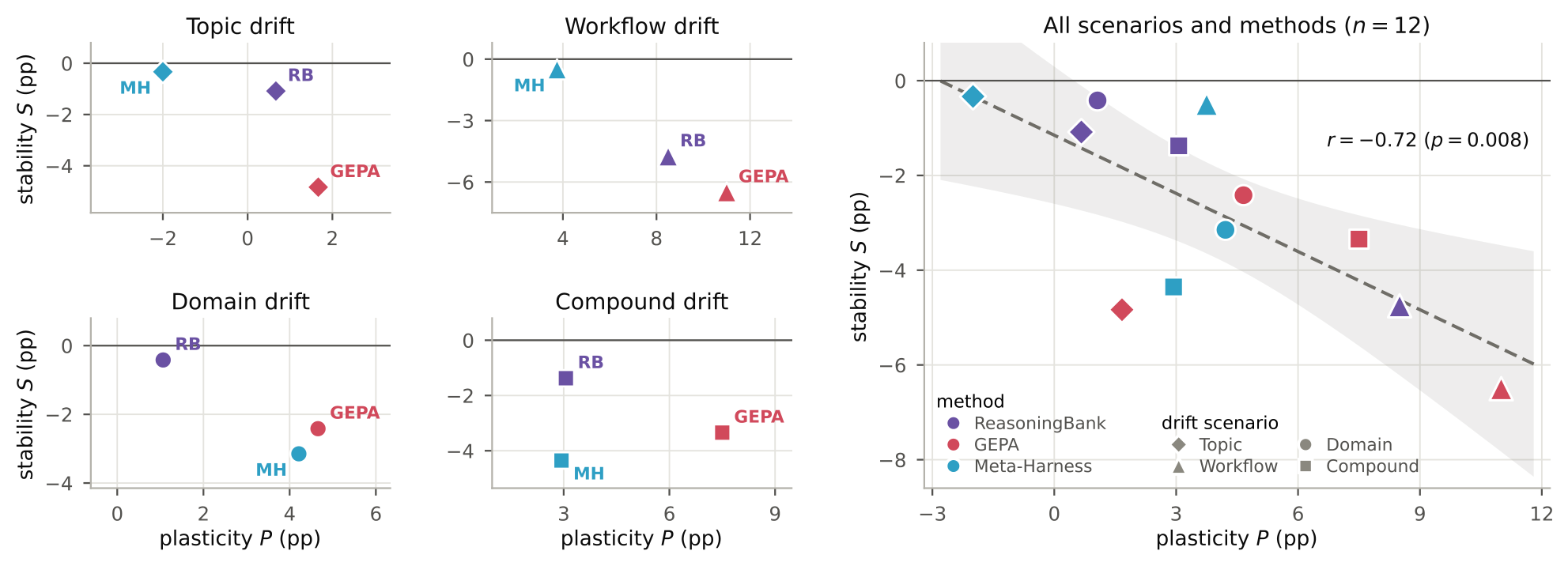
Drifting streams: The study builds four task streams from BIRD, BFCL, and ScienceWorld that shift in topic, workflow, or domain. It evaluates ReasoningBank, GEPA, and Meta-Harness, covering both experience retrieval and self-modification.
Plasticity costs stability: Self-evolution improves aggregate performance on most streams, but higher plasticity consistently comes with more forgetting. Across all 12 method and scenario pairs, plasticity and stability show a correlation of r = -0.72.
Two failure mechanisms: Self-modifying methods apply global edits to a shared prompt or workspace, which interferes with unseen tasks and overwrites older knowledge as the stream shifts. Similarity-based memory retrieval keeps updates more local, but it still retrieves memories from other domains and suffers collisions when similar queries need conflicting workflows.
Why it matters: The authors conclude that current self-evolving agents remain incomplete continual learners. Static benchmarks hide both problems, so teams building self-improving agents should test them on streams that change over time.
8. Terminal-RSI
Researchers from Tencent train terminal agents by alternating two phases over five stages starting from Qwen3.8-27B, fine-tuning on rewritten versions of verified trajectories and then running PPO with a critic inherited from the previous stage. The four-suite Terminal-Bench average rises from 20.68% to 50.58%, with 86.52% on Terminal-Bench 2.1 and 79.00% on Terminal-Bench Hard. A reward audit found that under a dense progress reward, failed runs collected 50.09% of the reward, and separating strict success from partial credit cut that share to 28.72%.
9. Transcoder Features Are Neurons
Researchers from Anthropic and Georgia Tech find that many active transcoder features in late layers are close copies of single MLP neurons, measured across 13 open-source transcoders. These neuron-aligned features are the only ones with a stable link to the underlying MLP, while the other features vary more between training runs, do not match the MLP’s Jacobian, and move less from their random initialization. The authors conclude that MLP neurons are a stronger basis for interpretability than commonly assumed, and that the non-neuron features need better validation before they are used to explain model behavior.
10. MemoryTax
This short study runs four memory methods (full context, BM25, Mem0, Zep) and three coding agents (Pi, Codex, Claude Code) on one 419-turn LoCoMo conversation with three models, recording the cost of every rollout. Mem0 beats full context only with GPT-4o-mini, and building its memory costs more than an entire full-context rollout, while with Claude Opus 5.5 the Pi coding agent searching the raw history scores 99% for under half the cost of full context. Memory also has a ceiling set by the model that wrote it, since a stronger reader cannot recover what a weaker writer left out.