
1. Harness Handbook
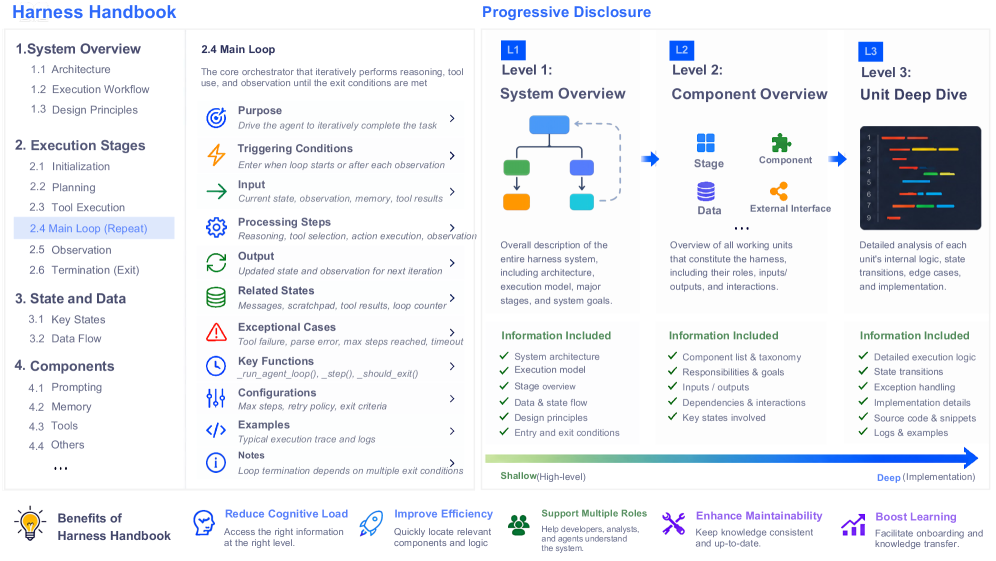
Teams now let agents evolve their own harnesses, but the harness itself becomes a sprawling codebase where finding every file behind one behavior is often harder than writing the edit. Harness Handbook attacks this by turning a harness into a behavior-centric map that stays linked to source.
Synthesized automatically: The Handbook is built from the harness codebase through static analysis and LLM-assisted structuring, so the representation is generated rather than hand-maintained and can be regenerated as the harness changes.
A three-level map: It progresses from an L1 system overview of architecture, execution model, and data flow, to L2 component overviews with responsibilities, inputs, outputs, and state, down to L3 source-backed unit details, with a navigation pane for cross-stage tracing.
Behavior-Guided Progressive Disclosure: BGPD walks an agent from a high-level behavior to the relevant implementation, then verifies candidate locations against the current source, so edits land on the right files instead of plausible-looking wrong ones.
Why it matters: As self-improving harnesses grow, the bottleneck shifts from writing changes to locating them, and a readable, navigable, editable representation gives builders and agents a shared map for safely evolving production systems.
Message from the Editor
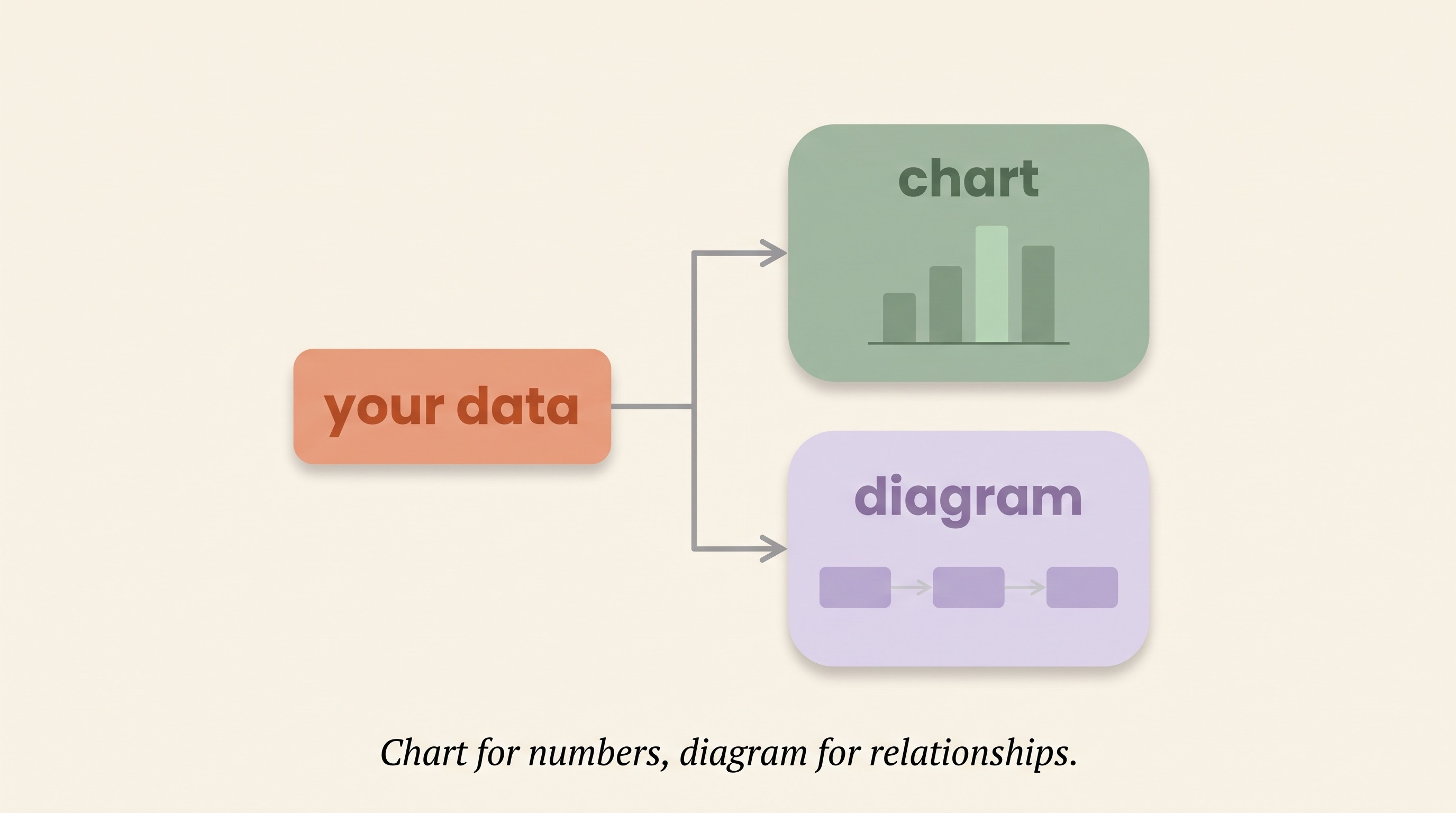
We just released Build HTML Artifacts with Agents, a beginner-friendly, hands-on lab where you work alongside an AI agent to turn plain-English requests into polished HTML artifacts. Across 12 short labs, you build profile cards, data tables, charts, dashboards, and comparison grids in a live workspace, learning the request, inspect, and refine loop with no coding experience required.
2. From Memory to Skills
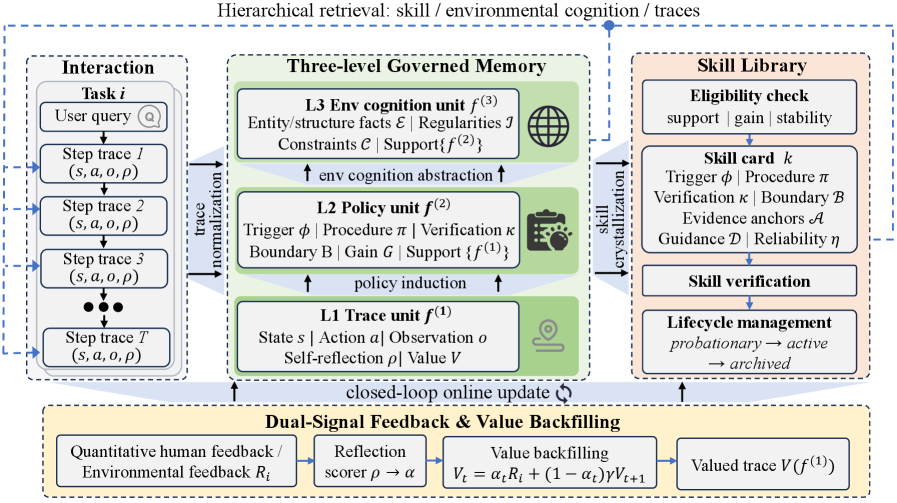
Most agent memory systems retrieve past traces as passive context, so hard-won experience never becomes something the agent can directly execute. MSCE, a training-free memory-skill co-evolution framework, instead governs how experience turns into callable skills for long-horizon LLM agents.
Three-level governed memory: Experience is organized into L1 grounded step traces, L2 reusable procedural policies, and L3 declarative environmental cognition, giving the agent a structured store rather than a flat log of prior runs.
Skills with evidence: L2 policies with positive estimated gain are crystallized into callable skill cards that retain evidence links, applicability boundaries, decision guidance, verification rules, and reliability estimates, so a skill carries the context needed to trust it.
Reflection-weighted value backfilling: Sparse terminal feedback is propagated through dense local self-reflections to produce evidence-calibrated trace values, which then govern how memory and skills evolve and get retired.
Why it matters: On EvoAgentBench and LoCoMo, MSCE outperforms state-of-the-art skill-augmented and memory-driven baselines with strong cross-domain transfer, pointing toward agents that compound their own experience instead of rediscovering it each session.
3. PRO-LONG
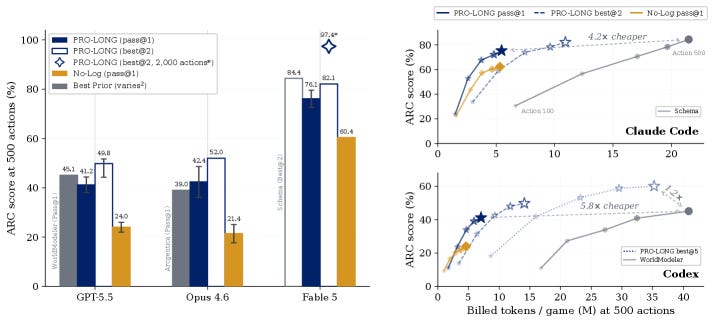
Long-horizon tasks force a harness to decide what to save from a long stream of observations and how to load it back into context, and richer summaries usually make the exact detail you need harder to retrieve. PRO-LONG sidesteps this tradeoff with programmatic memory.
Keep everything, search it: Rather than compressing history into bespoke memory, PRO-LONG keeps a complete, structured interaction log and leans on coding-agent tooling to search that history on demand, so no observation is discarded up front.
A minimal framework: The design is deliberately lightweight, avoiding hand-built memory harnesses and instead treating the full log as a searchable artifact the agent queries when it needs a specific past detail.
Strong, cheaper results: On the full ARC-AGI-3 public game set, it improves over a base coding agent by an average of 18.0 points across frontier models, and matches or exceeds specialized state-of-the-art harnesses at up to 76.1% pass@1 while using 4.2 to 5.8 times fewer tokens.
Why it matters: It shows that for exploratory, long-horizon settings, a simple searchable log can beat elaborate memory engineering on both accuracy and cost, which is a practical recipe teams can adopt now.
4. Global Workspace in LLMs
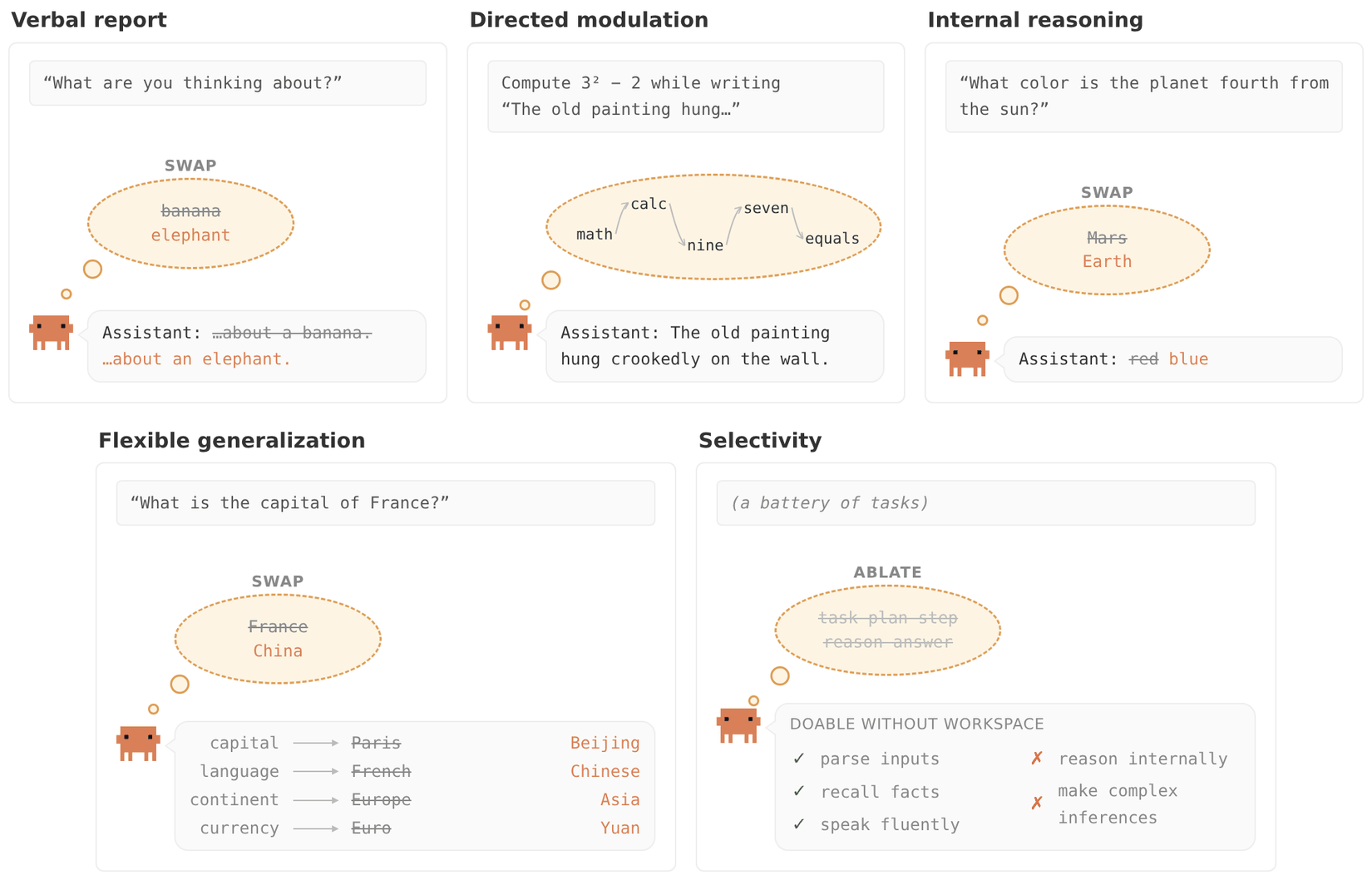
This Anthropic interpretability work gives a mechanistic account of when a model’s verbalized reasoning actually drives its behavior. It identifies a small, privileged set of internal representations that behaves like the global workspace some neuroscientists tie to conscious access.
A new lens: The Jacobian lens, or J-lens, surfaces the directions in the residual stream that a model is poised to verbalize at any point, and the collection of these directions is named the J-space.
Workspace-like roles: J-space contents can be reported, deliberately summoned and held, used to carry the intermediate steps of silent reasoning, and passed as arguments to downstream computation, matching the functional signature of a global workspace.
Small but decisive: The J-space accounts for no more than roughly 10% of activation variance and appears mainly in the middle of the network, yet suppressing it leaves the model able to parse input and speak fluently while it loses the ability to perform complex internal reasoning.
Why it matters: For anyone building on chain-of-thought or steering vectors, this clarifies which internal representations actually drive reasoning, and the authors deliberately limit the claim to access rather than subjective experience.
5. GAMUT
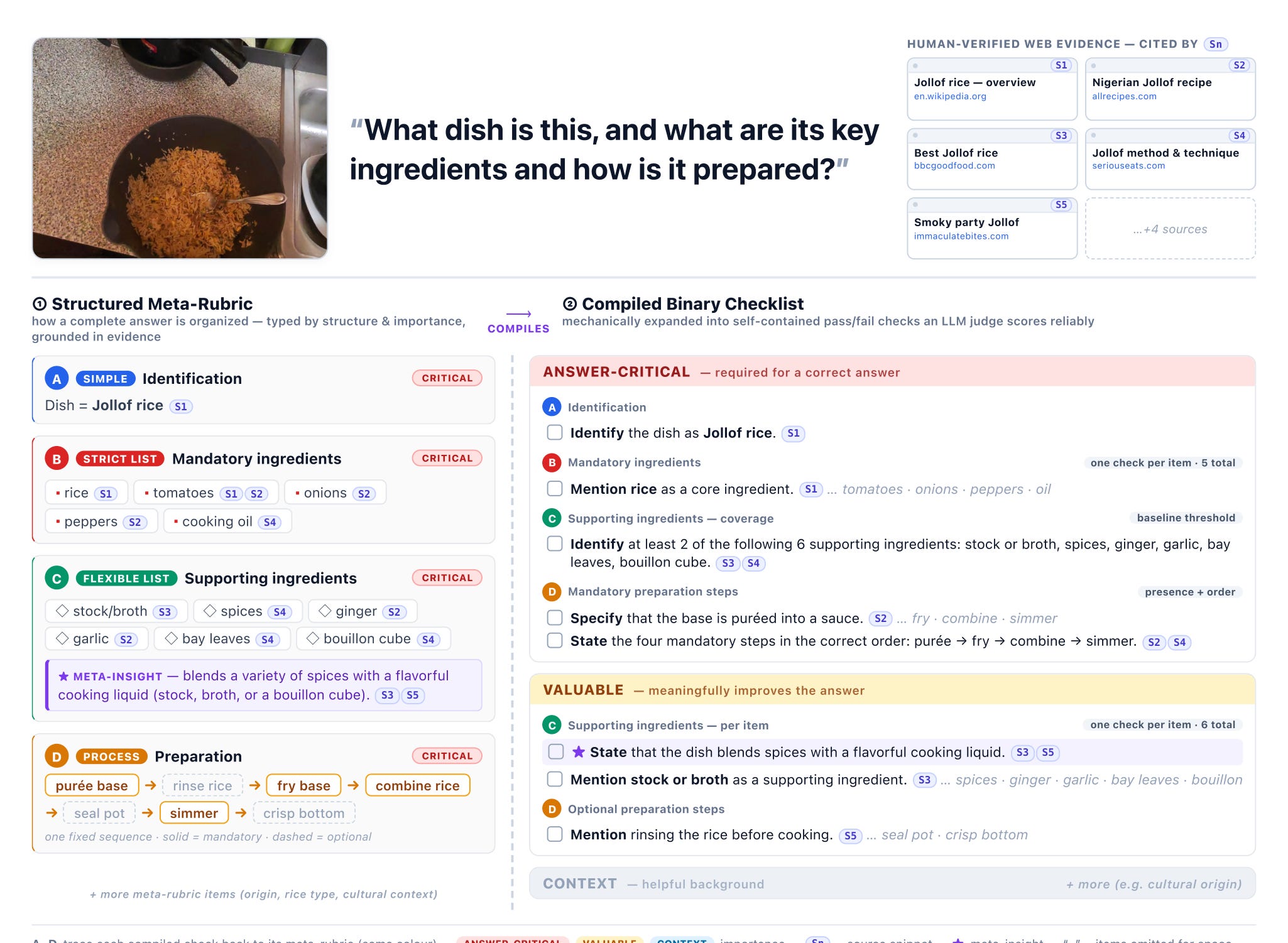
Most factuality evaluation measures precision, whether the claims in an answer are correct. This Meta AI work targets the harder and mostly ignored half, completeness, meaning whether an answer covers everything it should, and packages it as the GAMUT benchmark.
Completeness is structured: The facts a complete answer should contain rarely form a flat list, since they involve open-ended sets where coverage matters, ordered processes, and relationships among facts that independent boolean checks cannot capture.
Two-level meta-rubrics: A structured meta-rubric encodes the organization and importance of required content, then compiles mechanically into a flat checklist of binary, machine-gradable items that an LLM judge can score reliably, keeping rich structure while inheriting low-variance grading.
Grounded and verified: The benchmark holds 1,813 questions grounded in real wearable imagery across 10 diverse domains, each paired with an evidence-backed rubric verified by expert annotators, and a text-only variant is released for models without vision.
Why it matters: Across 14 frontier and open-weight models the benchmark stays genuinely hard, with a best score of 58.7% from Gemini 3.1 Pro, while remaining highly discriminative and robust to the choice of judge.
6. Progressive Disclosure
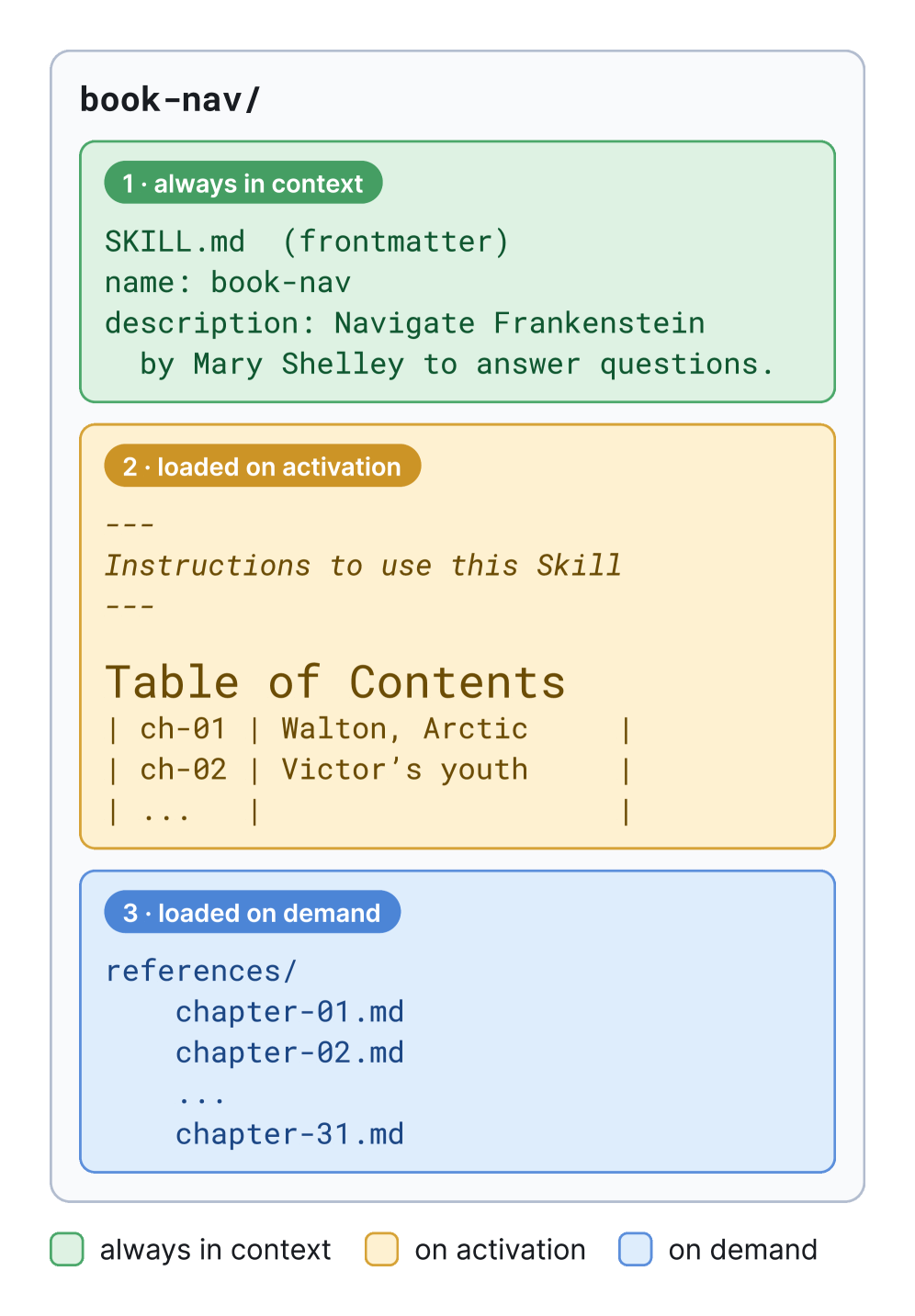
Agent Skills package expertise into folders an agent loads on demand, and progressive disclosure exposes only what a query needs, from a short description down to specific passages. Practitioners adopted this pattern fast for book-length tasks, but the supporting evidence stayed anecdotal until now.
A controlled study: The authors run the first controlled comparison of progressive disclosure, pitting raw-document navigation and several Agent Skills pack designs against a classical hybrid retriever across three agent harnesses and three model families on InfiniteBench.
The gain is harness-dependent: On a single book, progressive disclosure helps a lot when the agent navigates the raw document poorly, and the benefit falls to near zero when a strong harness already divides and retrieves the text on its own.
Complexity has a cost: Because the pattern’s value hinges on the surrounding harness as much as the skill format, treating progressive disclosure as an automatic upgrade can add machinery without buying accuracy.
Why it matters: As Agent Skills spread, this replaces intuition with measurement, telling builders when packaging documents for progressive disclosure is worth it and when the harness already does the job.
7. Structured Output Collapses Diversity
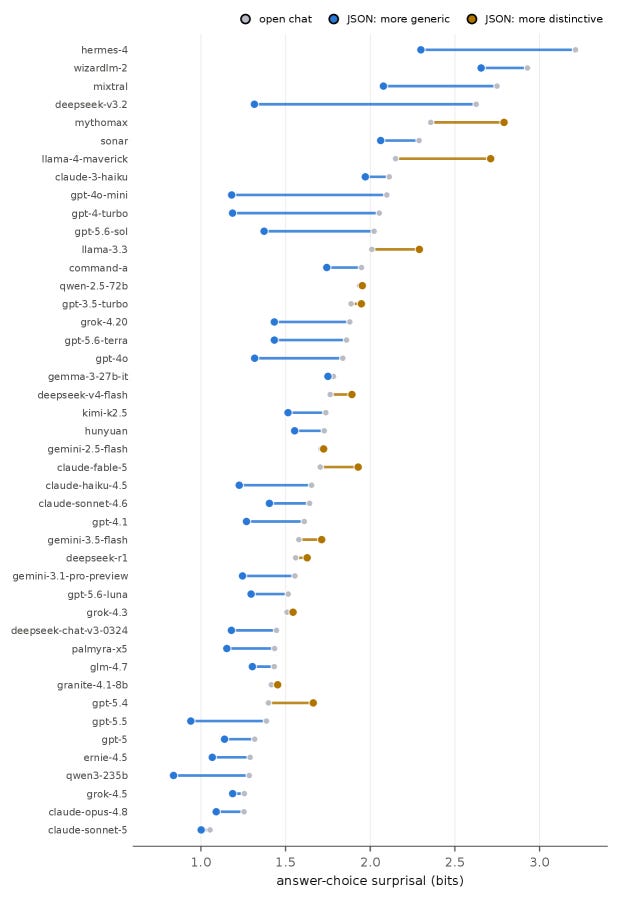
Teams benchmark models in chat, then ship them behind JSON schemas for tools, extraction, and routing. This study of 44 language models shows that the structured surface you deploy is measurably more homogeneous than the chat surface you evaluated on.
JSON moves the defaults: Asking for JSON shifts 53% of a model’s stable chat defaults, mostly back toward the crowd, and installs new defaults absent from chat, so the same model answers differently once wrapped in a schema.
Specific to trained formats: Diversity compression is significant for JSON and XML, absent for YAML and CSV, and reversed for an arbitrary bracket wrapper, which points to tool-use post-training rather than serialization itself as the cause.
Where the collapse lives: Enforcing the schema at the decoder compresses no further than simply requesting it, so the effect comes from the model’s response to the structured register rather than constrained decoding.
Why it matters: Diversity you measured in chat can vanish in production, quietly hurting sampling, synthetic data, and any workflow that depends on varied outputs, so structured surfaces deserve their own evaluation.
8. Bad Memory in Agents
Persistent memory is what makes an agent useful across sessions, and it is also a place an attacker can leave something behind. This work evaluates prompt injection from memory files in Claude Code and OpenAI Codex, across Claude Haiku 4.5, Claude Opus 4.7, GPT-5.2, and GPT-5.5. The results are uneven but sobering. Getting an agent to overwrite its own memory using untrusted external content is difficult, yet payloads already planted in those files reliably attack current and future sessions, with attack success and persistence varying widely across systems, models, adversarial goals, and multi-session sequences.
9. Copying and 2D-RoPE
Frontier models can write proofs yet stumble on faithfully copying a long block of text that sits well within their context window. This paper traces the failure to 1D positional encodings, whose inductive bias favors a copying shortcut based on matching local context rather than carefully locating the corresponding input positions. The fix is 2D-RoPE, which lays text out on a 2D grid and gives each token a row and a column ID, so copying becomes retrieving tokens at a fixed column offset. Shallow Transformers with 2D-RoPE copy perfectly at input lengths hundreds of times longer than those seen in training.
10. RoboTTT
Recent robot foundation models run on single-step or short-history context, a strange way to attempt a five-minute assembly task. RoboTTT, from NVIDIA with Stanford and UT Austin, integrates test-time training into vision-language-action policies to scale visuomotor context to 8K timesteps, three orders of magnitude past prior policies, without growing inference latency. The longer context unlocks one-shot in-context imitation from human video, on-the-fly policy improvement, and robustness to perturbations. It improves overall performance by 87% over a single-step baseline, fully completes a ten-stage assembly task that no baseline finishes, and gains 62% from pretraining with 8K rather than 1K timesteps.
This is amazing brother!