
1. Verification as a Scaling Axis
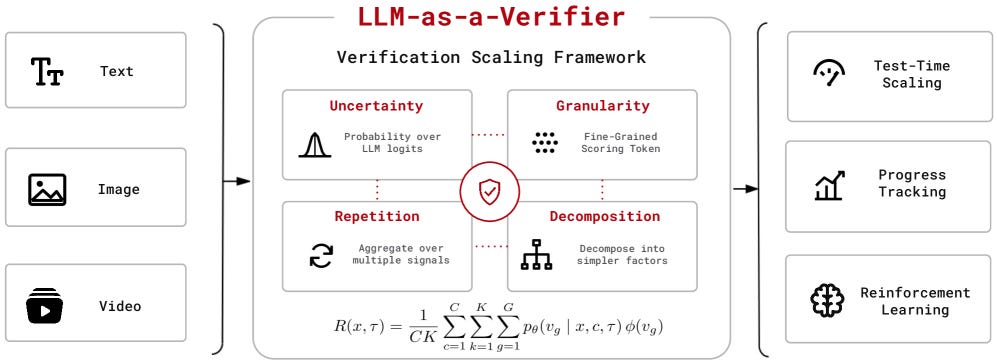
Verification is emerging as a distinct scaling axis alongside pre-training and test-time compute, and this Stanford, NVIDIA, and UC Berkeley collaboration builds a training-free verifier that reads a continuous, calibrated score straight off the scoring-token logits instead of trusting a discrete pass or fail grade.
Scores from logits, not grades: Rather than asking a judge model for a discrete verdict, the method reads a continuous calibrated score off the scoring-token logits, giving a smoother and more informative signal with no fine-tuning.
Three tuning knobs: Accuracy improves through score granularity for cleaner separation, repeated evaluation to cut variance, and criteria decomposition to reduce complexity, all without touching model weights.
Broad, strong numbers: It reaches 86.5% on Terminal-Bench V2, 78.2% on SWE-Bench Verified, 87.4% on RoboRewardBench, and 73.3% on MedAgentBench, spanning coding, robotics, and medical agents.
Why it matters: The same continuous score doubles as a dense reward for SAC and GRPO and as a task-progress signal shipped in a Claude Code extension, so one verifier serves evaluation, training, and live agent monitoring at once.
Message From Our Sponsor
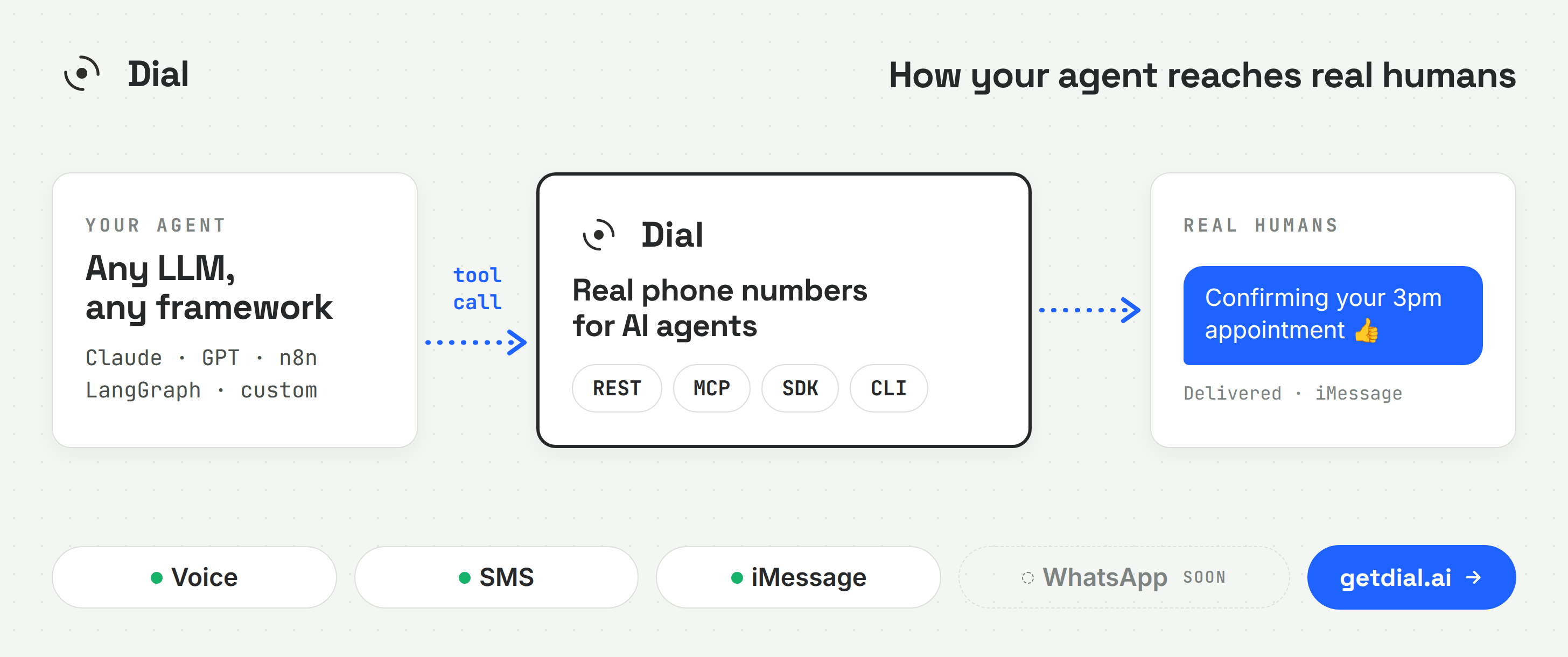
Weekend project: an agent that calls your dentist, texts your customers, or answers a real phone line. Dial gives your agent a live number in minutes - voice, SMS, iMessage, WhatsApp* - via REST, SDK, CLI, or MCP, plugging straight into Claude, Codex, Cursor, Hermes or n8n.
Backed by a16/SR - Dial is already replacing months of CPaaS work for builders shipping agents into production. No telecom knowledge required, and you can be sending your first message before your coffee’s done.
2. Always-On Agents
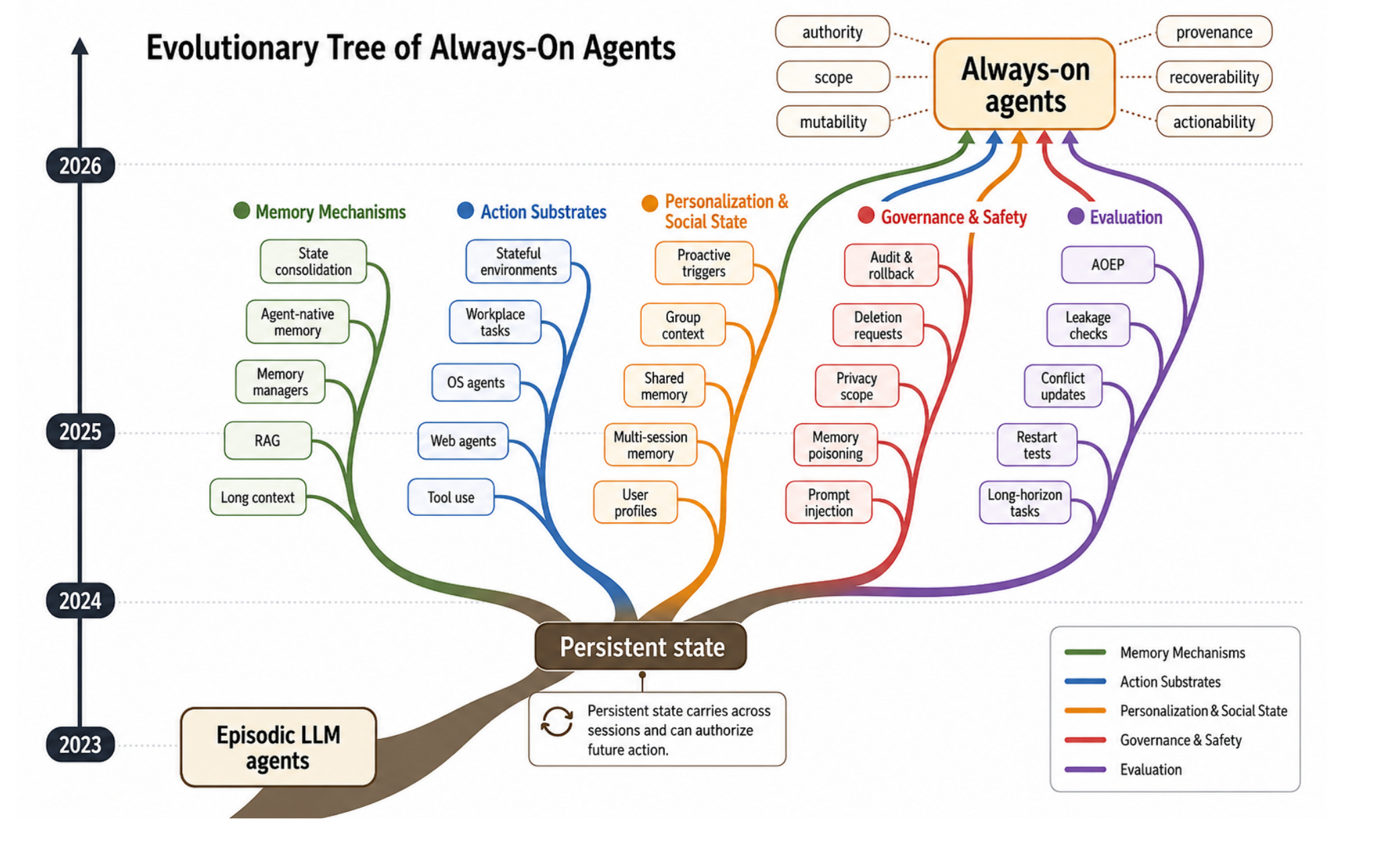
Always-on agents are systems whose future behavior depends on durable state built up across earlier interactions, and this 130-plus page survey argues that state is far more than memory. It spans task ledgers, permissions, credentials, commitments, provenance, triggers, and effects the agent has already committed to the outside world.
State as first-class, not just memory: The survey reframes agent state to include authority, obligations, and externally committed effects, the things that make a long-lived agent consequential rather than merely conversational.
Six axes per state item: Each piece of state is scored on authority, scope, mutability, provenance, recoverability, and actionability, giving builders a vocabulary for reasoning about what a stored fact can actually do.
A full state lifecycle: It traces state from write and retrieve through forget, audit, and rollback, surfacing the operational questions that production always-on systems must answer.
Why it matters: As agents move from single sessions to continuous operation, treating durable state as a governed, auditable resource is what separates a safe long-running system from one that quietly accumulates risk.
3. HOLA
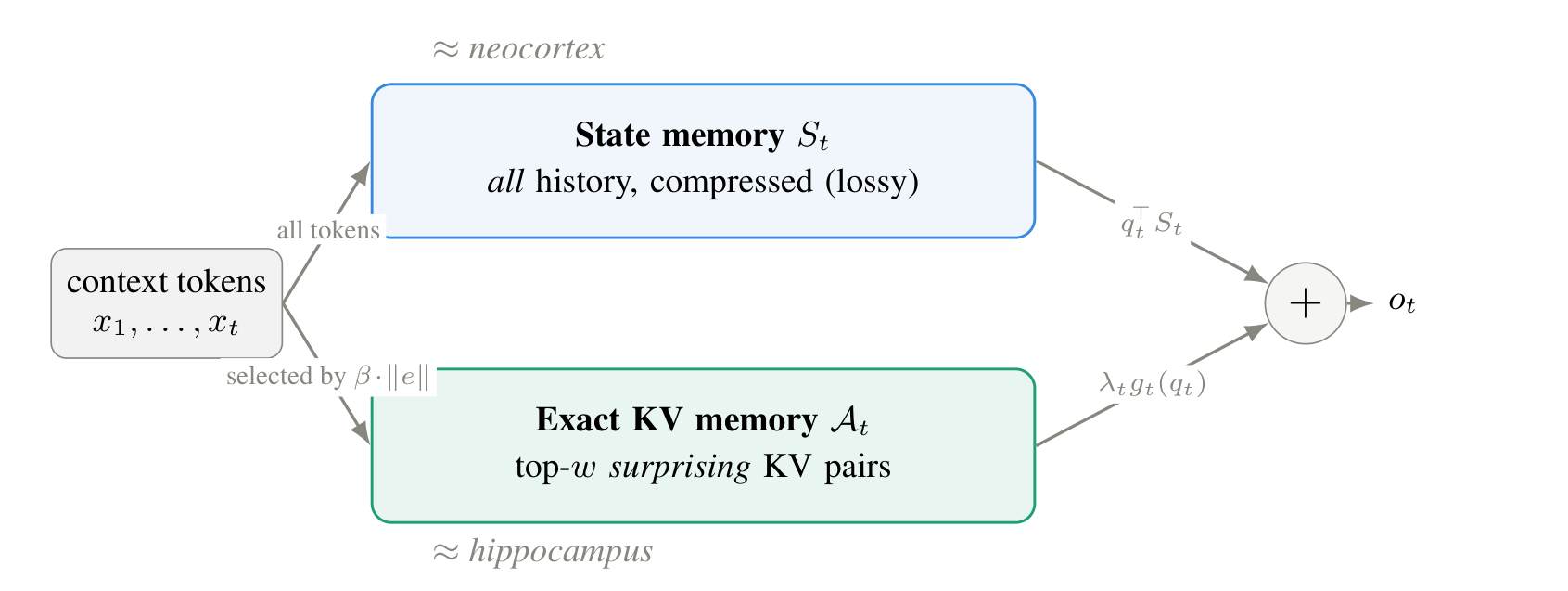
Linear-attention and state-space models compress an entire prefix into a fixed-size state, buying constant memory but overwriting earlier facts when many key-value associations compete. HOLA gives linear attention a hippocampal complement, pairing a compressive recurrent state with a small exact memory to recover long-range recall.
Two memories, different jobs: HOLA keeps the usual delta-rule state as compressive memory and adds a bounded exact KV cache, forming a semiparametric test-time memory where each store handles what it is best at.
Selective, learning-free writes: The cache writes without a learned eviction module, keeping only tokens whose prediction residual was actually committed to the state, so it stores exactly the associations that should not be forced through compression.
Strong recall at small scale: At 340M parameters on 15B SlimPajama tokens, it lowers Wikitext perplexity from 27.32 to 22.92, below a full-attention Transformer++ at 26.88, and stays robust on RULER needle recall out to 32k tokens, 16 times its training length.
Why it matters: It shows you can keep linear attention’s efficiency and still recover the exact recall that pure compression destroys, a practical path for long-context models that cannot afford full attention.
4. Puzzle-75B
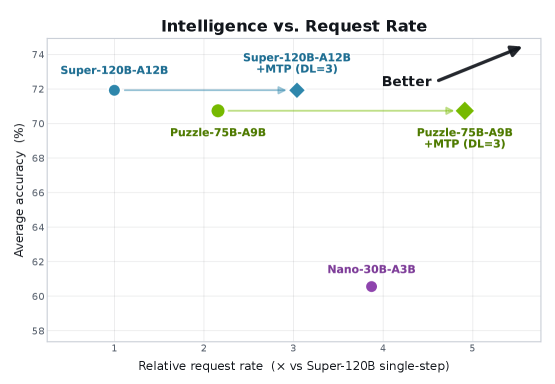
Bigger mixture-of-experts models keep winning on quality, but serving them at interactive latency is still hard. NVIDIA compresses the hybrid MoE Nemotron-3-Super into Puzzle-75B-A9B and roughly doubles interactive server throughput while holding quality.
Joint structural search: Heterogeneous MoE pruning, active-parameter budget, and Mamba pruning are optimized together rather than one at a time, wrapped in an iterative pipeline with distillation, RL, quantization, and a Multi-Token Prediction head.
Large throughput gains: On a single 8xB200 node it hits about 2x the parent’s server throughput at matched user-throughput, a direct win for anyone serving these models under latency constraints.
Concurrency at long context: At 1M-token context on a single H100, concurrency climbs from 1 request to 8, expanding what long-context workloads a single accelerator can host.
Why it matters: Accuracy holds across reasoning, coding, long-context, and agentic benchmarks, so cheaper serving with agentic capability intact changes what teams can afford to run in production.
5. The Harness Effect
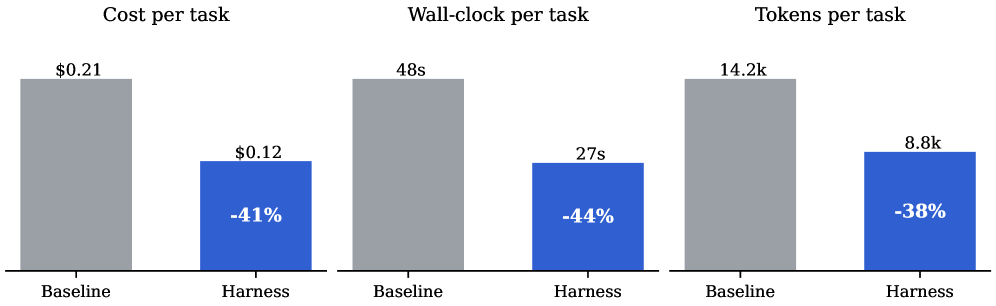
As orchestration harnesses mediate every model call, this study asks how much the harness alone moves cost and performance. It ran 22 evaluation tasks across six foundation models, then changed only the orchestration layer while holding the models constant.
Harness-only, models fixed: By varying just the orchestration layer over models like Claude Sonnet 4.6, Gemini 3.1, Qwen 3.6, and GLM 5.1, the study isolates the harness as the variable and measures its independent effect.
Big, consistent savings: Holding models constant, the harness cuts blended cost per task 41%, tokens per task 38%, and median wall-clock 44%, with completion quality at parity.
Two clean regularities: Efficiency is model-invariant, every model gets 33 to 61% cheaper, while quality gain correlates almost perfectly with baseline model strength (r=0.99), an effect the authors call harness leverage.
Why it matters: On this workload the orchestration layer moved cost per task more than the entire spread of the model menu did, making the harness the one component whose efficiency multiplies across every model a team runs.
6. ReContext
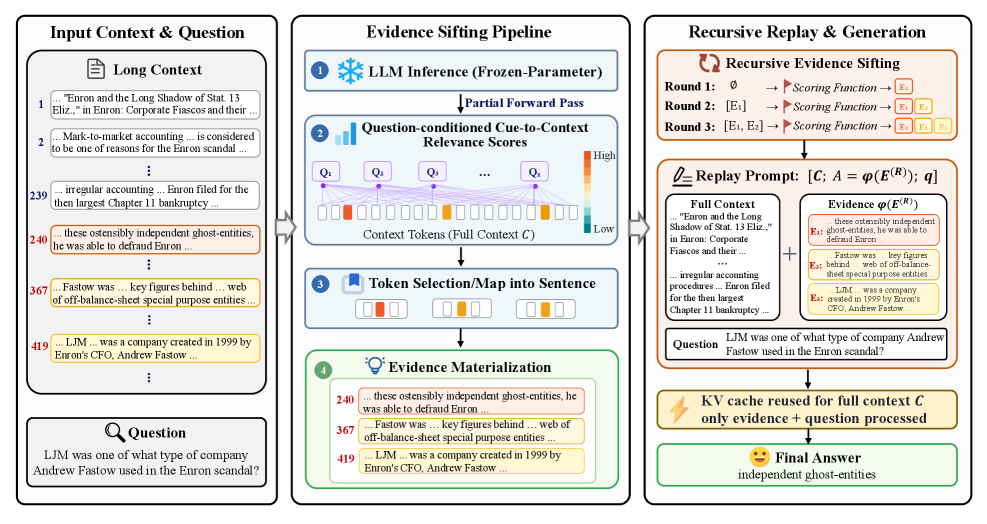
Models now support 128K context windows yet still fail to use evidence already sitting in the prompt. ReContext is a training-free inference harness for long-context reasoning that uses model-internal relevance signals to build a query-conditioned evidence pool, then replays it right before final generation while preserving the full original context.
Memory framing of context: It treats the context as a memory store, the question as a retrieval cue, attention as cue-trace association, and replay as trace reactivation, a clean cognitive analogy that drives the design.
No training, no pruning: There is no fine-tuning, no external memory, and no pruning of the original context, so the method drops into existing models without changing weights or losing information.
Consistent gains across backbones: Across eight 128K long-context datasets it improves evidence utilization on Qwen3-4B, Qwen3-8B, and Llama3-8B, taking the best average rank on all three, with public code.
Why it matters: It targets the real long-context failure, using evidence that is already present, and fixes it at inference time, a cheap and general lever for reasoning over long prompts.
7. Agent Limitations Taxonomy
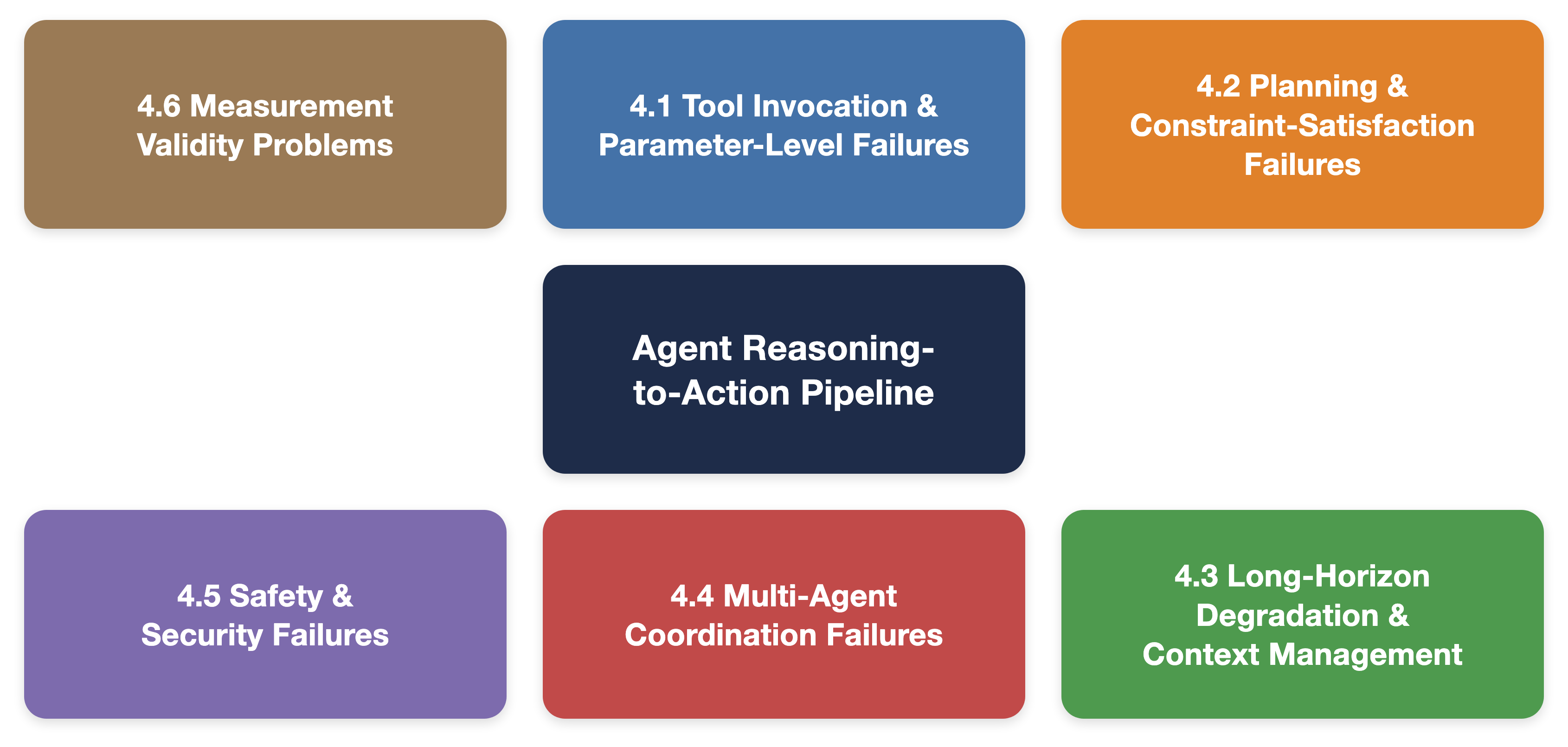
Benchmark scores keep climbing, yet the same agent failures resurface across otherwise unrelated evaluations, hidden behind the leaderboard. This University of Oxford work synthesizes 27 benchmark, taxonomy, and audit papers spanning 19 benchmarks into the first cross-cutting taxonomy of LLM-agent limitations.
Six failure clusters: The taxonomy names tool invocation and parameter errors, planning and constraint-satisfaction failures, long-horizon degradation from context accumulation, multi-agent coordination breakdowns, safety failures under adversarial or underspecified conditions, and measurement validity problems.
Failures compound nonlinearly: Reliability drops faster than task length grows, so strong sub-task scores do not add up to end-to-end success on longer tasks.
Scaffolding is not a fix: Adding scaffolding does not reliably improve reliability, undercutting the assumption that more orchestration automatically buys robustness.
Why it matters: By giving shared names to failures that leaderboards obscure, the taxonomy helps teams diagnose why agents break in production instead of trusting benchmark gains that do not transfer.
8. BlockSearch
BlockSearch runs the first systematic study of in-context retrieval at the scales real retrievers actually face, million-token corpora and length generalization far beyond training size. It introduces a 0.6B language-model retriever whose architectural and training changes improve over prior LM baselines and length-generalize up to 10 times beyond their training length, pointing toward retrievers that stay reliable as context windows keep growing.
9. RLVR Meets Human Likeness
RL with verifiable rewards only optimizes what you can objectively score, so style, structure, and diversity quietly collapse and reward hacking creeps in. This MIT work adds an adversarial discriminator trained on human demonstrations as a learned proxy for the human output distribution, and the generator maximizes both task accuracy and that human-likeness signal. Across bug fixing, story generation, and a reward-hacking benchmark, it preserves RLVR’s accuracy gains while restoring the fuzzy properties it usually destroys, with misbehavior nearly disappearing.
10. Replicating ML Papers with Agents
This work tests whether a coding agent can replicate a scientific ML paper from its materials alone, using a skill that turns each paper claim into a target with recorded evidence and gating completion on workspace evidence rather than the agent’s final message. Across twelve runs over four papers, all twelve workspaces pass the completion gate and all 158 recorded targets are matched with report coverage. Yet repeated runs still differ in how papers are split into targets and in numerical fidelity, so completion becomes reproducible even when the path is not.