
1. Judges as a Lifecycle
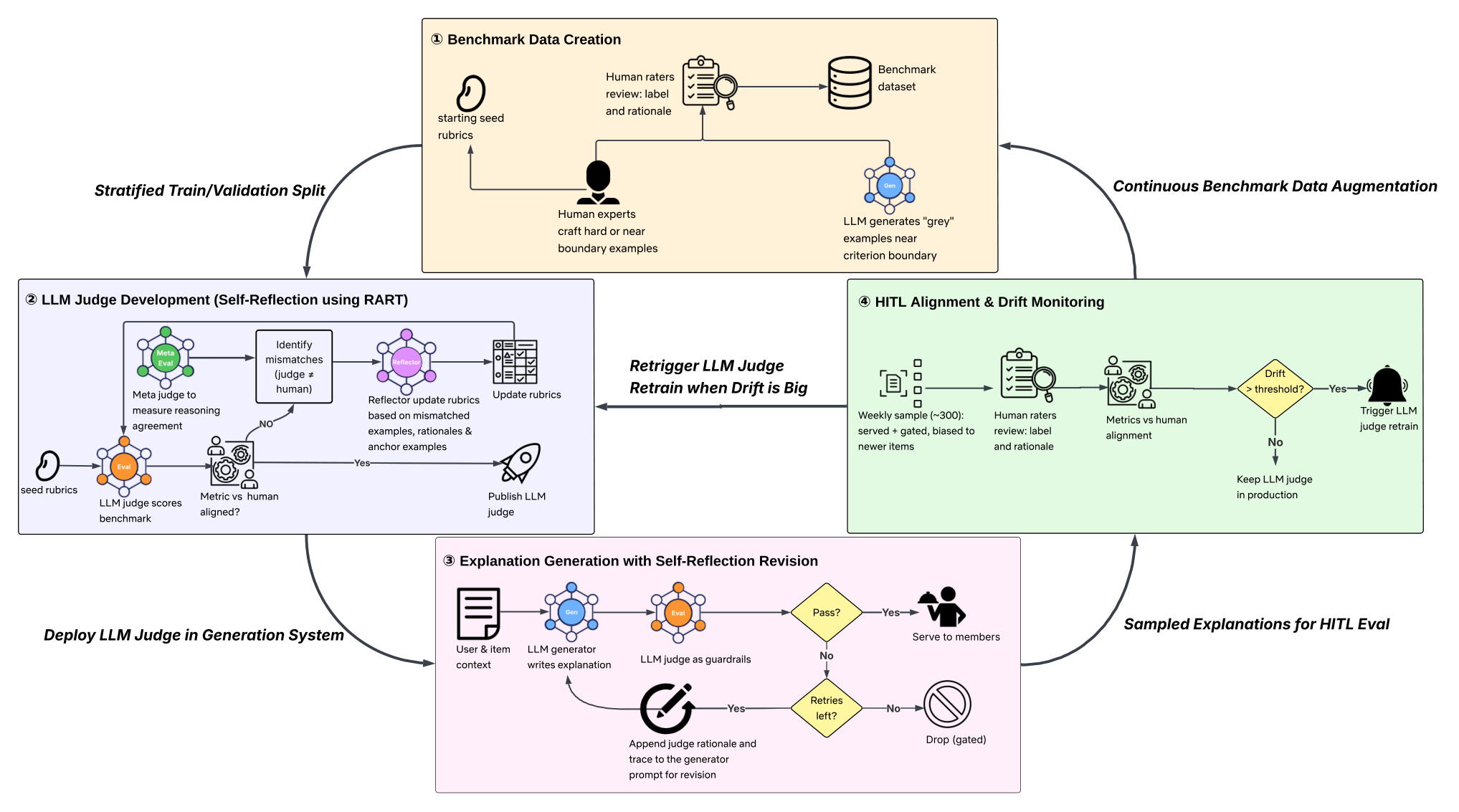
Most teams validate an LLM judge once, ship it, and never look at it again. Netflix runs judges over hundreds of thousands of show-level recommendation explanations per week, served to millions of members on mobile, and this writeup describes what it takes to keep one honest at that volume.
Four phases instead of one artifact: Birth defines multiple evaluation criteria and builds curated benchmarks with human labels and rationales. Training refines the rubric. Deployment puts the judge to work. Monitoring watches for drift and triggers re-tuning behind a review gate.
Rubric tuning carries the learning signal: Reasoning-Aligned Rubric Tuning uses a meta-judge over the judge’s reasoning output as the learning signal, so mismatches between judge and human get traced back to specific rubric language rather than patched with more prompt text.
One judge, two roles: The same judge gates quality and drives reflective generation, appending its rationale to the generator prompt so failed explanations get revised instead of dropped.
Why it matters: A five-week A/B test over tens of millions of members shifted viewing toward previously unwatched content and increased successful browse-to-play sessions against a no-explanation control, with no quality-related takedowns. This is the rare LLM-judge writeup with production consequences attached.
2. Skill Lift
Enterprise teams reviewing shared skill libraries almost always gate on a scanner that checks structure, style, and security. NVIDIA measured whether that gate predicts anything about how a skill actually performs, and the answer is close to no.
The review gate is nearly uncorrelated with quality: Across 145 real skills from internal and public catalogs, structural scan scores correlate with LLM-judge quality at a Spearman rho of 0.14. Passing the scanner tells you the skill is well formatted, nothing more.
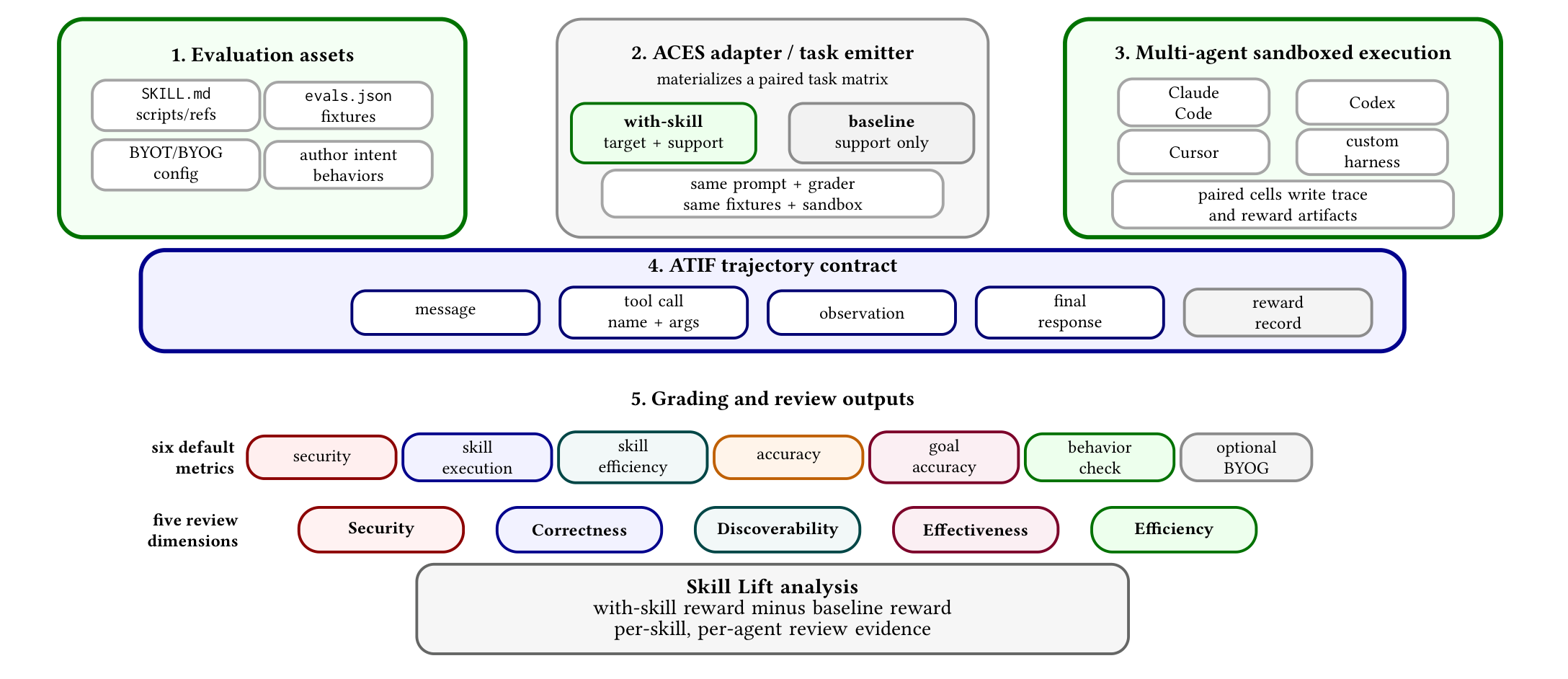
Measure the delta, not the document: ACES proposes Skill Lift. Run the same task twice under the same model, sandbox, workspace, and scorer, once with the skill loaded and once without, then measure the difference in what the agent completed.
Results compare across harnesses: 947 paired cases from 58 production skills were scored across four harnesses, with trajectories normalized into a shared Agent Trajectory Interchange Format so a skill’s lift in Claude Code can be read against its lift in Cursor.
Why it matters: The largest process-metric gains show up in skill execution, behavior check, and skill efficiency, which points at what skills are actually for. If you run a review process today, this gives you the paired-run design to replace it with something that measures outcomes.
3. Context Management as Code
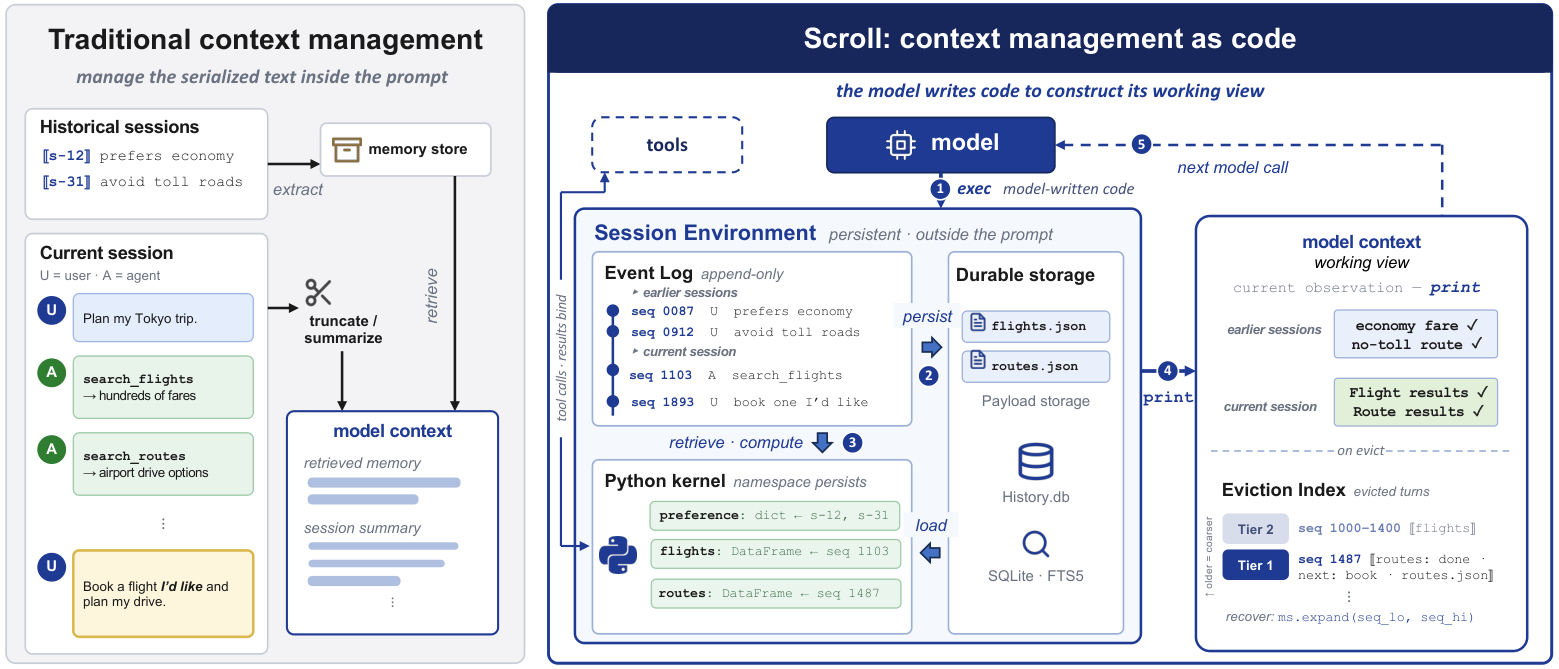
Every memory system asks you to design a schema up front, then rewrite it when the agent starts doing something you did not anticipate. Scroll, from Alibaba, removes the schema entirely and hands context construction to the model as a programming problem.
State lives outside the prompt: Each session is backed by an append-only event log and a sandboxed, persistent Python kernel. Tool outputs, retrieved history, and derived state bind to typed variables across model calls instead of being serialized into the prompt every turn.
Only printed projections cross the boundary: Model-written code searches and transforms that state, and just the explicitly printed output enters the working view. The event log keeps lossless ground truth, so nothing gets committed to a compressed form before you know what will matter.
Eviction stays recoverable: When the working view nears its budget, stale spans are evicted but remain retrievable. An eviction index keeps compact landmarks tied to exact event-log addresses, so the agent navigates back to a region instead of searching the whole log.
Why it matters: With Qwen3.8-Max it reaches 94.8% on LongMemEval_S, 73.1% on BEAM_10M (5.1 points over the best published memory system), and 86.7% on LOCA_256K. Because context management runs as code, it inherits every future improvement in model coding ability.
4. JIT-Agent
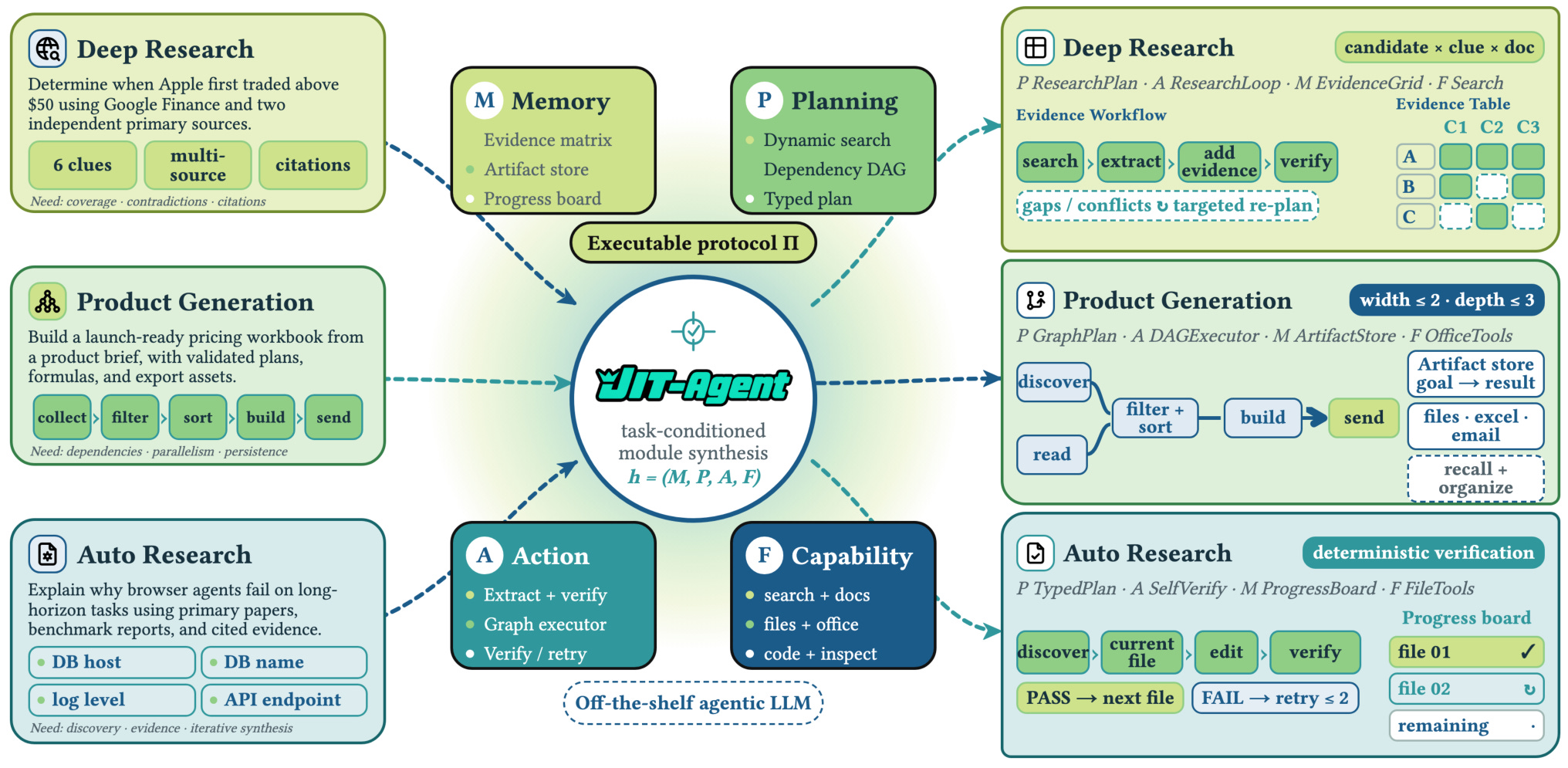
Harnesses are hand-built and then frozen, which means one design has to serve deep research, product generation, and long-horizon coding equally well. JIT-Agent is a model whose output is a harness, synthesized per task.
A fixed protocol, a variable harness: The harness is formalized as a composable artifact under a four-module protocol covering memory, planning, action protocol, and tool orchestration. JIT-Agent instantiates those modules for the task at hand rather than picking from a menu of presets.
Repair happens mid-run: Harnesses get patched during execution, and the system self-evolves by distilling performance signals from an expanding archive of prior configurations, so recurring task shapes converge on better starting designs. Nothing about the backbone changes, only the scaffolding wrapped around it.
Backbones move a long way: With JIT-Agent attached, DeepSeek-V4-Flash surpasses GPT-5.6 on DeepSearchQA (+9.1) and OdysseyBench (+4.3), and GLM-5.2 gains up to +20.2 points. The generated harnesses are performance-competitive with mature runtimes like OpenCode and Claude Code.
Why it matters: Generated harnesses are still an underexplored direction, and the appendix is worth the read on its own for the named designs that emerge (Palimpsest, Trapdoor, Origami, Gearbox). Those are legible patterns you can steal by hand even if you never run the generator.
Message from the Editor

We just released Introduction to Exo, a hands-on DAIR Academy lab on the open-source agent harness built for recursive self-improvement. Across 6 labs, you drive the real exo CLI in a live terminal, give an agent a shell, read its raw event log, and fork a conversation to travel back in time. Free for a limited time.
5. Prime Agent
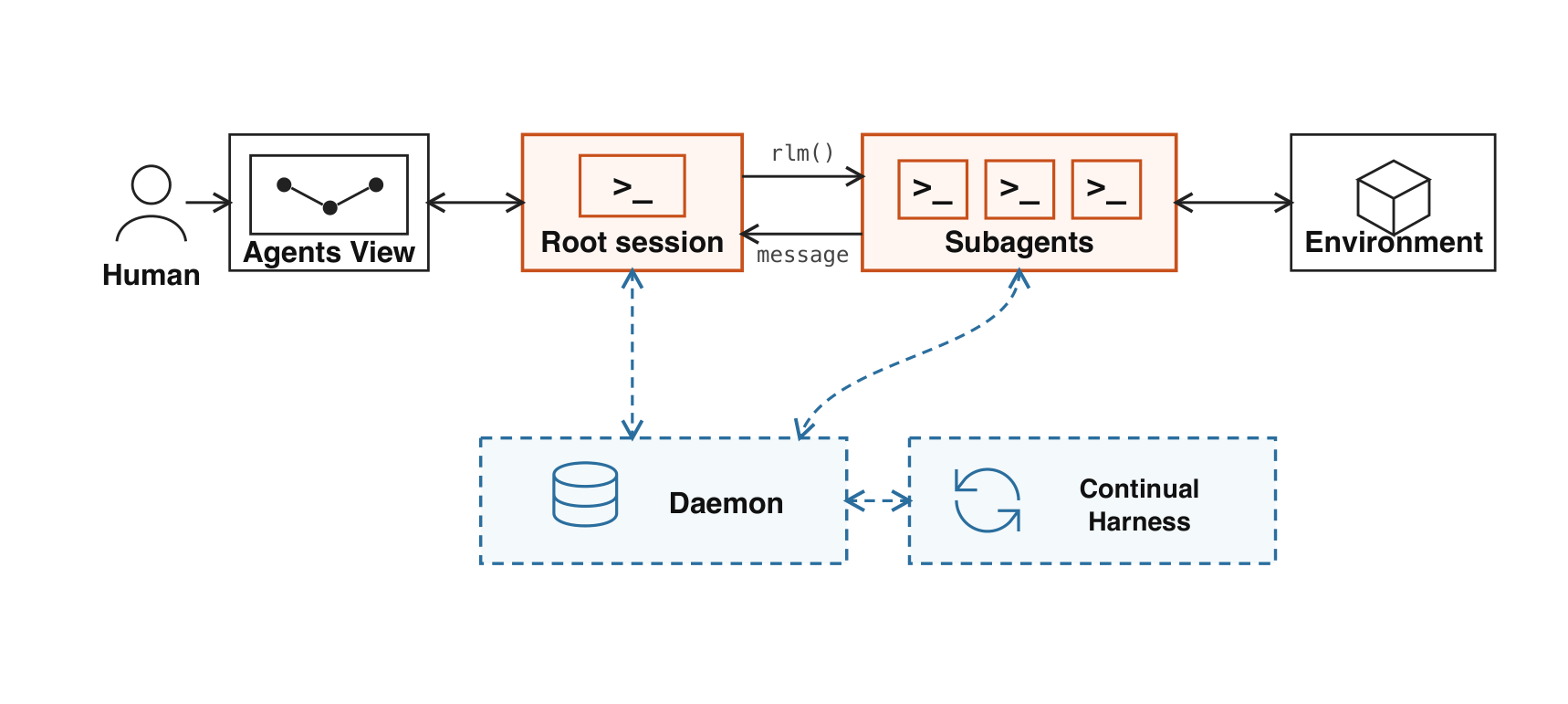
Prime Intellect released an open-source harness built for long-horizon work, and what persists between runs sets it apart. Most harnesses reset everything except the files on disk, which caps how much a system can compound.
The model programs its own context: A persistent IPython REPL lets the model process its context programmatically instead of reading a flat transcript, so filtering, aggregating, and re-deriving state become code the model writes rather than tokens it re-reads.
A Continual Harness carries the rest: Histories, memories, skills, prompts, and subagent specifications persist across trajectories. Improvements accumulate across runs instead of being rebuilt from scratch each time the agent starts.
The jump on ARC-AGI-3 is large: Holding the model class fixed, RHAE Best@1 moves from 30% to 95.5%. It also matches or beats native harnesses on long-context coding, GPU kernel generation, and autonomous nanoGPT speedruns.
Why it matters: This is a working reference implementation of the compounding-harness idea rather than a paper describing one, and it is open source. If you have been reading about self-improving harnesses and wanted something to run, start here. The state hierarchy diagram alone is a useful map of what belongs in the prompt and what belongs in managed storage.
6. What Compaction Destroys
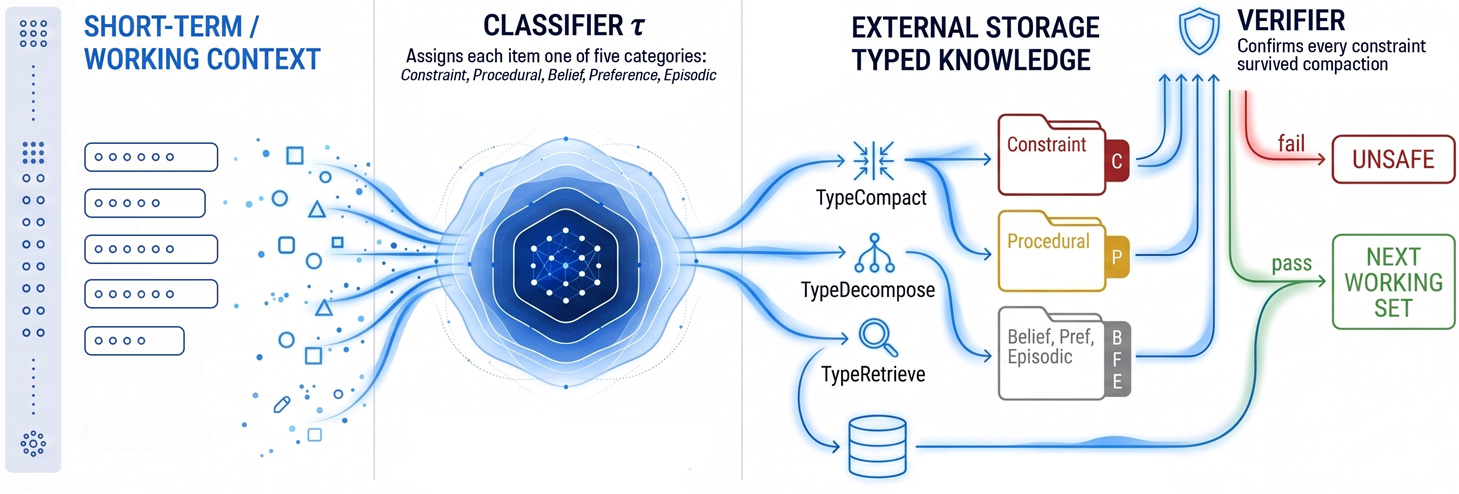
If you keep safety rules or coding standards in an AGENTS.md or a CLAUDE.md, this one is worth your time. Researchers measured what context compaction actually destroys across 20 production agent configurations, and safety rules are among the first casualties.
Everything gets summarized at the same rate: A safety rule and an episodic log compete for the same tokens, and when the budget overflows both get compressed equally. Only the rule needs exact wording to stay enforceable, and nothing in the pipeline knows that.
The decay is steep: Claude Code compact on Sonnet 4.6 preserves 53% of safety rules after one round. After five rounds it drops to 10%, which is the regime any long-running agent session ends up in.
Type-aware routing is the fix: Knowledge Triage classifies each line of the knowledge base by type, then routes each type through its own retention policy using three deterministic operators for compaction, partitioning, and retrieval.
Why it matters: The approach preserves 2 to 4x more safety rules at every compression ratio with 96% recall over five rounds. The framing generalizes past safety too. Anything in your context that depends on exact wording needs a different retention policy from the narrative around it.
7. Co-Scientist in Real Labs
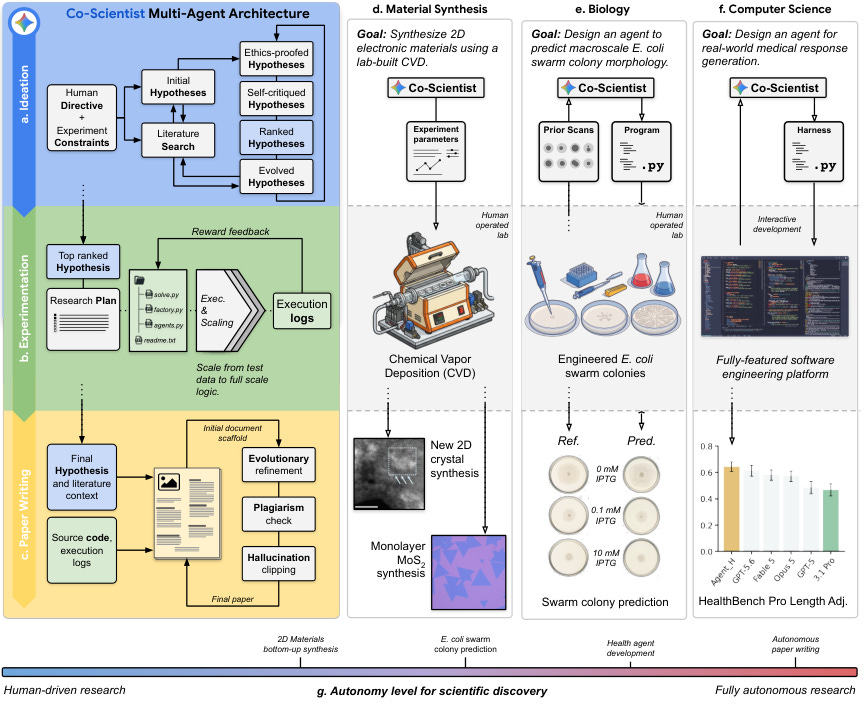
Google DeepMind takes Co-Scientist out of simulation and into physical experiments across materials science, biology, and computer science. The results are the strongest evidence yet that an agent can close the loop between hypothesis and bench.
It drove a real reactor: The system designed a safe precursor route for MXenes and operated a semi-automated chemical vapor deposition reactor, producing a lamellar 2D material with structural similarities to the Ti3C2Tx lattice.
Recipes tailored to a specific lab: It adapted growth protocols to laboratory constraints in minutes, enabling single-attempt growth of monolayer MoS2, MoSe2, and WS2. Experimentalists will find that result the hardest to dismiss.
A discovered architecture beat six frontier models: In computer science it discovered an inference-time scaling architecture that beat six frontier models on HealthBench Hard and Professional under blinded physician review. In biology it predicted E. coli swarming phenotypes across inducer gradients from sparse imaging data, matching unpublished measurements.
Why it matters: 30 domain experts wrote 450 reviews on end-to-end generated papers, and the reliability modules measurably reduced hallucination and plagiarism. Real-world validation plus expert review at that scale puts this well past the usual AI-for-science demo.
8. Recuris
Recuris splits agent memory in two, with a Working Memory tracking task progress and an Experiential Memory holding skills, so skill selection is grounded in the current task state rather than the full growing history. Because skill use is anchored to an explicit state, a failed run points at a specific memory component, and a fixed Meta-Agent turns that evidence into validation-gated updates to Skill Memory. It improves task success in 35 of 37 completed model-benchmark pairs, adding 17.8 points to GPT-5.6 Sol on tau-bench and taking Claude Opus 5 to 87.9%.
9. Meta^n
Systems that edit themselves have to leave part of their own editing machinery untouched to stay stable, which caps realized meta-depth at roughly two. Meta^n keeps the meta-operation fixed and recurses on its input instead, applying one operator repeatedly to its own products and letting convergence set the depth rather than fixing it in advance. Across two backbones it outperforms prior self-improving agents on all eight benchmark families, and on ARC-AGI-2 it is the only method scoring above zero.
10. EvoMal
Shared skill libraries are usually treated as a safe way for coding agents to reuse each other’s work, and EvoMal shows they propagate malware. A planted malicious skill is never invoked, but the agent retrieves it as an authoring template, writes a new skill that preserves the payload, and each authored copy re-enters the library to be imitated again. Across six models the self-poisoning rate runs 20.3% to 41.8%, deleting every planted skill does not clean it up, and a counter-prompt discouraging banner-style copying drops it to 6.7%.
AI’s next phase is not about better chat it is about building agents that remember, adapt and deliver results. Production is the new benchmark.