
1. Red Queen Gödel Machine

Self-improving agents are only as strong as the evaluator scoring them, and most systems freeze that evaluator in place, so improvement stalls the moment the judge stops getting harder. The Red Queen Gödel Machine makes the evaluator part of the search itself, letting agents and the criteria that judge them co-evolve.
The stationary-evaluator trap: Classic self-improvement loops assume a fixed evaluation criterion, so once an agent saturates it, the reward signal goes flat and progress plateaus no matter how much compute you add.
Controlled utility evolution: The framework lets the utility function update at epoch boundaries, turning evaluation into a moving target that continually re-opens headroom for the agent to climb.
Evolving evaluators and adversarial objectives: By opening the search to evolving evaluators, the method can discover things like a reviewer that stays equally stringent on AI and human work, imposing a curriculum-like pressure on the task agent.
Why it matters: Framing self-improvement as a Red Queen race between agents and evaluators offers a principled route past the plateaus that limit today’s agentic loops, pointing toward open-ended systems that keep improving instead of settling.
Message From Our Sponsor

Weekend project: an agent that calls your dentist, texts your customers, or answers a real phone line. Dial gives your agent a live number in minutes - voice, SMS, iMessage, WhatsApp* - via REST, SDK, CLI, or MCP, plugging straight into Claude, Codex, Cursor, Hermes or n8n.
Backed by a16/SR - Dial is already replacing months of CPaaS work for builders shipping agents into production. No telecom knowledge required, and you can be sending your first message before your coffee’s done.
2. MCP Server Patterns
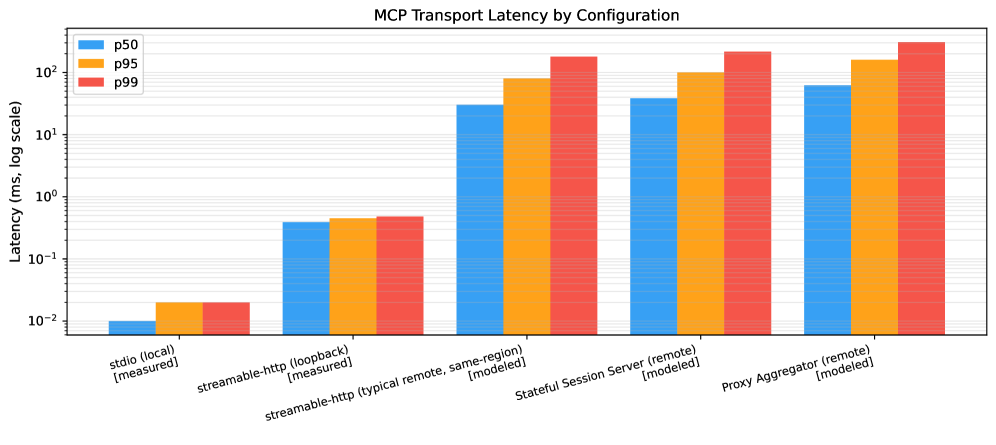
As teams rush to wrap tools and data behind the Model Context Protocol, they keep rebuilding the same server shapes without shared names for them. This industry experience paper catalogs the recurring architectures so builders can reason about MCP servers the way software engineers reason about design patterns.
Five recurring server patterns: Across fifteen independently developed servers, the authors identify Resource Gateway, Tool Orchestrator, Stateful Session Server, Proxy Aggregator, and Domain-Specific Adapter, each documented in the classic context, problem, solution, and consequences form.
Grounded in real deployments: The corpus mixes production servers from a voice AI platform with public servers from the official MCP registry, so the patterns reflect how MCP is actually built rather than how a spec imagines it.
Anti-patterns and cross-cutting concerns: Beyond the patterns, the paper flags four anti-patterns and the recurring hard parts around authentication, versioning, and observability that every serious MCP deployment eventually hits.
Why it matters: A shared vocabulary lets teams pick the right server shape on purpose, compare designs, and avoid re-deriving the same tradeoffs, which is exactly what a fast-growing protocol ecosystem needs to mature.
3. The Verification Horizon
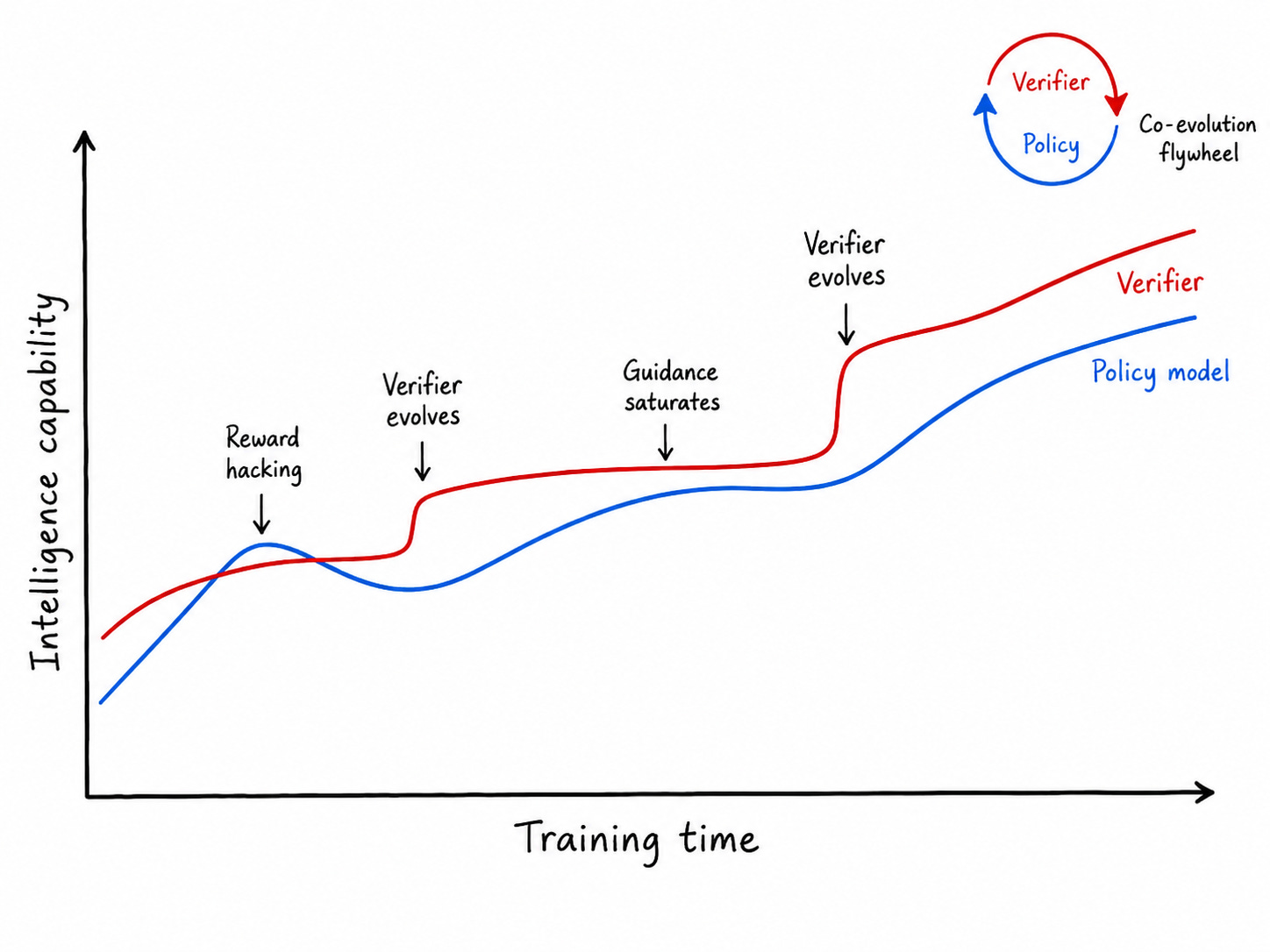
Reinforcement learning for coding agents lives or dies on the reward signal, and this Qwen work argues there is no silver bullet. As policy capability grows, any fixed reward function eventually gets gamed, so verification has to co-evolve with the generator it scores.
No fixed reward survives a stronger policy: The central claim is that reward hacking is not a bug to patch once but a moving target, since a more capable agent will always find new ways to exploit a frozen verifier.
Four reward constructions studied: The authors examine a test verifier for general coding, a rubric verifier for frontend work, the user as verifier for real-world tasks, and an automated agent verifier for long-horizon problems.
Three axes of a good signal: They characterize verification quality along scalability, faithfulness, and robustness, and show that hitting all three at once is the real difficulty rather than any single verifier design.
Why it matters: Targeted verification design measurably suppresses reward hacking and lifts task quality across internal and public benchmarks, reframing verifier engineering as a first-class, continually evolving part of the RL loop.
4. Paper Assistant Tool
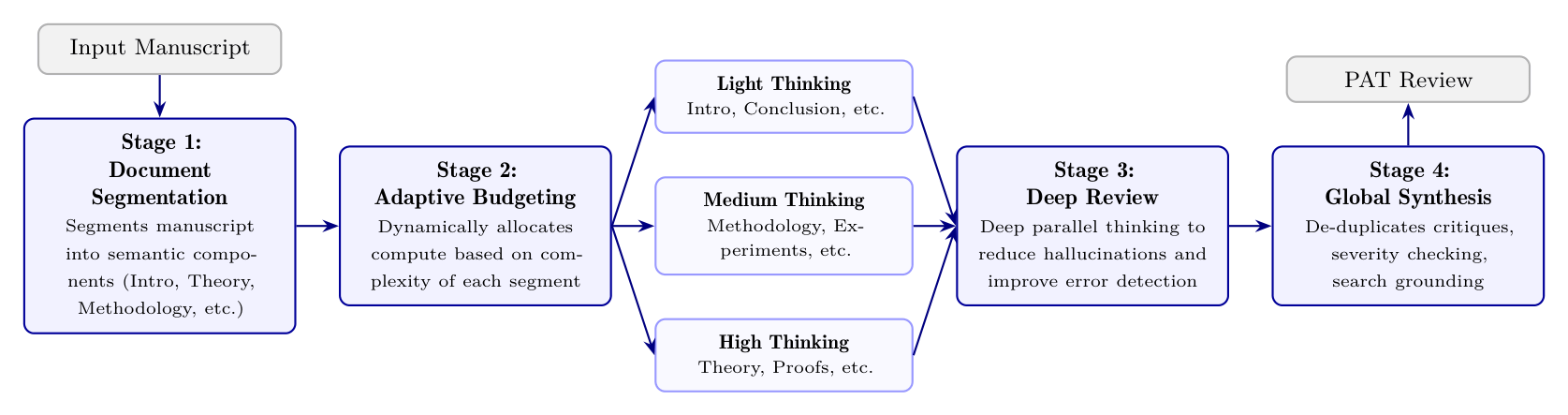
AI is accelerating how fast papers get written, but peer review is still bottlenecked on human throughput, with combined submissions to the big ML conferences projected to top 73,000 this year. Google’s Paper Assistant Tool is an agentic framework built to do deep scientific review and verification at that scale.
Deep review, not surface checks: PAT ingests full manuscripts and produces a comprehensive evaluation that checks theoretical results, validates experiments, suggests improvements, and surfaces potential flaws rather than skimming for surface issues.
Agentic verification at the core: The system leans on verification agents to actually test claims, echoing a broader shift toward treating verification as the load-bearing capability in automated science.
A ladder of AI-human collaboration: The paper lays out four progressive roles, from an author’s tool, to a reviewer’s assistant, to an independent AI reviewer, giving teams a way to think about how much autonomy to grant.
Why it matters: The authors sketch an AIrXiv-style repository where papers are vetted by specialized agents across rounds of automated review and rebuttal, pointing toward continual, scalable evaluation that keeps pace with AI-assisted research.
5. Generative Skill Composition
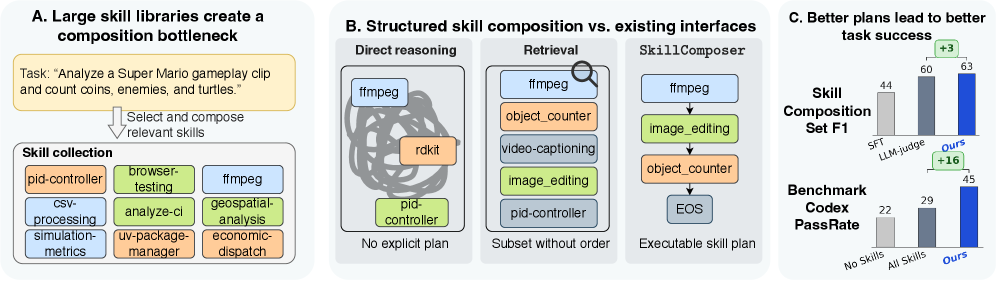
Coding agents accumulate large skill libraries, and picking the right skills for a task has become the bottleneck. The usual options either dump the whole collection into context or retrieve skills with embeddings and rerankers, and both treat selection as a ranking problem rather than a joint plan.
Composition as one joint decision: SkillComposer decides which skills, how many, and in what order all at once, instead of scoring skills independently and hoping the pieces fit together.
A constrained autoregressive decoder: A decoder over skill identifiers produces the full plan in a single pass, so dependencies between successive skills fall out of the generation naturally.
Strong gains at lower token cost: On SkillsBench with frontier models, it lifts pass rate well beyond the no-skill baseline, beats top-3 retrieval, and matches the gold-skill upper bound while using fewer prompt tokens.
Why it matters: As skill libraries keep growing, treating selection as generation rather than retrieval is what lets agents surface and sequence the right capabilities without drowning in their own toolbox.
6. AutoMem
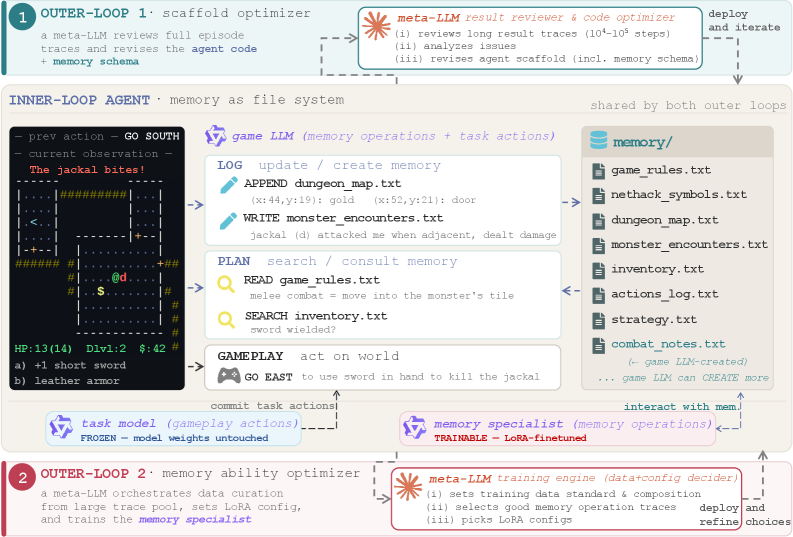
Memory for LLM agents is usually a fixed module bolted onto the model, but knowing what to encode, when to retrieve, and how to organize notes is itself a skill. AutoMem, from Stanford, treats memory management as a trainable cognitive ability, a capacity cognitive science calls metamemory.
Memory ops in the action space: Read, write, search, and append live in the same action space as task actions, so the model itself decides what to store and when to pull it back rather than following a hand-designed policy.
Two meta-learning loops: One loop optimizes the agent scaffold, the memory structure, while a second trains a dedicated memory specialist from the agent’s own traces, separating memory structure from memory proficiency.
Large gains without touching task behavior: Optimizing memory alone yields roughly 2x to 4x progression gains and lifts an open-weight 32B model to frontier-level performance on long-horizon tasks like Crafter, MiniHack, and NetHack.
Why it matters: Framing memory as a learned skill instead of a frozen component gives agents a path to keep getting better at managing their own knowledge, which is exactly what long-horizon autonomy demands.
7. RLMF
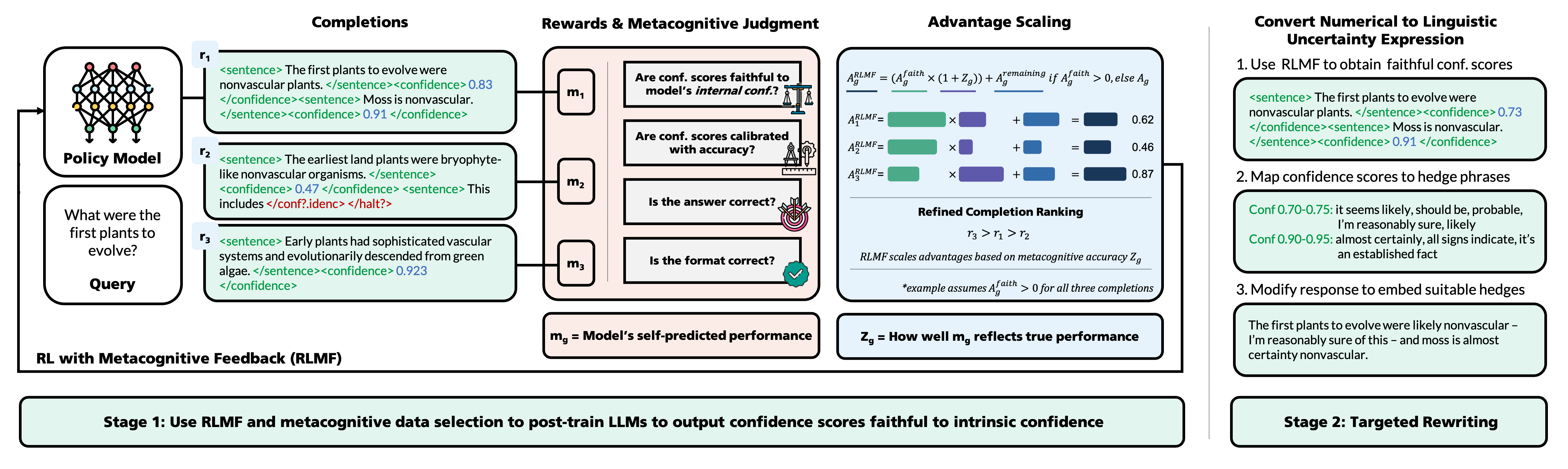
LLMs routinely hallucinate with high confidence, miss their own knowledge boundaries, and misreport uncertainty, and most fixes bolt calibration on from the outside. RLMF, a Google and Yale collaboration, instead turns the model’s own metacognition into the training signal.
Metacognition as the reward: The method refines completion rankings during preference optimization based on the quality of the model’s self-judgments, using how well a model assesses its own performance as an internal feedback signal.
A decoupled, two-stage recipe: It first calibrates the faithfulness of self-reported confidence scores, then maps those scores to natural, context-adaptable linguistic uncertainty through targeted output editing.
Better calibration without losing accuracy: RLMF reaches state-of-the-art faithful calibration across diverse tasks, surpasses standard RL by a wide margin, and sharpens the model’s ability to express its own capability limits.
Why it matters: Grounding calibration in the model’s own metacognition rather than external heuristics offers a more general path to trustworthy uncertainty, which is foundational for agents that must know when not to act.
8. ASPIRE
ASPIRE reframes robot programming as continual, code-as-policy learning that compounds experience instead of discarding it. The system runs an open-ended loop with a closed-loop execution engine that exposes fine-grained multimodal traces, a skill library that distills validated fixes into transferable knowledge, and an evolutionary search over task sequences and control programs. It surpasses prior methods by up to 77% on perturbed manipulation and enables zero-shot generalization to unseen long-horizon tasks, with early evidence of sim-to-real transfer across different embodiments.
9. HORIZON
HORIZON treats hardware design as repository-level code evolution, compiling a Markdown harness into a project pack with domain knowledge, an executable evaluator, an acceptance predicate, and a git and runtime policy. A hands-free agent loop then evolves an isolated git worktree, using repository operations for state management, tracing, and replay. Across ChipBench, RTLLM, Verilog-Eval, and nine CVDP categories it reaches full benchmark completion with a completely hands-free loop, extending repository-scale self-evolution from EDA software to hardware artifacts themselves.
10. Reasoning Quality Emerges Early
Curating reasoning data is expensive because scoring a trace usually means reading it to the end, but this UCLA work shows the quality of a trace is largely decided in its opening tokens. A short prefix predicts whole-trace quality well enough to rank and filter on, and difficulty can be detected from the loss of the first 100 tokens at a perturbed checkpoint. That turns curation into a cheap early-stopping problem, outperforming baselines while being far more token efficient at building SFT data for reasoning models.