
In today’s issue:
OpenRouter State of AI: 100 trillion tokens of real-world LLM usage
Mistral announces Mistral 3
DeepSeek releases DeepSeek-V3.2:
Google launches Workspace Studio
Puppeteer: RL-trained multi-agent orchestration
Cloudflare acquires Replicate
Agentic Context Engineering
How AI Is Transforming Work at Anthropic
A Layered Protocol Architecture for the Internet of Agents
Top AI dev news, tools, and papers.
Top Stories
OpenRouter State of AI
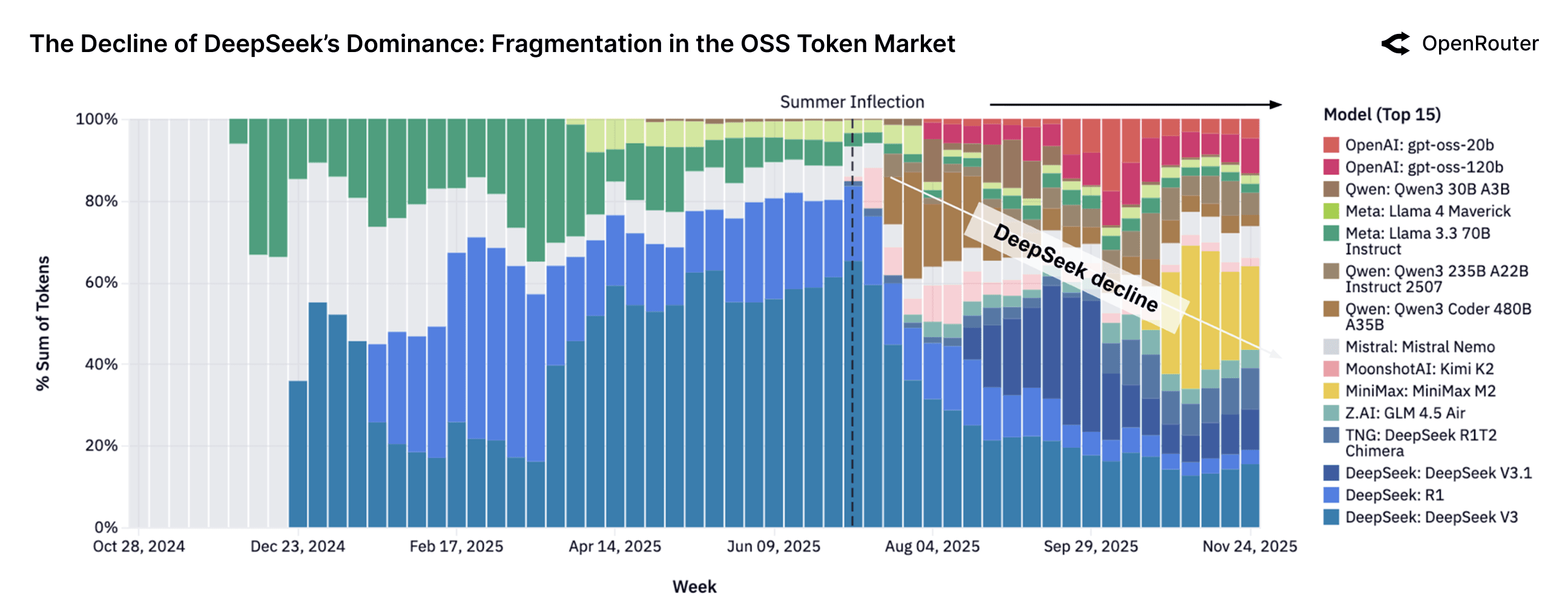
OpenRouter releases its empirical State of AI report analyzing over 100 trillion tokens of real-world LLM interactions across two years. The research reveals fundamental shifts in how developers use language models - programming now dominates at 50% of all tokens, reasoning models handle over half of traffic since o1’s December 2024 release, and open-weight models captured a third of usage with Chinese models (DeepSeek, Qwen) growing from under 2% to approximately 30%.
Agentic inference rise: Reasoning models now represent the majority of token volume. Tool-calling adoption expanded noticeably, with Claude and Gemini leading tool-enabled workflows. Average prompt lengths nearly quadrupled from 1,500 to 6,000 tokens, reflecting increasingly complex, context-heavy agentic workloads.
The Glass Slipper effect: Early adopters whose needs align with specific capability breakthroughs demonstrate substantially higher retention - approximately 40% at month five compared to rapid churn in later cohorts. Models like Claude 4 Sonnet established sticky foundational cohorts, while others failed to create meaningful retention.
Multi-model ecosystem: No single provider dominates. Claude leads programming tasks with over 60% share initially, though competitors gained ground. Users maintain multi-model strategies rather than single-vendor commitments, suggesting LLM markets remain segmented rather than commoditized.
Roleplay dominates open-source: Creative and roleplay applications consistently exceeded 50% of open-source model usage, revealing substantial consumer engagement beyond productivity tasks that challenge assumptions about LLM use cases.