
In today’s issue:
Microsoft ships seven new MAI models
MAI-Thinking-1 takes on Claude Sonnet
Gemma 4 12B runs agents on a laptop
NVIDIA opens 550B Nemotron 3 Ultra
Anthropic warns of recursive self-improvement
Agents’ Last Exam stumps frontier agents
Claude Platform gets an ant CLI
Cognition launches Devin Desktop
Nous ships Hermes Desktop
Codex builds iOS apps end-to-end
ChatGPT memory learns to dream
Multi-agent computer use beats solo CUAs
Economy of Minds prices agent actions
LEAP solves all 12 Putnam problems
A harness rewrites itself for +19 SWE points
And all the top AI dev news, papers, and tools.
Top Stories
Microsoft Launches Seven In-House MAI Models
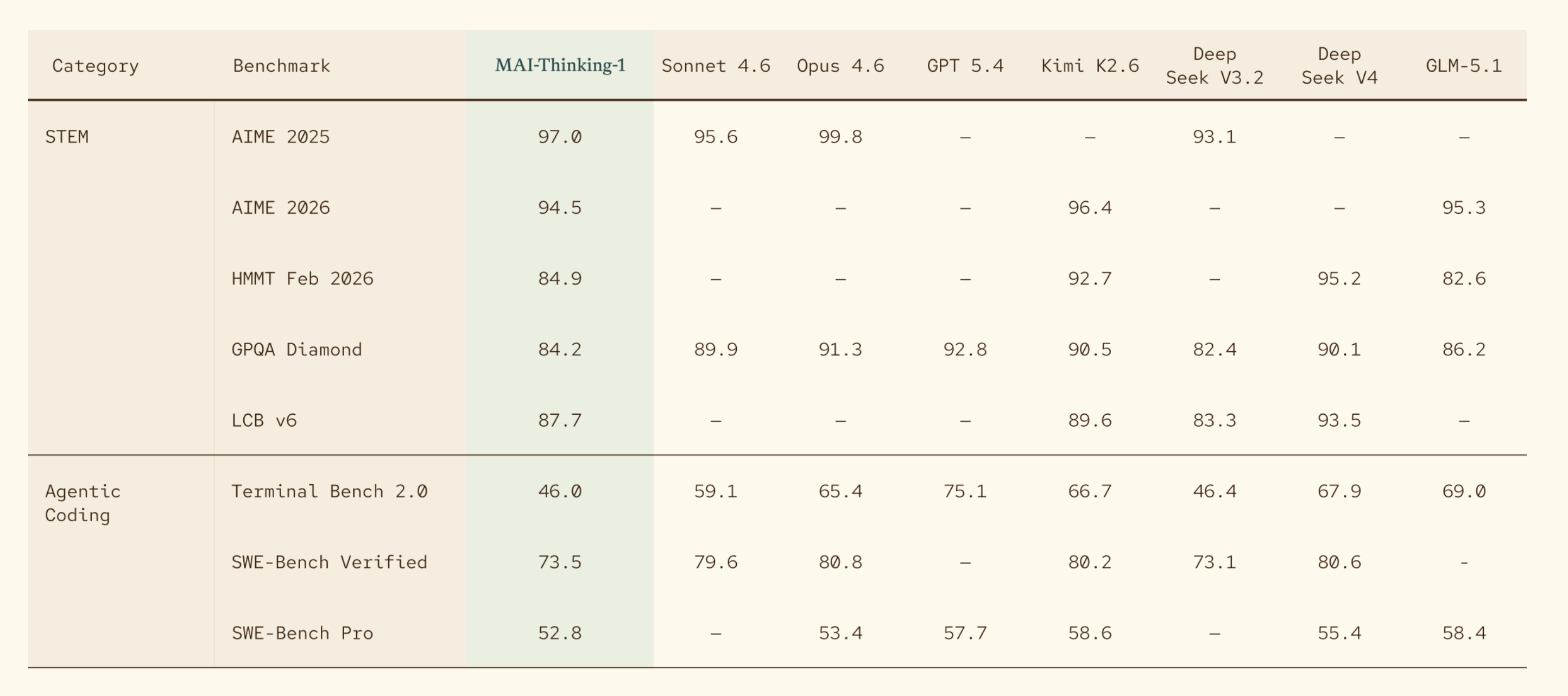
Microsoft AI unveiled a family of seven models trained from scratch, led by MAI-Thinking-1, its first reasoning model, in a bid for long-term self-sufficiency from OpenAI.
MAI-Thinking-1: A 35B reasoning model that scores 97% on AIME and 53% on SWE-Bench Pro, with early testers preferring it side-by-side over Claude Sonnet 4.6 on overall quality.
A full stack: The launch also ships MAI-Image-2.5 and Flash, MAI-Transcribe-1.5, MAI-Voice-2 and Flash, and MAI-Code-1-Flash for code generation.
Clean training: Every model was trained on commercially licensed data with no distillation from third-party labs, which Microsoft frames as a hedge against legal risk for enterprise customers.
Why it matters: Suleyman positions the release as a “hill-climbing machine,” a shared training infrastructure meant to keep Microsoft on the frontier as compute scales, and a direct shot at its biggest enterprise rival.
MAI-Thinking-1 ships with a detailed 109-page technical report.
Gemma 4 12B Brings Agentic Reasoning to Your Laptop
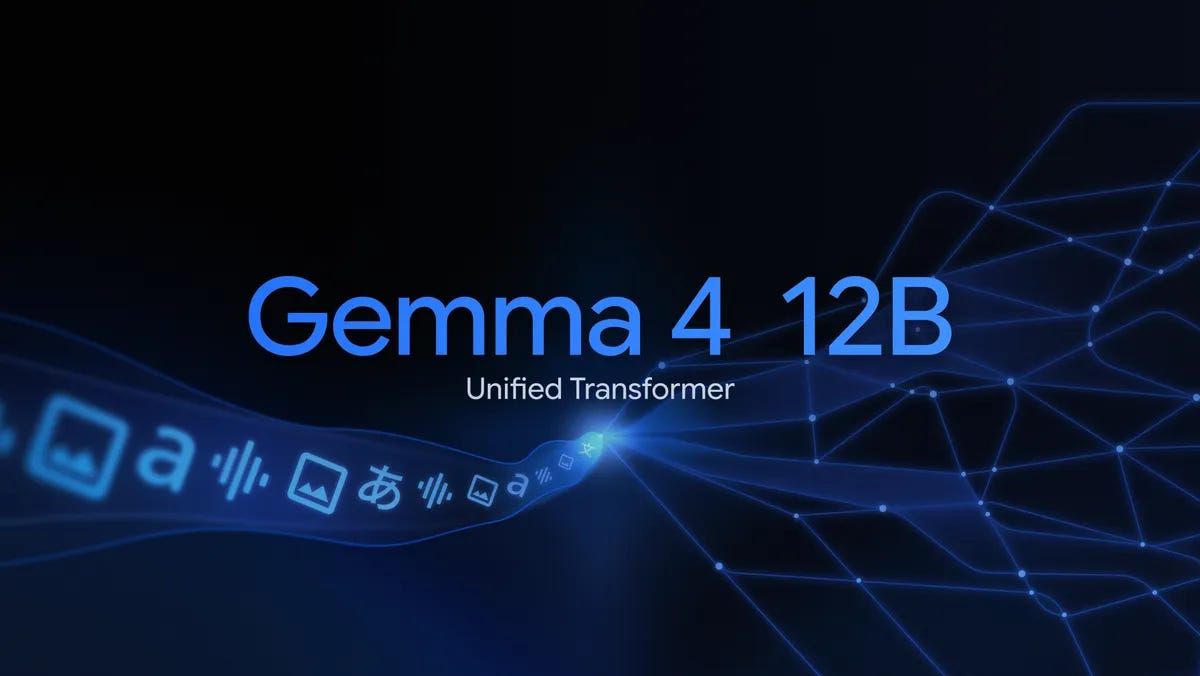
Google released Gemma 4 12B, a unified, encoder-free multimodal open model that brings agentic reasoning, vision, and native audio to consumer hardware under an Apache 2.0 license.
Encoder-free design: Vision inputs pass through a single lightweight matrix multiplication and audio is projected directly into the same space as text tokens, dropping separate modality encoders.
Runs locally: Fits in 16GB of VRAM or unified memory, small enough for a laptop, with support across LM Studio, Ollama, and Google AI Edge Gallery.
Punches up: Reaches performance nearing Google’s larger 26B MoE model at less than half the memory footprint, and is the first mid-sized Gemma with native audio input.
Community traction: The release topped Hacker News, with builders showing it running on a 10-year-old Xeon CPU.