
In today’s issue:
OpenAI ships GPT-6 Cyber
GPT-6 Astra edits Qwen’s weights directly
Anthropic details Claude’s dreaming memory
Exo agents rewrite their own harness
METR measures AI R&D acceleration
NVIDIA questions long-context agents
Cognition launches SWE-2 Flash
Mistral Studio adds managed agents
Harness Leaderboard compares nine harnesses
Benchmark tests agents as teammates
And all the top AI dev news, papers, and tools.
Top Stories
GPT-6 Cyber Linux Exploits
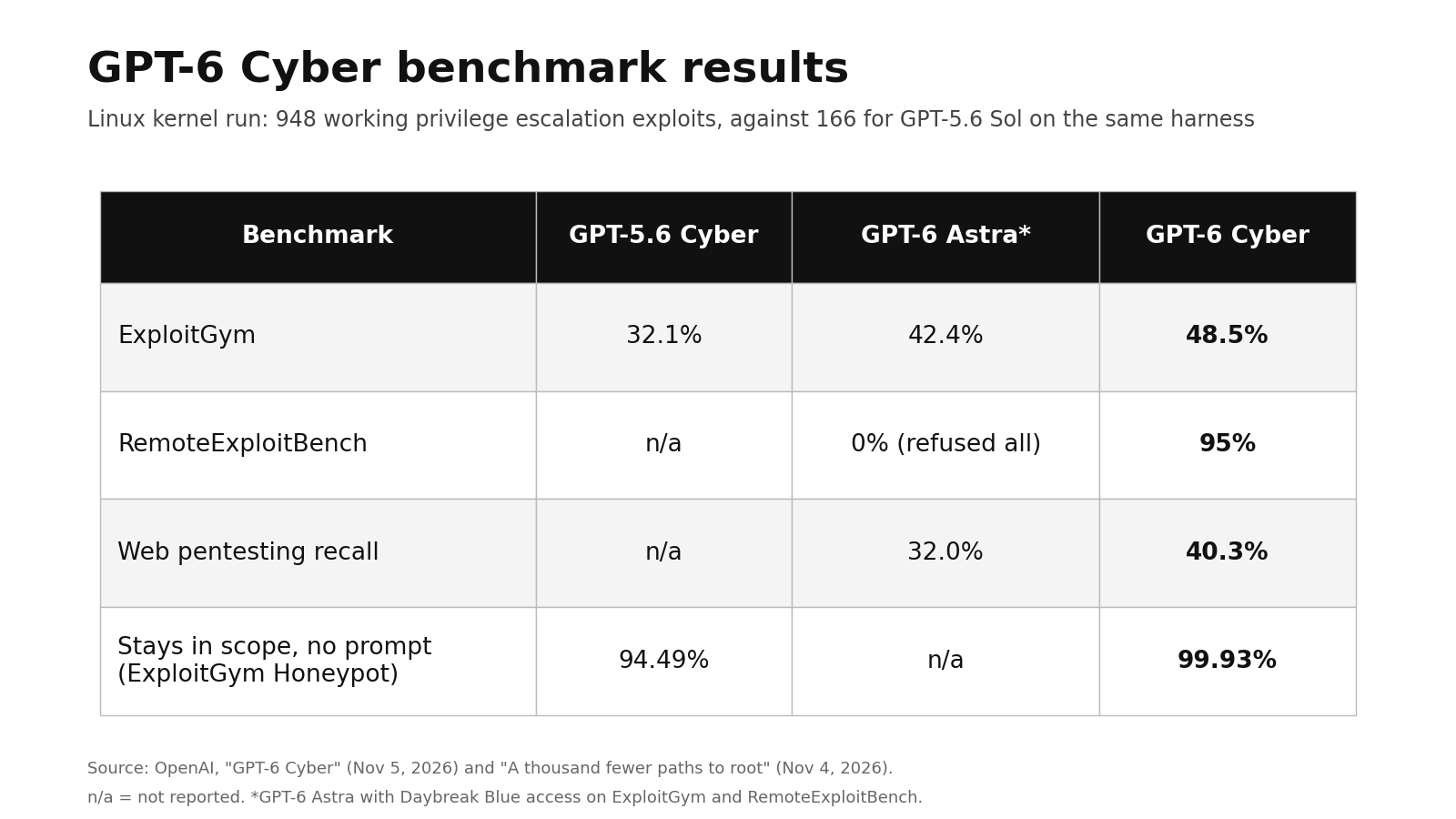
OpenAI introduced GPT-6 Cyber, a cybersecurity model trained to find and validate exploitable vulnerabilities while staying within the scope researchers set. A day earlier, OpenAI described the autonomous Linux kernel pipeline that powered this model.
Benchmarks: GPT-6 Cyber scores 48.5% on ExploitGym, up from 32.1% for GPT-5.6 Cyber, and completes 95% of RemoteExploitBench tasks, while GPT-6 Astra with Daybreak Blue refused every task. OpenAI classifies it as Critical in cybersecurity under its Preparedness Framework.
Staying in scope: On ExploitGym Honeypot, an evaluation informed by the Hugging Face incident, it avoided out-of-scope services in 99.93% of tests without its deployment prompt (94.49% for GPT-5.6 Cyber) and in 100% with it.
Linux pipeline: Scout agents picked 5,034 audit targets, analyst agents produced 2,308 candidate findings, and triage agents reproduced 1,724 of them. Exploit agents then produced working exploits for 948 distinct local privilege escalation bugs on a stock desktop distribution, at $1,213,430 in API credits (about $1,279 each), compared with 166 for GPT-5.6 Sol in July.
Lessons for agent builders: In an early run, 20 of 200 reported exploits reached root through a different 0-day than the assigned one, so OpenAI added an independent check. Heavy technique scaffolding added only 1.5 points for GPT-5.6 Cyber, so the team removed it.
Access: It also found 81 high-severity Firefox vulnerabilities, and it is available through the API and Codex to select Daybreak Red customers.