
In today’s issue:
Z.ai releases GLM-5.4 loop transformer
RCI tests when agent teams win
OpenAI and Cisco open-source Shirudo
Cognition ships SWE-2.1
Ramp Labs introduces speculative encoding
Claude agents migrate Messages API to Rust
Anthropic launches Claude Ship
Anthropic tests sandbox escape with Siren
ShellBench tests agents on everyday work
OpenAI pipeline finds 948 kernel exploits
And all the top AI dev news, papers, and tools.
Top Stories
GLM-5.4
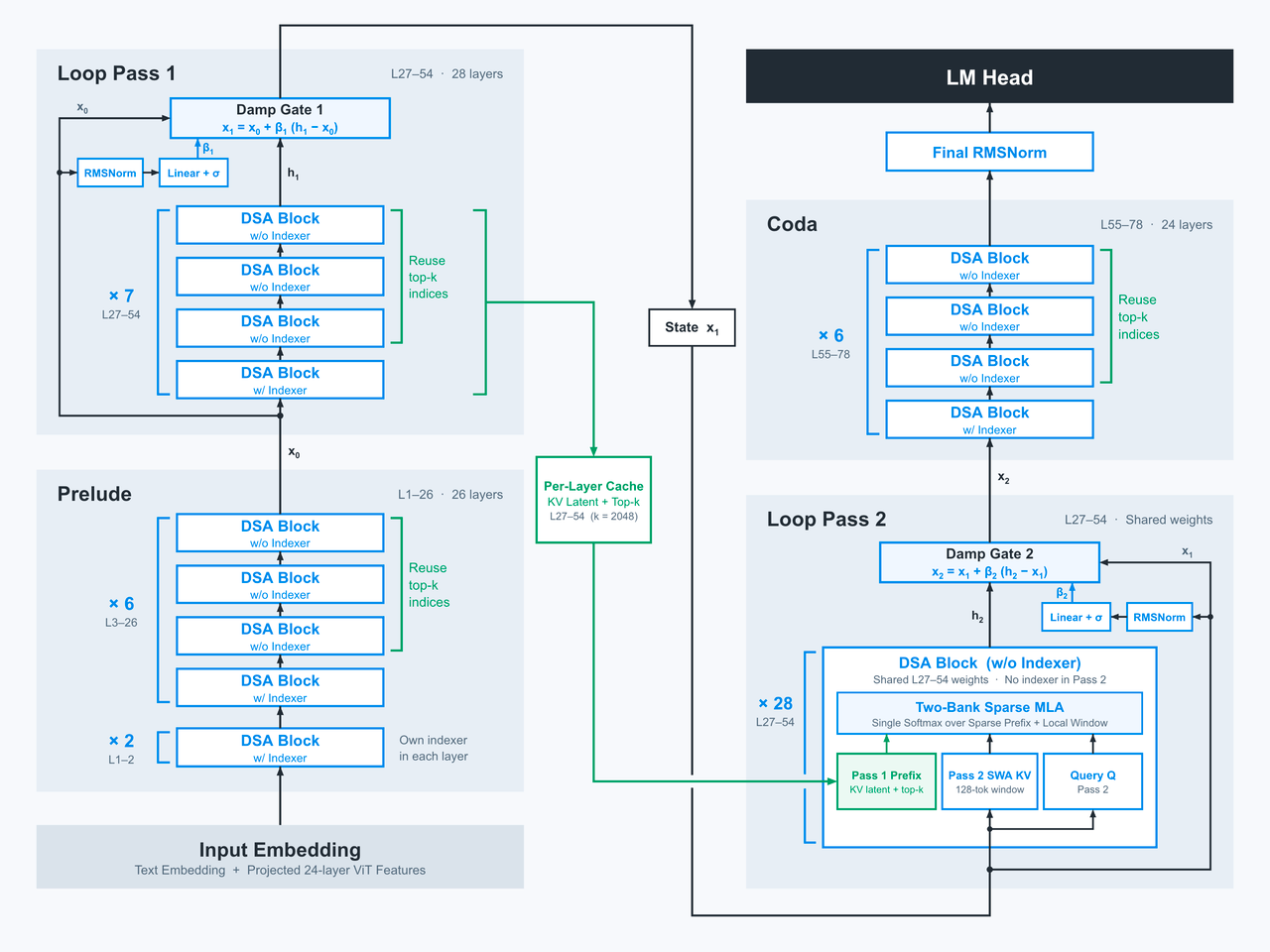
Z.ai released GLM-5.4, its first flagship model built on a loop transformer, which runs a shared block of layers several times per token so the model can reason more deeply without adding parameters. Z.ai says it reaches intelligence levels comparable to 2T-3T parameter models.
Loop architecture: GLM-5.4 loops 28 layers of the 750B GLM-5 base model for two iterations. Z.ai adapted the pre-trained base model through continued training instead of training a looped model from scratch.
Gated updates: Per-token gates write each pass back into the residual stream. The first pass writes conservatively to build global context, the second refines the output, and harder tokens get larger first-pass updates.
Cheaper second pass: The second loop reuses the first pass’s sparse KV cache plus its own sliding window, so the extra loop costs one sliding window of cache instead of a full context cache. It also reuses the first loop’s sparse attention indices, adding no indexing overhead.
Ablation results: On a 30B model with the same architecture and about 10% more training compute, looping raised AIME25 from 19.17 to 30.42 and GPQA-Diamond from 47.58 to 56.26. Average output length fell by 10% to 14% on most benchmarks.
Availability: GLM-5.4 runs at up to 200 tokens per second off-peak and is available in the GLM Coding Plan, ZCode, and Z.ai Chat. API access is coming soon, and Z.ai plans to release the weights after safety hardening.
Recursive Collective Intelligence
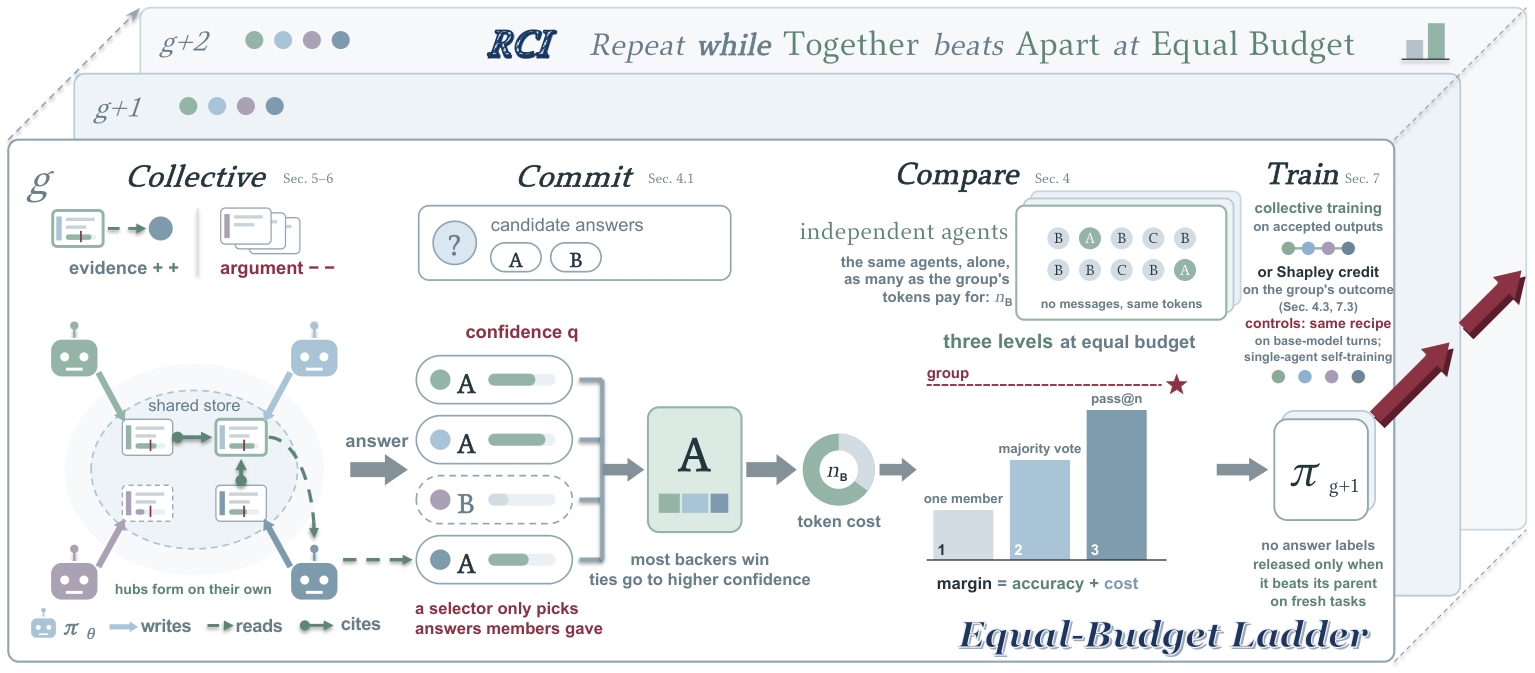
This paper tests when a team of LLM agents is smarter than the same agents working apart, and whether a team can train its next generation on its own work without labels or a teacher.
Equal-budget ladder: A group is graded against as many independent agents as its tokens can pay for, at three difficulty levels (beating one member, beating their majority vote, and beating their pass@n).
Debate falls short: Re-implemented multi-agent debate, a shared blackboard, and a delegating coordinator stayed at or below the compute-matched vote on six shared-information benchmarks. When every agent already holds the evidence, a message mostly repeats what its reader knows.
Forwarding facts works: On HiddenBench, where each agent holds part of the decisive facts, forwarding those facts beat pass@n at 9B, 27B, and 35B-A3B. At 27B, four agents with split facts were more accurate than one agent holding every fact at the same budget (0.959 against 0.942).
Emergent hubs: Identical 27B agents allowed to hand over their reading budget formed a hub in about a third of runs, which raised accuracy by 18 points. Self-organizing groups spent about two-thirds of their tokens on coordination.
Recursion: Label-free generations kept improving on unseen problems for four to six generations on PlanBench, HiddenBench, and Hanabi. Gains narrowed as fewer problems stayed at the edge of what the group could solve.