
In today’s issue:
GLM-5.3-Flash ships under MIT
Tencent opens Hy4 preview weights
Qwen previews the Qwen4 architecture
Claude gets its own browser
Terminal-Bench-Science scores agents on science
OpenAI reports first Jalapeño results
Skild S1 learns from one video
Headlong keeps agents always thinking
X launches Chat Agents
MCP publishes its next roadmap
AI4AI-Bench tests recursive self-improvement
Agents close 81.7% of the speedrun gap
Repo-wide migrations survive 5.4% of runs
And all the top AI dev news, papers, and tools.
Top Stories
GLM-5.3-Flash Ships Under MIT
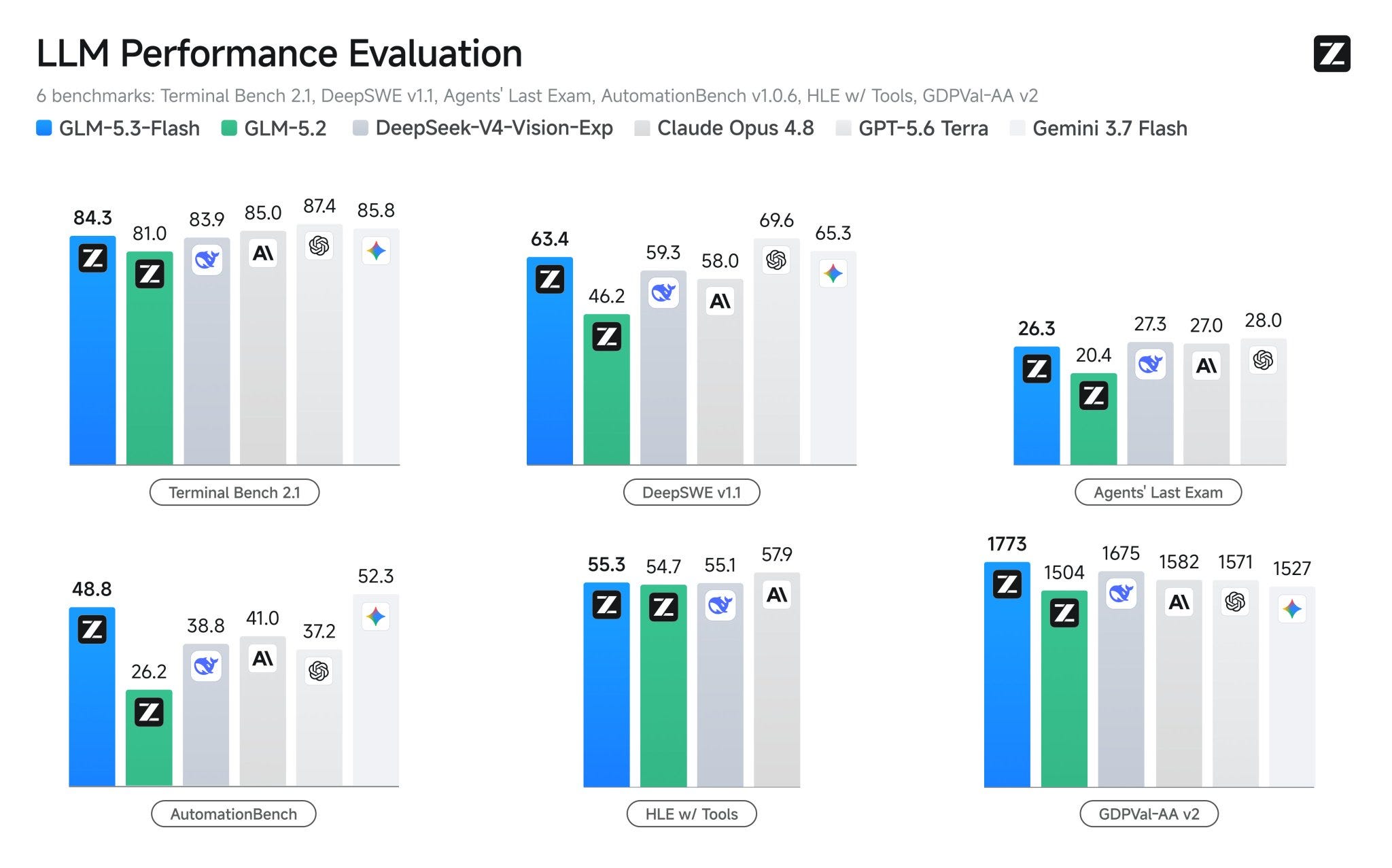
Z.ai released GLM-5.3-Flash, a natively multimodal 320B-A18B model with a 1M-token context window, published under the MIT license. It was previously previewed as Ox Alpha.
Agentic benchmarks: 84.3 on Terminal Bench 2.1, 63.4 on DeepSWE v1.1, 48.8 on AutomationBench v1.0.6, 55.3 on HLE with tools, and 1773 on GDPVal-AA v2, ahead of GLM-5.2 on every one.
Coding performance: On Z.ai Code Bench v1.0, run through Claude Code, GLM-5.3-Flash beats GLM-5.2 at every effort level and at max effort comes within half a point of Claude Opus 4.8 at 29.0 against 29.5.
Priced to run in a loop: $0.15 per 1M input tokens, $0.50 per 1M output, and $0.03 for cached input, which makes long agent trajectories cheap to iterate on.
Hybrid attention carries the efficiency: Linear attention captures local dependencies while sparse attention retrieves global context through a lightweight indexer, cutting attention compute 3.0x and KV cache 4.4x against GLM-5.3. Against GLM-4.5 it nearly halves both activated parameters (18B against 32B) and layers (45 against 92).
Served on Chinese silicon: Z.ai ran the model anonymously as ox-alpha on OpenCode and OpenRouter before release and served all of that traffic on Chinese AI chips, reporting 3x better end-to-end serving performance than its own earlier baseline on the same hardware.